How a Bladder Turns into a Pear express
The bladder is like a balloon: as it fills, the wall stretches and the shape changes. Doctors usually monitor the pressure inside and how much fluid has entered, but they rarely look at the geometry itself — how the surface curves. Yet irregularities can appear before the usual metrics deteriorate.
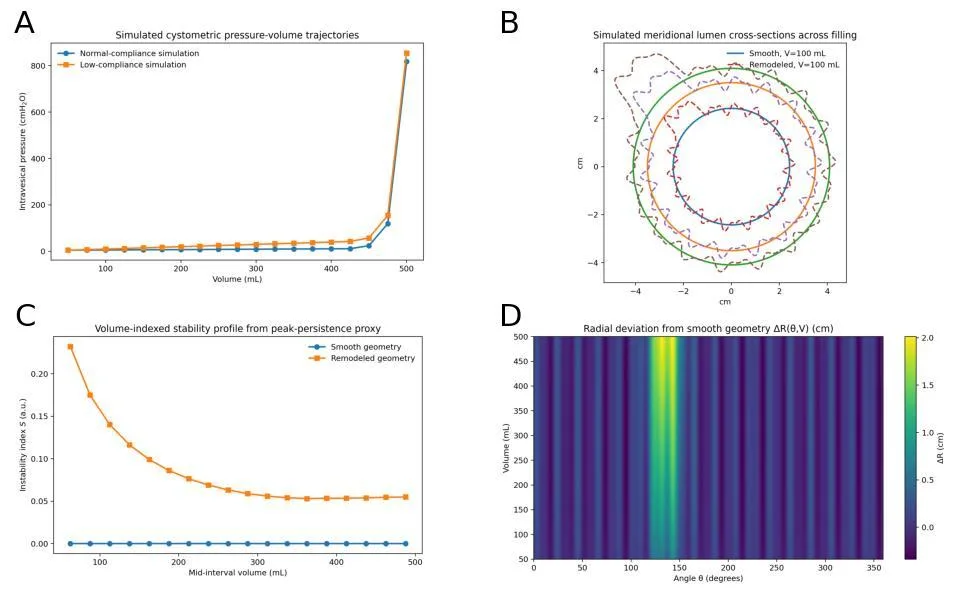
The authors created a computer model: they set the mechanical properties of the wall from the literature and gradually "poured" fluid in, as in real life. For each volume, they computed the shape and checked whether it remained smooth and stable. Then they compared two scenarios: healthy uniform stretching and hidden tissue remodeling, where some areas of the wall become stiffer or thinner than others. Pressure and compliance were nearly identical, but geometry differed significantly.
This approach is reminiscent of watching a balloon: if there's a weak spot, it bulges before the balloon pops. Similarly, early irregularities in the bladder wall may indicate future diverticula (outpouchings) or loss of tone. By taking images at regular intervals and comparing shape, dangerous changes can be spotted before symptoms arise.
Original abstract
as written by the authors arXiv:2603.01054
Bladder function is typically assessed through pressure volume relations, compliance indices and flow measurements, whereas structural evaluation relies largely on qualitative imaging findings. These approaches do not formally quantify how bladder geometry changes during filling. To distinguish structural reorganization from pure mechanical stiffness, we developed a simulation based topological analysis of bladder filling grounded in mechanical parameters derived from the literature. Progressive filling was modeled under quasi static conditions, generating multi volume geometries from which spatial descriptors were computed. Drawing on the Freudenthal suspension theorem, filling was interpreted as a dimensional expansion process and structural stability was evaluated by testing whether geometric invariants remain preserved across increasing volumes. Simulated smooth expansion and controlled structural perturbations were compared under identical loading conditions. Pressure trajectories and wall stress estimates were similar across configurations when compliance was matched, whereas geometric descriptors showed divergent volume indexed stability profiles in the presence of remodeling. Computable instability measures identified progressive spatial heterogeneity despite preserved global pressure behavior. By providing a quantitative measure of geometric continuity across successive filling states, our approach indicates that structural remodeling may become detectable before conventional functional impairment appears. Progressive surface irregularity can arise even when compliance, detrusor pressure and flow parameters remain within reference limits. Serial imaging over time may support identification of individuals at greater risk of diverticula formation, decompensation or structural complications despite stable pressure measurements.
The human bladder holds on average 400–600 ml, but the urge to urinate occurs already at 150–200 ml — long before full distension.
Science fiction often describes biosensors that warn of disease through the slightest changes in the body; here's a similar idea — monitoring the shape of an organ, not just its function.