Geometry, in this context, is not just the static study of shapes but a dynamic quantum entity that evolves and influences physical systems. The corpus titles reveal its role in phenomena like black holes with multiple horizons, quantum walks on tori, and the regulation of dimensionality by temperature. Geometry here is a flexible, sometimes emergent property of spacetime or abstract state spaces, shaping how particles move, how information is stored, and how the universe expands.
History
The idea of geometry as a dynamic entity traces back to general relativity (Einstein, 1915), where spacetime curvature is determined by matter and energy, and later to quantumgravity theories that treat geometry as quantized.
How it works
In quantumphysics, geometry often refers to the mathematical structure of the space in which a system evolves—such as a torus or a curved manifold. This structure determines the allowed states and dynamics: for instance, quantum walks on a torus exhibit periodic interference patterns, while the geometry of a black hole's horizons dictates its thermodynamic properties. Temperature can alter the effective dimensionality of a system, effectively changing its geometry.
In practice
Geometric concepts are applied in designing quantum algorithms, understanding topological materials, and modeling cosmological inflation, where quantum fluctuations shape the large-scale structure of the universe.
Fun fact
In some quantum systems, the geometry of the state space can be 'squeezed' or 'stretched' by external fields, effectively changing the rules of particle motion without altering physical space.
The standard cosmological model ΛCDM (which includes dark energy and cold dark matter) is the score of a cosmic symphony. It describes how space expanded after the big bang. How dark matter clumped together. How galaxies ignited. For a long time, everything played flawlessly.
In the quiet of the quantum world, there is no emptiness. Particles are intertwined by invisible threads — entanglement. The authors of the work proposed that the very fabric of spacetime is woven from these threads. This is not just a metaphor: they built a mathematical framework where the distance between points is determined by how much shared information they hold.
A black hole is not just an abyss where everything falls. Right at its horizon, in the so-called quantum atmosphere, a faint glow is born — Hawking radiation. This is not calm light but a churning stream of particles that can influence the most delicate quantum connections.
Forget the flat sheet: embryonic tissue is a dynamic landscape of hills and folds. On convexities, cells stretch; in concavities, they compress, as if performing a dance governed by laws eerily similar to spacetime curvature.
In mathematics there is a sieve that sifts not dust, but infinity itself. It’s called a Q-space: here any subset turns out to be a Gδ set — a countable intersection of open sets, as if sifted through an unimaginably fine mesh.
Why do some systems, from gene networks to air travel, preserve imprints of the past longer than others? For a long time, network science blamed topology: the number of connections, modularity, spectrum. But two networks with the same skeleton can remember and forget in completely different ways.
Toss a handful of phosphorus into silicon, and at a certain impurity concentration the material suddenly starts conducting electricity. This is a metal-insulator phase transition, and it happens abruptly. But what exactly changes in the electron wave functions when an insulator becomes a metal?
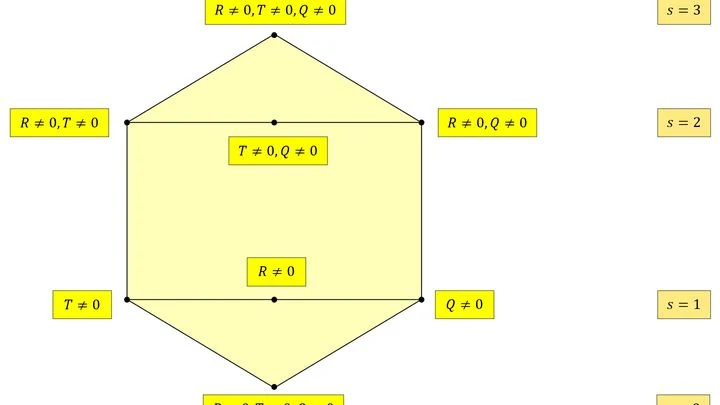
Gravity is usually explained through the curvature of spacetime. Massive bodies press it down like a bowling ball on a stretched rubber sheet. But this approach has two lesser-known twins. In one, gravity arises from torsion (twisting) of spacetime; in the other, from its non-metricity (when lengths and angles change during transport).
Sunlight hits a silicon wafer, and a current flows in the circuit. That's the familiar work of a solar cell: light knocks out electrons, and a p–n junction (the boundary between two layers with different conductivities) forces them to move in one direction. But in some crystals, current arises differently — without any junctions, purely from the material's internal structure.
When a massive star exhausts its fuel, the core collapse can spawn a supernova and a neutron star, but with enough mass, nothing halts the crush — a black hole is born.
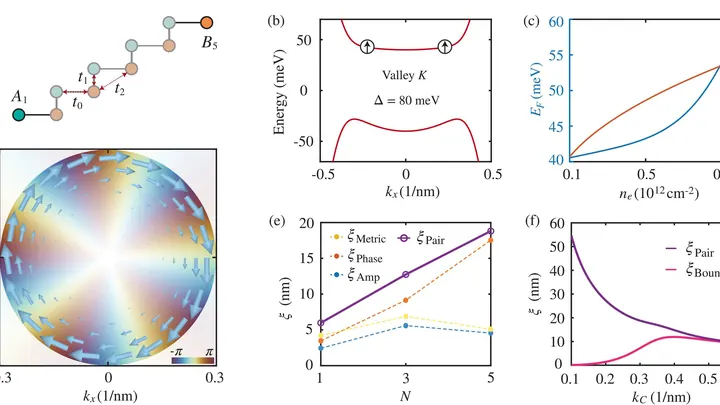
In a superconductor, electrons pair up like dancers holding hands. Usually, the distance between them, the pair size, depends on how fast they move and how strongly they are bound. But sometimes the dance floor almost disappears, and there's nowhere to move. This happens in materials with flat electronic bands: electrons nearly freeze, and the usual rules stop working.
The birth of the universe is often compared to inflating a balloon: in the first moments, it stretched rapidly. But the very "rubber" of this balloon was probably not perfectly smooth — rather, it was covered with the finest ripples.
Imagine a mountain range where height represents an organism's fitness. Every point on the slope is a particular set of genes. Evolution climbs upward, but the terrain of this phylogenetic network landscape is cut by ridges and valleys.
A plastic heart rests on the water and doesn't tip over, no matter how you turn it. It freezes in any position, as if the water were holding it by invisible strings. This trick is possible thanks to the Zindler curve — a shape in which all lines that divide the area in half have the same length. The Zindler curve is a closed curve where any chord that bisects the area has the same length.
It all started with tiny quantum flickers on the primal canvas. Inflation — an avalanche-like expansion proposed by Alan Guth — stretched those brushstrokes to the scale of galaxies.
An ordinary door swings both ways, but the physicists rigged a one-way door for atoms — enter at will, but leaving is off-limits. The atoms were cooled nearly to absolute zero — in such deep cold, they merge into a single cloud. This cloud was placed in a neat lattice of laser beams, adding a tiny irregularity, like a step at the threshold.
Each qubit has its own little ring, freely sliding on the doughnut. All quantum logic boils down to smooth movements: shift, flip, connect. Entanglement, for example, is when two doughnuts stick together, and the rings on them begin to spin synchronously, like figure skaters in pairs skating.
The key insight: the geometry of the surface dictates the rules of the game.
A lizard falling from a branch doesn't just tumble: it catches the air with its body and turns the fall into a glide. Engineers have long borrowed tricks from such feats, but until now there was no common language to compare the gliding of a snake, a lizard, and a man-made wing. The new study introduces such a language: a three-dimensional map of velocities that shows where any motion inevitably ends up.
River water flows smoothly until it hits a narrow spot. There the current speeds up, and around a bend it may swirl into a vortex. Similar funnels, but just molecule-sized, can gather particles in one place all by themselves — no pump or motor needed.
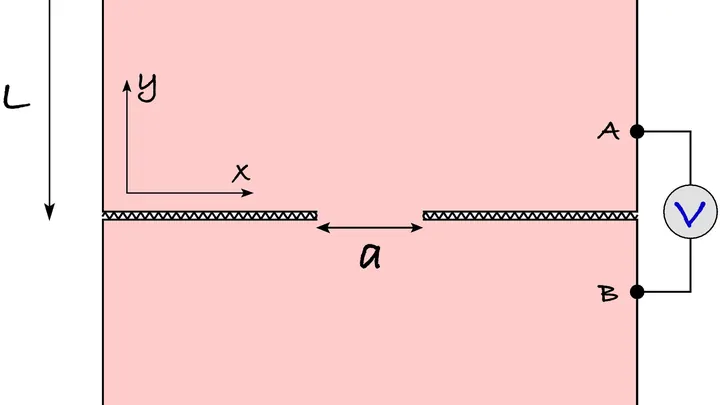
If you force water through a narrow neck, the flow speeds up right at the edge, and a whirlpool forms behind the obstacle. Electrons in ultra-clean two-dimensional materials, such as a thin layer of graphene, behave in much the same way.
Pour a handful of dry sand: it will spread into a neat cone. Now grab a box of star-shaped pasta: the pile will stand almost vertical. Why? It's all about particle shape.
Physicists built cylindrical piles from particles of different geometries — from smooth spheres to 'polypods' with several arms, like a sea star.
A spinning black hole acts like a giant funnel, but instead of just sucking in everything around it, it twists space itself, like a swift river current. New calculations show that in this maelstrom, stable vortices can be born from ultralight particles — likely building blocks of dark matter.
Picture a globe divided into cells: near the poles they shrink into narrow wedges, while at the equator they stretch into wide bands. If you connect random points on such a globe with lines, the compass arrows will lie: connections will point to where there are more cells, not where the flows actually go.