A survey is a systematic method of gathering information from a sample of individuals, typically through questionnaires or interviews, to infer characteristics of a larger population. In physics and other sciences, surveys are essential for collecting empirical data that can be used to test hypotheses, calibrate models, and understand complex systems. The titles in the corpus show surveys applied to diverse topics: from crowd dynamics (hydrodynamics of stampedes) to microbiome research and brain connectivity mapping.
History
The modern survey method has roots in the 19th century, with pioneers like Adolphe Quetelet applying statistical methods to social data. However, the systematic use of surveys in science expanded greatly in the 20th century with the development of probability sampling and opinion polling.
How it works
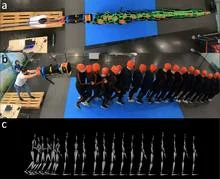
Surveys work by selecting a representative subset of a population and asking standardized questions. The responses are then analyzed statistically to draw conclusions about the whole group. Key steps include defining the target population, designing unbiased questions, choosing a sampling method (e.g., random or stratified), and ensuring the sample size is large enough to reduce random error. In physics contexts, surveys might involve measuring physical quantities or behaviors across many subjects, as in the SIVE virtual city experiment, where data from many simulated agents are collected to validate urban models.
In practice
Surveys are used in market research, public health, social science, and increasingly in physics-based fields like human dynamics and complex systems, where they help calibrate models of crowd behavior, disease spread, or social networks.
Fun fact
The word 'survey' comes from the Old French 'surveoir', meaning 'to look over', reflecting its original use in land measurement rather than opinion polling.
Two photographers shoot the same mountain. One takes a hundred shots from the summit and only a couple from the base; the other does the opposite. If you try to align their images, the algorithm might decide that the summit in one photo matches the summit in the other simply because there are many similar points there, not because it's the same spot. Sampling density throws it off.
A perfume bottle is not just glass with liquid. It is a snapshot of its time, a frozen melody of fragrant notes. From 1900 to 2024, tens of thousands of such 'melodies' have accumulated, and now they can be studied as a single organism.
The 120 residents of Montelago are not people but digital characters. Each, besides a name and biography, has three hidden coordinates: trust in municipal authorities, assessment of source credibility, perceived adequacy of information. These numbers are known to the creators but not to the system itself.
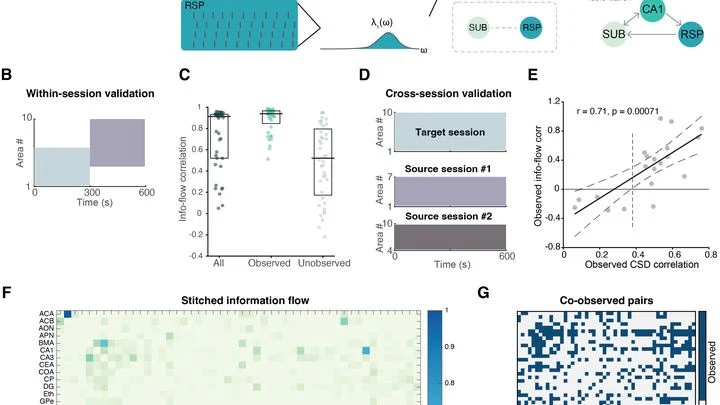
A patchwork quilt where each patch is a recording of activity from a small brain region. One patch was stitched on Monday in London, another on Tuesday in New York, and a third a month ago in Tokyo. This mosaic covers the brain only partially, and there is no common seam to join them.
When you're planning a renovation, you don't buy paint by eye: you measure the wall area. In science, deciding how many samples to collect is a similar guess, but the stakes are higher. Skimp on samples, and your study becomes a lottery: you might miss a real effect, or you might mistake noise for a discovery. Overshoot, and you're wasting tubes, months, and, in animal experiments, lives.
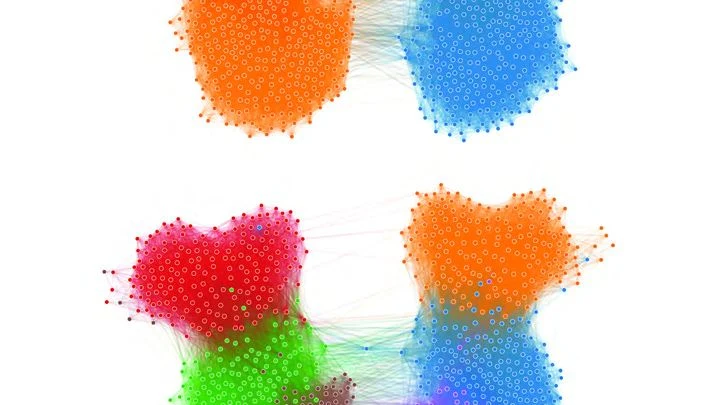
A social network is like a city: there are giant neighborhoods and tiny alleys. When an algorithm looks for tight-knit groups, it often picks out a couple of huge clusters and many small fragments. But the client (say, a municipality) needs districts of roughly equal size to distribute clinics or schools evenly.
Imagine a mountain range where height represents an organism's fitness. Every point on the slope is a particular set of genes. Evolution climbs upward, but the terrain of this phylogenetic network landscape is cut by ridges and valleys.
An album with hundreds of family photos holds countless stories. If you look at each picture on its own, you might easily decide that Uncle is a real giant: that day he happened to stand a step higher than everyone else. But flip through the whole album, and it becomes clear — his height is perfectly ordinary; it's just that a step showed up in a couple of frames.
When a typical computer searches for a law of nature from data, it tries to guess a complete formula in one go. It's like a cook who, without knowing the recipe, dumps all the ingredients into a pot at once and hopes for soup. Most often, the result is an inedible mess: the formula is long but meaningless, and it fails on new data.
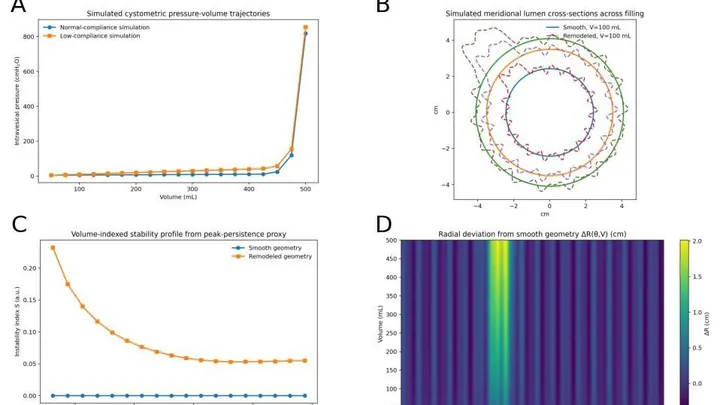
The bladder is like a balloon: as it fills, the wall stretches and the shape changes. Doctors usually monitor the pressure inside and how much fluid has entered, but they rarely look at the geometry itself — how the surface curves. Yet irregularities can appear before the usual metrics deteriorate.
Science is like a city where residents pave the streets themselves. Where paths are already worn, new houses go up, while untouched vacant lots go unnoticed — not because building there is impossible, but because no one ever looks.
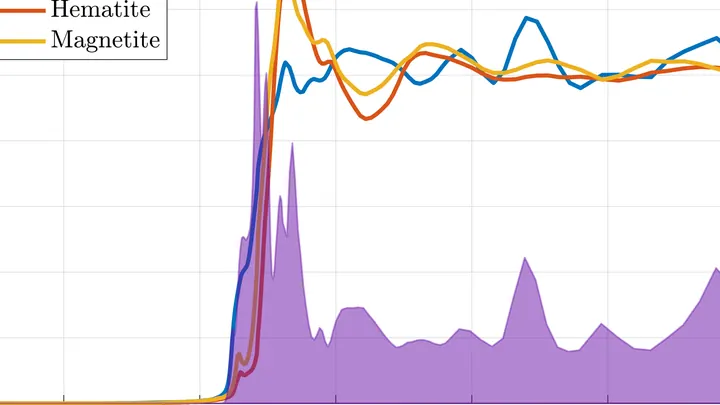
A chemical map of a sample is like a mosaic: each point has its own color, its own chemical composition. To assemble such a mosaic, a spectromicroscope scans the sample point by point, recording a spectrum at each location — a "fingerprint" of how the material absorbs or emits light.
A density of four people per square meter is the threshold beyond which a crowd ceases to be a sum of individual pedestrians and becomes something else. In Pamplona's Plaza Consistorial during the San Fermín festival, local density reached nine people per square meter.
Imagine an interpreter who gets distracted by every rustle in the hall. The more rustles, the more errors in the translation, even though the meaning of the speech hasn't changed. The same happens with data: if measurements are unevenly spaced, standard analytical tools start "hearing" changes that never occurred in the underlying process.
Two images of the same place: one taken in the morning from a drone, the other in the evening from a satellite. The first shows shadows from trees, the second shows glints on the water. It's like two accounts of the same event in different dialects: the words are similar, but the grammar is different.