Volume is the measure of the three-dimensional space that a substance or object occupies. It is a fundamental physical quantity, typically measured in cubic meters in the SI system, and is distinct from mass, which measures the amount of matter. Volume is an extensive property, meaning it scales with the size of the system, and it plays a crucial role in determining density, pressure, and other thermodynamic properties.
History
The concept of volume has been understood since antiquity, with early methods for measuring volumes of irregular objects attributed to Archimedes in the 3rd century BCE. The modern mathematical formalization came with the development of calculus by Newton and Leibniz in the 17th century.
How it works
For a regular solid, volume can be calculated from its geometric dimensions. For liquids and gases, it is often measured directly using graduated containers or by displacement. In physics, volume is a state variable in equations of state, such as the ideal gas law, where it relates to pressure and temperature. In more advanced contexts, volume can be defined in curved spacetime or in higher-dimensional spaces, where it may not behave intuitively.
In practice
Volume measurements are essential in fields ranging from medicine (dosage calculations) to engineering (fuel tank design) and physics (determining the density of celestial bodies).
Fun fact
In the context of the universe, the total volume of the observable universe is estimated to be about 4 × 10^80 cubic meters, yet it may be only a tiny fraction of the entire universe's volume.
Inside every cell, things are constantly meeting and parting. Some pairs hold tight, like Velcro, while others barely touch, like pollen on the wind. These fleeting touches, where the binding strength is comparable to a grain of salt dissolving in a glass of water, govern many of the cell's signals and decisions.
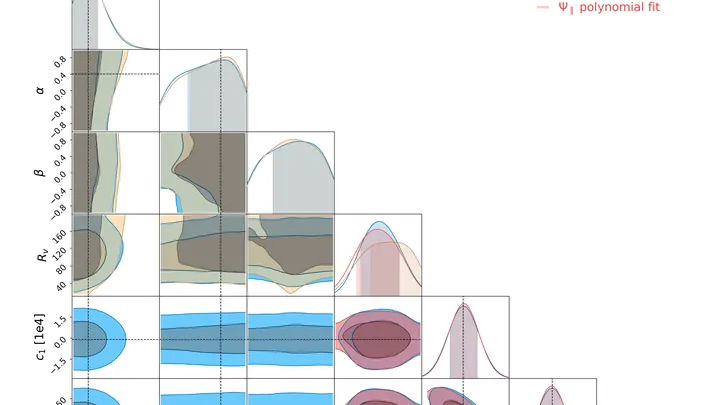
The standard cosmological model ΛCDM (which includes dark energy and cold dark matter) is the score of a cosmic symphony. It describes how space expanded after the big bang. How dark matter clumped together. How galaxies ignited. For a long time, everything played flawlessly.
A handful of sand lands on the table. The grains settle in different ways, but if the handful is large, the total volume barely changes. That's roughly how classical gravity works: space appears smooth and definite. But look closely at the individual grains, and you'll find that at the quantum level, volume itself is no longer fixed.
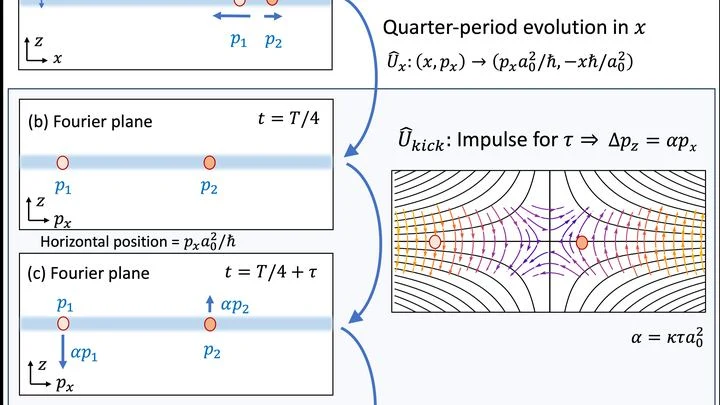
Fireflies flash in a dark forest: you see each flash, but not the flight. A quantum gas microscope can show individual cold atoms, like those fireflies. But until now, it couldn't tell you how fast they're moving.
Now scientists have found a way to fix that.
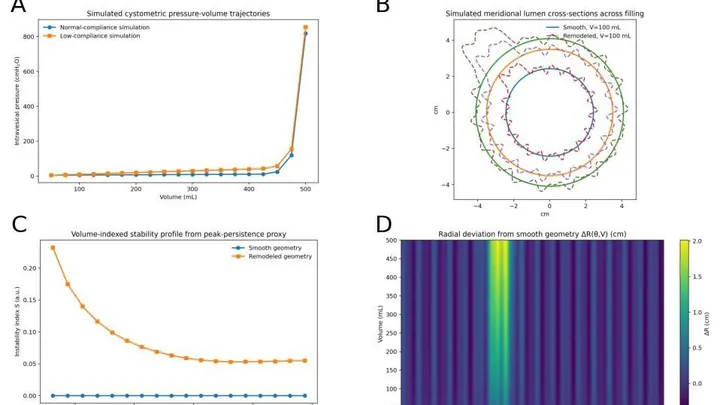
The bladder is like a balloon: as it fills, the wall stretches and the shape changes. Doctors usually monitor the pressure inside and how much fluid has entered, but they rarely look at the geometry itself — how the surface curves. Yet irregularities can appear before the usual metrics deteriorate.
You are counting sand grains falling in an hourglass, but each time the wind adds or removes a few. In the most sensitive cameras, the task is similar: you need to figure out how many "sand grains" (electrons) the sensor itself added, and how many came from light. This inherent sensor noise is called readout noise, and it hinders seeing weak signals — for example, the light of a distant star.
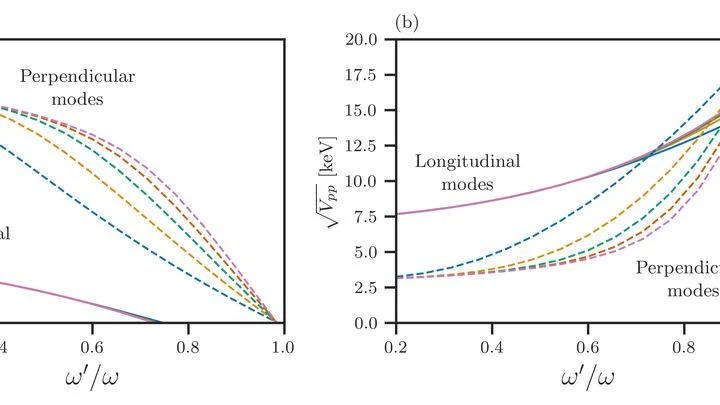
A speck of glass floats in a laser beam. Air molecules, photons, even Earth's gravity give it little pushes, and by watching its jitter, you can tell what pushed it. But every measurement has a limit: the particle's own noise hides weak signals. Quantum mechanics sets that limit, but it can be bypassed.
Galaxies in the Universe are not scattered randomly: neighboring ones move in the same direction, like a school of fish, while distant ones each go their own way. Where the boundary between 'together' and 'apart' lies has been unclear until now.
A team assembling a jigsaw puzzle from random pieces: how many simultaneous moves does it take to complete the picture? If the pieces are independent, they all go down at once. If each piece depends on the previous one, you have to work one at a time. So it is with systems: some states assemble instantly, others require a long sequential effort.