Wing vs. Gust: Twin Vortices express
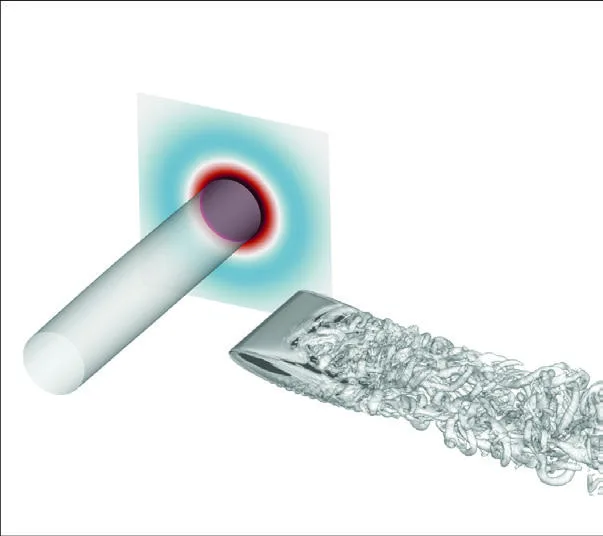
A sudden gust hits a wing, and a huge vortex swirls above it. Such a vortex can abruptly change lift, making the plane's nose dip. Engineers have long sought ways to predict these vortices, but complexity gets in the way: fast airflow is full of small chaotic eddies.
In the new study, two flows were compared: a very slow one (Reynolds number 600) and a fast one (10,000). The Reynolds number indicates how prone a flow is to turbulence — the higher it is, the more small vortices. It turned out that the large vortex cores, which create dangerous lift fluctuations, are arranged identically in both cases. The small ripples in fast flow do not change the overall picture.
The secret is that a gust tears a powerful sheet of vorticity off the wing's surface, as if unwinding an invisible veil from it. This veil rolls up into large vortices in the same way in both slow and fast flow. Therefore, to study dangerous gusts, one can use cheap slow experiments and avoid expensive high-speed wind tunnels.
Large vortices are like the skeleton of the flow. Small eddies are just the skin, which trembles but does not change the shape of the bones. If we learn to see this skeleton in advance, aircraft will be able to pass through turbulent zones more smoothly.
A Reynolds number of 600 corresponds to a flow of about half a meter per second over a small wing, while 10,000 is already tens of meters per second, like a real aircraft.