An obstacle in fluid dynamics is any solid object that disrupts the flow of a fluid. When the obstacle has sharp corners, it forces the fluid to change direction abruptly, which can lead to the formation of vortices, turbulence, and other complex flow patterns. In the context of superfluids, sharp corners have a particularly dramatic effect: they can destroy the superfluid state by creating conditions that allow quantized vortices to nucleate and proliferate.
History
The study of flow around obstacles dates back to the 19th century with work by Stokes and Kirchhoff; the specific effect of sharp corners on superfluids was explored in the late 20th century in the context of superfluid helium and ultracold atomic gases.
How it works
In a superfluid, flow is irrotational except at quantized vortex lines. A sharp corner creates a strong local velocity gradient, which lowers the energy barrier for vortex nucleation. Once a vortex forms, it can grow and interact with the flow, dissipating energy and breaking the frictionless flow. In ordinary fluids, sharp corners simply create separation points where the boundary layer detaches, generating a wake of vortices.
In practice
Understanding obstacle-induced turbulence is crucial for designing efficient pipelines, aircraft wings, and ship hulls; in superfluids, it informs experiments on quantum turbulence and vortex dynamics.
Fun fact
In a superfluid, a sharp corner can act as a 'vortex factory,' generating a steady stream of quantized vortices that carry away angular momentum.
In 1934 Jean Leray proved that the Navier–Stokes equations always have solutions "in a generalized sense". Whether a solution stays smooth or can break down into a singularity he could not tell, and nobody could for ninety years. In 2000 the Clay Institute made the question one of its seven Millennium Prize problems.
In a Paris laboratory, light was made to flow around an obstacle the way water flows around a rock in a stream. But this water is special: it feels no friction.
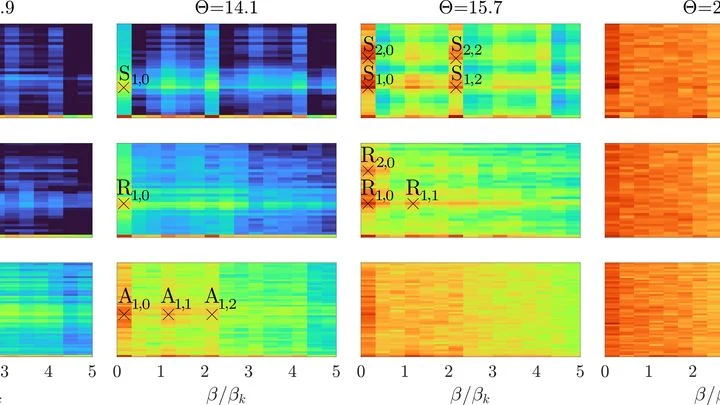
Water confined between two cylinders flows in smooth layers when the inner one rotates. But once the speed crosses a certain threshold, the layers crumple into toroidal rolls, like a stack of bagels. Physicists call these Taylor vortices: the flow loses stability and a regular pattern emerges.
Two dancers on one stage: the triangle and the stripe. In a quantum gas of dysprosium atoms cooled to 62 nanokelvin, these two spatial structures have met for the first time in a single experiment. The gas is held in a trap shaped like a surfboard, and its atoms are among the most magnetic in the periodic table.
A sphere rolls down a chute. What shape should the chute be to make the descent as quick as possible? Three centuries ago, the answer was the cycloid — a curve resembling the arc of an upside-down bridge. But submerge the chute in a thick liquid, and everything changes: the fluid slows the sphere, and the fastest path becomes something else.
If you pour honey into a colander with a hundred small holes, it will drip in thin streams, but each stream will swirl around the edge of the hole. Engineers need to understand such swirls: they affect how quickly water filters, how oil comes out of a reservoir, or how a drug seeps through tissues.
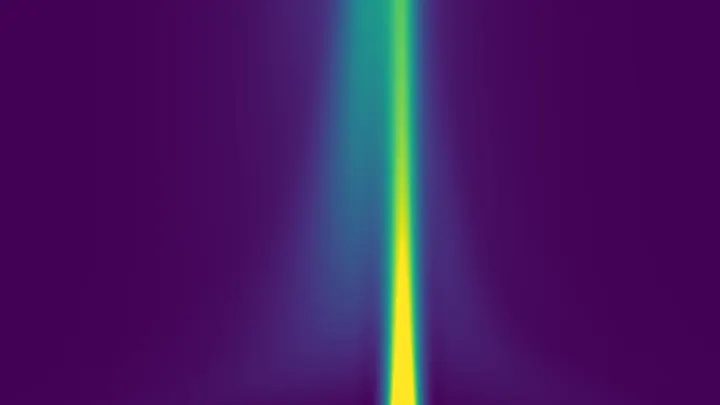
A globular cluster, a dense swarm of hundreds of thousands of stars, plows through a galaxy like a bullet through water. In ordinary dark matter (the invisible mass that holds galaxies together), it should quickly lose speed due to dynamical friction.
The universe right after the Big Bang was like a boiling cauldron: bubbles of a new state of matter were bursting and growing everywhere. These were first-order phase transitions — exactly like water boiling, only at temperatures reaching trillions of degrees.
A stone falls into still water, and smooth rings spread across the surface. If the stone doesn't just fall but also spins, tiny whirlpools, vortices, appear on the surface. Light can do the same, only instead of water, it's space and time themselves.
In the conventional Heisenberg picture, spins at low temperatures are supposed to line up in a strict pattern. But there are crystals — like pyrochlore — where geometry has its own way. Each ion sits at a vertex of a tetrahedron, and the main interaction enforces a rule: two spins point inward, two outward.
In water cooled to –40°C, a paradoxical pause sets in: perfect hexagonal ice is in no hurry to form. Instead, a disordered structure with interspersed cubic layers emerges — a real cradle for future symmetry, brimming with disorder yet already charged with hidden architecture.
In the first moments of its life, the Universe resembled a boiling cauldron. As it cooled, phase transitions occurred — much like steam turning into water, but instead of molecules, the very state of space changed. In this cauldron, bubbles of the new phase were born, akin to bubbles in a pot coming to a boil.
In the mountains, there is a saddle — a point where the trail from one valley crosses over into another. Standing exactly on it, you take a step and are already descending the new slope. In chemistry, such a place is called the transition state: a brief moment when atoms are frozen on the threshold of transformation.
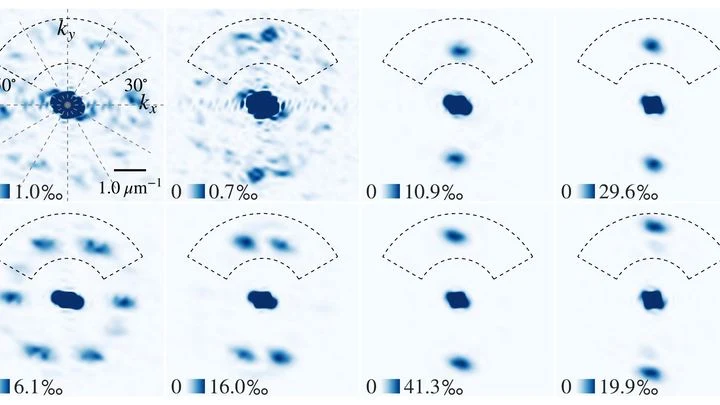
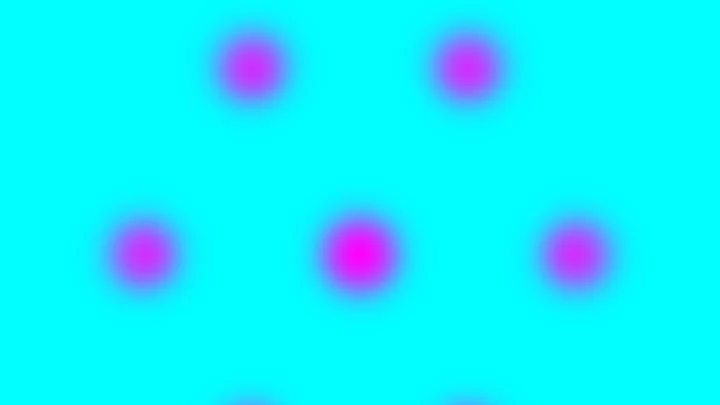
A supersolid is matter that is both crystalline and fluid. It is created from atoms cooled almost to absolute zero. In new work, physicists obtained such a substance as a triangular lattice of droplets. Each droplet oscillates in its own rhythm.
Imagine a packed dance floor where dancers glide without any friction — passing through each other without a touch. That's a superfluid. In a neutron star's crust, neutrons could behave this way, but a rigid lattice of ions gets in the way, like suddenly sticking the dance floor full of pillars.
Mountain river water doesn't flow smoothly: it churns, swirls into eddies, and suddenly accelerates. This chaotic motion is called turbulence. But even within it, there are hidden rhythms — rare and intense bursts that briefly alter the entire flow pattern.
A drop of thick shampoo falls into water and freezes into a strange rope. A liquid that both flows and springs back is called viscoelastic. In it, tiny particles under ultrasound behave quite differently than in water. Viscoelasticity is a material's ability to both spread like honey and return to shape like rubber.
Sugar dissolves in tea, and then with a single motion gathers back into the spoon. In an ordinary kitchen, you won't see that — viscosity and disorder get in the way. But in the world of ultra-slow motions, where inertia vanishes, such tricks become reality.
A superfluid gas behaves like a frictionless liquid. Two clouds of such gas are connected by a narrow bridge, and a stream of particles flows through it. This resembles the Josephson effect in superconductors, but here the particles are neutral atoms instead of electrons.
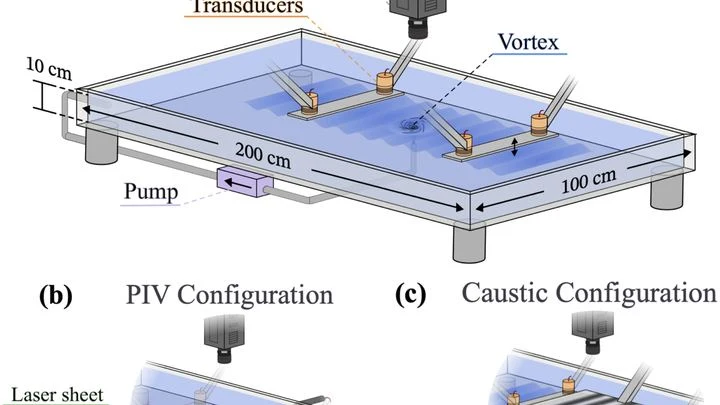
Water going down the drain swirls into a vortex. An everyday sight in the kitchen. But this very vortex turned out to be able to reproduce two effects that physicists usually associate with black holes and the rotation of planets.
The first effect is the shift of a wave as it goes around an obstacle.
In a pot of boiling water, steam bubbles rise and pop. In the quantum world of a superfluid, bubbles behave differently: they can collide and give birth to vortices — tiny swirling flows, like whirlpools in a river.
Scientists modeled such a liquid using a holographic approach.
A cell about to divide first marks its waist. Beneath its membrane, in a thin gel of protein filaments, movement begins. The filaments flow like a slow river, and a belt forms in the middle of the cell. This belt tightens more and more until the cell is pinched in half.
Scientists built a computer model of this process.
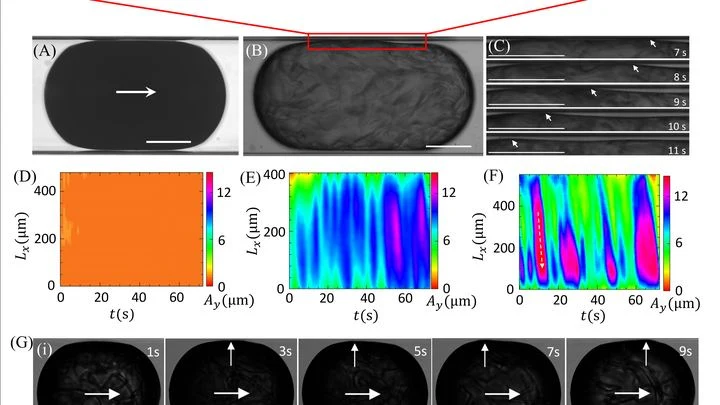
A tiny oil drop squeezes through a water channel narrower than itself. In pure water, it crawls along calmly, like a round bead. But add a little soap to the water, and the drop begins to bend, like a caterpillar.
Inside the kidneys, liver, and other organs, fluid flows through channels that squeeze and release like a hose underfoot. The walls of these channels are not rigid: they are porous, elastic, and soaked with moisture.
A drop of oil in water, coated with soap molecules, behaves differently from a bare drop. Soap molecules are tiny rods: one end loves water, the other loves oil. In a quiescent fluid, they stand on the surface like a picket fence, lowering the surface tension — the force that pulls the drop into a sphere.
The Sun drives the water cycle, and rain returns it to the ground. But now, every drop is a tiny hammer striking the surface. Floating plastic particles (microplastics, mostly carbon) upon impact jump up like popcorn kernels on a hot skillet. But instead of popping, they get wrapped in a thin water film and turn into weightless beads.
A sudden gust hits a wing, and a huge vortex swirls above it. Such a vortex can abruptly change lift, making the plane's nose dip. Engineers have long sought ways to predict these vortices, but complexity gets in the way: fast airflow is full of small chaotic eddies.
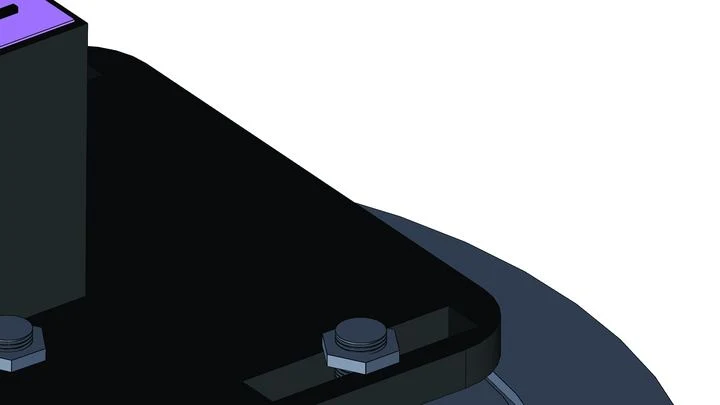
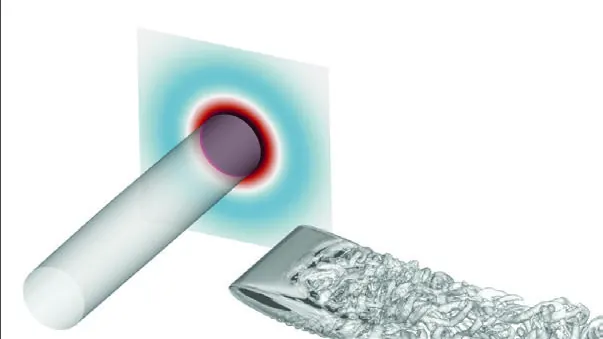
A superfluid flows without friction, like water in a perfectly smooth pipe, but the moment it hits an obstacle, the picture changes. In a new study, researchers looked at how a superfluid stream flows around rectangular walls and pits with sharp corners.
River water flows smoothly until it hits a narrow spot. There the current speeds up, and around a bend it may swirl into a vortex. Similar funnels, but just molecule-sized, can gather particles in one place all by themselves — no pump or motor needed.
In the macroscopic world we know, any motion inevitably decays: friction, a dissipative process that scatters energy, intervenes. But quantum reality has surprises in store.
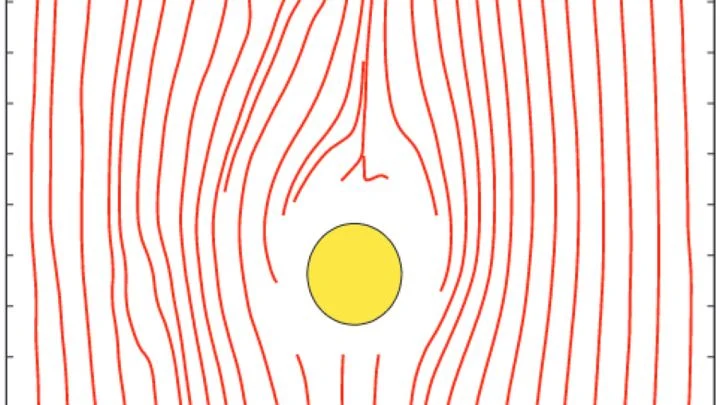
Liquid helium cooled to near absolute zero behaves like two fluids at once: a normal viscous part and a superfluid part that flows without friction. When such a flow hits a cylinder, vortices are born behind it. But sometimes vortices appear in front of the cylinder — where classical laws say they shouldn't be.
In a jar of oily liquid float millions of tiny magnetic grains: each about the size of a bacterium. Switch on a magnet, and the grains, like obedient little soldiers, line up into long threads. But why do they form threads rather than clumps? It turns out it's not just about magnetism.
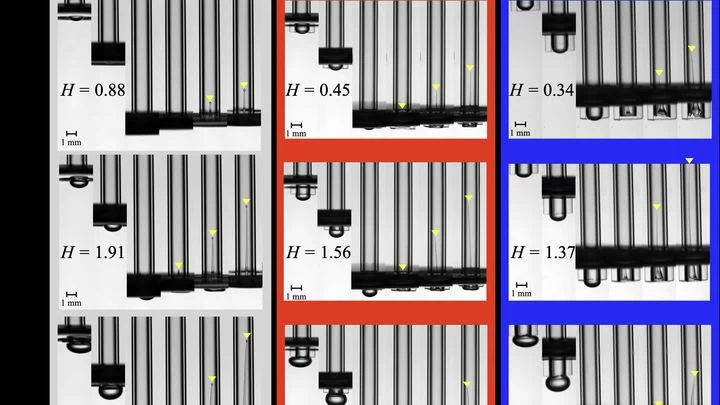
A drop falls into a glass, and a tiny jet, a thin fountain, shoots up from the surface for an instant. Something similar happens with a bubble stuck to the wall of a tube when you yank the tube downward. Water around the bubble rushes in, and a jet fires from its top. The speed of this jet depends on the bubble's shape — how much it bulges, like an umbrella dome.
A blunt cylinder flying at six times the speed of sound isn't the most elegant object, but it's the star of a new simulation. The surface of such a vehicle is never perfectly smooth: during atmospheric entry, the heat shield ablates, leaving bumps and pits.
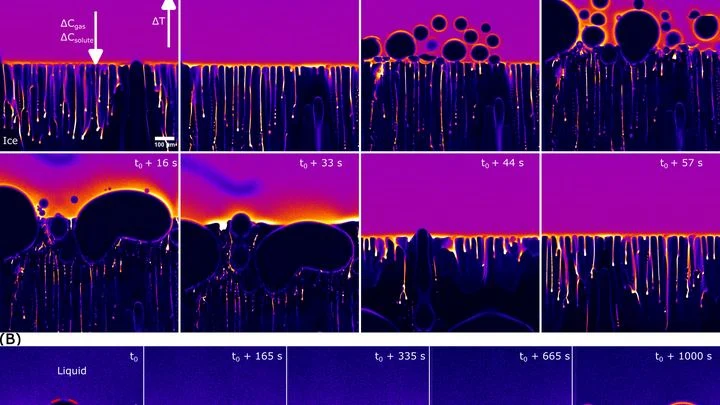
In a glass of soda, bubbles merrily rise to the top. But if you freeze the water, some bubbles end up trapped in the ice. How do they get there? After all, ice grows, pushing gas aside, but it doesn't always manage to.
The wind blows steadily, but suddenly a gust hits, and leaves swirl up in a vortex. Inside such a gust, the air speed changes not smoothly but in jumps — sometimes sharply forward, sometimes sideways. These rare and strong bursts are called intermittency, and they are the main mystery of turbulence.
In superfluid helium, a state where liquid flows without friction, quantized vortices spontaneously arise: microscopic funnels resembling whirlpools in ordinary Water, but governed by quantum mechanics.
A spinning black hole acts like a giant funnel, but instead of just sucking in everything around it, it twists space itself, like a swift river current. New calculations show that in this maelstrom, stable vortices can be born from ultralight particles — likely building blocks of dark matter.