A spiral is a curve that winds around a central point, with its distance from that point either increasing or decreasing at a steady rate. Spirals are ubiquitous in nature, from the shape of galaxies and hurricanes to the shells of mollusks and the tracks of charged particles in magnetic fields. In physics, spirals often arise when a system combines circular motion with a radial drift, such as a charged particle spiraling along a magnetic field line or a planet's orbit slowly decaying due to gravitational wave emission.
History
The study of spirals dates back to ancient Greece, with Archimedes describing the spiral that bears his name in his work 'On Spirals' around 225 BC. The logarithmic spiral was later studied by Jacob Bernoulli in the 17th century, who was so fascinated by its self-similarity that he requested it be engraved on his tombstone.
How it works
A spiral forms when two independent motions are superimposed: a circular component and a radial component. For example, a charged particle in a magnetic field moves in a circle, but if it also has a velocity component along the field, the path becomes a helix—a three-dimensional spiral. In fluid dynamics, spiral patterns emerge from differential rotation, where inner regions rotate faster than outer ones, stretching any initial disturbance into a spiral arm. The mathematical description typically uses polar coordinates, with radius r = a·θ for an Archimedean spiral or r = a·e^(bθ) for a logarithmic spiral.
In practice
Spiral geometries are used in antenna design, spiral heat exchangers, and in the design of spiral galaxies' density wave theory, which explains how spiral arms persist over time.
Fun fact
The spiral pattern of a sunflower's seeds follows the Fibonacci sequence, with consecutive seeds separated by the golden angle of approximately 137.5 degrees, optimizing packing efficiency.
An old city gains new suburbs. In the center, narrow streets where life has nearly stopped, while on the outskirts construction is booming. That is what a spiral galaxy looks like when its core stars have long aged and new stars are still being born in the outer disk.
A vortex in a magnetic material is like a whirlpool, but instead of water, the directions of magnetization twist. An electron flying through such a vortex feels not just a magnetic field, but a curvature of space: its path bends as if it were rolling down a funnel with a narrow neck.
The early Universe was like a rapidly cooling ocean. At colossal temperatures, everything was one — quarks, electrons, forces all blended into a symmetric 'steam.' But as it expanded and cooled, this steam condensed, phase transitions cascading one after another like water turning to ice.
At the hearts of many galaxies, cosmic tops of incredible power spin — supermassive black holes. Their nature was first described by Schwarzschild right after Einstein gifted the world with general relativity.
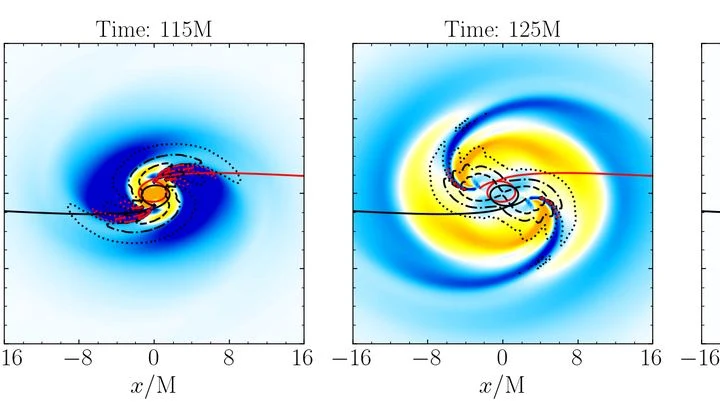
Two black holes race past each other like Formula 1 cars on opposite lanes. In standard general relativity, they remain 'bald'—no extra fields appear around them. But if you add a scalar field to the equations (something like an invisible fog permeating space), the rules change.
The open ocean is a vast basin where almost no one measures the wind directly. Fixed platforms are rare and expensive, and satellite scatterometers, instruments that probe the surface with radar, need ground truth for calibration. Coastal zones have such data, but far from shore, there's a void.
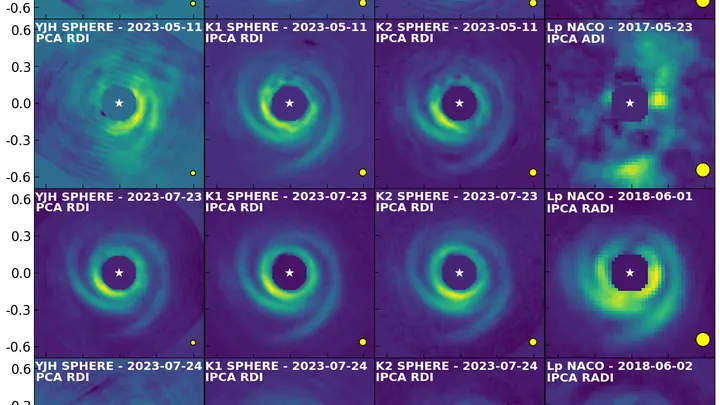
460 light-years away, around the star HD 135344B, a dense disk of gas and dust is swirling. It looks like a giant vinyl record that someone has cracked: a gap yawns in the disk, and across it, like a slender bridge, stretches a dust filament.
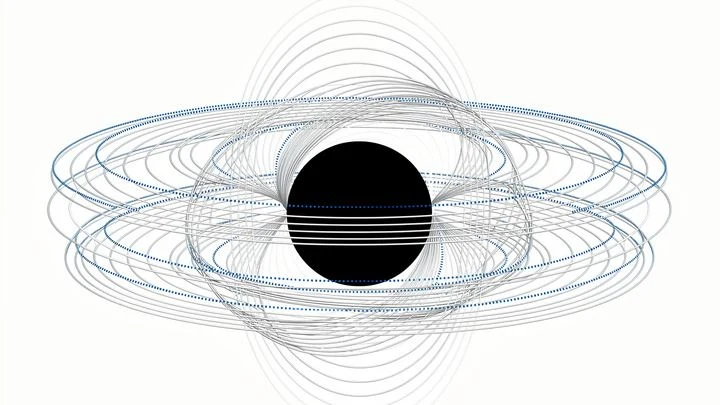
Imagine a soap bubble with electricity trapped inside and walls made of an invisible field: that's roughly what a black hole with 'resonant hair' looks like. This isn't real hair, but a cloud of scalar field held around the hole by its own interactions.
Every shell is a stone diary of growth. The mollusk doesn't build it from a blueprint like an architect; it simply adds material along the edge, following the same rule over and over. It's as if a snail glued a new strip to its house each day, nudging it slightly sideways and making it a bit bigger. It's this repetition, not complex control, that creates the species' characteristic shape.
A flock of birds or a school of fish sometimes swirls into a vortex, even though no individual commands 'spin.' Such collective rotation helps the group stay together and mix better. It is usually explained by the individuals being asymmetric, like a screw, or pushing each other with a twist. But a new study finds another route.
Previously, astronomers calculated galaxy mass as if they were perfect spheres. But a galaxy is a flat pancake. The new 'Lost and Found' model takes the actual shape into account: it sums up the gravitational pull from all parts of the disk, not just the central bulge. The result is stunning: many galaxies need a third less invisible dark matter than previously thought.
The Sun sometimes produces flares — bright explosions that hurl streams of charged particles into space. On April 22, 2021, one such flare occurred in an active region where a dark sunspot was crossed by a bright "bridge" of hotter gas.
In ordinary water, ripples from a thrown stone spread in even concentric circles. But imagine a liquid whose molecules are like tiny screws with a right-handed thread. In such a medium, the surface acts like a one-way street: waves can only travel in a certain direction.
Ring-shaped reefs, atolls, are usually explained like this: corals grow along the edge of a volcanic island while the island slowly sinks. What's left is a hollow ring that can stretch for kilometers. But satellite images show similar rings around very small reefs where there are no volcanoes and no subsidence.
Cilia are tiny hairs on cell surfaces. They beat like oars, moving fluid. In the lungs, they push dust and microbes out. But their lengths vary: in humans, they are thousandths of a millimeter; in comb jellies, several millimeters. How do such different cilia work together?
Scientists built a machine that jerks fluid sharply, as if a cilium had struck. They filmed it with a high-speed camera.
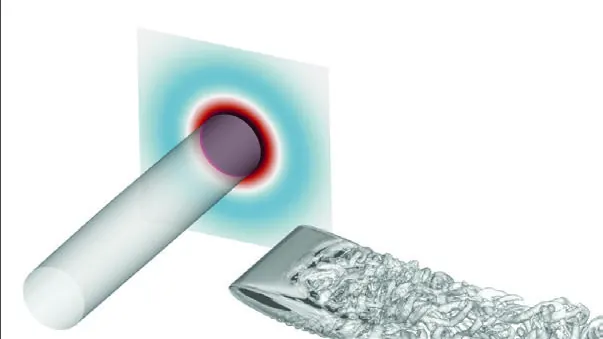
A sudden gust hits a wing, and a huge vortex swirls above it. Such a vortex can abruptly change lift, making the plane's nose dip. Engineers have long sought ways to predict these vortices, but complexity gets in the way: fast airflow is full of small chaotic eddies.
Toss a handful of pebbles into a pond, and the spreading ripples intersect, creating splashes and calms. That’s roughly how gravitational waves, predicted by Einstein, behave. Except it’s not water that’s oscillating, but spacetime itself.
A microbe with flagella rows through water the way a person rows with their arms. But if a person swims breaststroke, they go forward, while a microbe goes in a spiral. The reason is that a microbe has no single direction: each part of its surface pushes water in its own direction, and the body twists like a corkscrew.
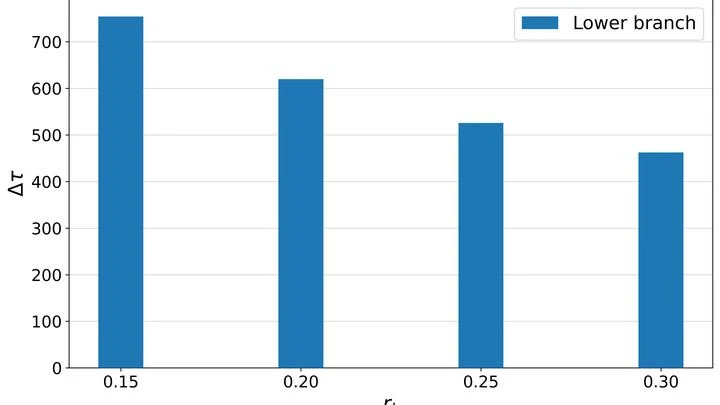
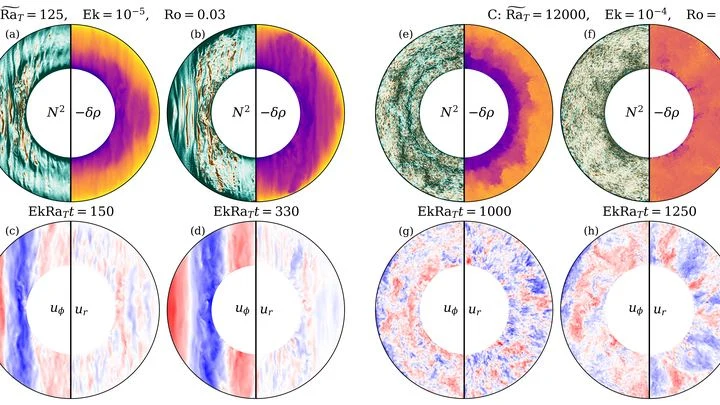
Inside giant planets like Jupiter and Saturn, heat doesn't always rise freely. Heavy elements, which are more abundant in some layers than others, prevent hot fluid from floating up. This creates semiconvection — a type of mixing where heat and composition spread at different rates.
The Sun doesn't rotate as a solid body: its equator spins faster than its poles. This difference in rotation speed creates layers that move at different speeds, like ocean currents at different depths.
A thin rubber film lies on a table. Someone grabs it by the middle and slowly pulls upward. The film doesn't just rise: it arches into a dome, then wrinkles run along the dome's edge, like pleats on a skirt. Pull higher — the wrinkles gather into large folds that cross the entire film. And if you start lowering it, the folds don't disappear but collapse into new shapes.