A tropical atmospheric circulation with rising air over the western Pacific and sinking air over the eastern Pacific, driven by zonal sea surface temperature gradients.
The Walker circulation is a giant loop of air that rises over the warm western Pacific Ocean, flows eastward high in the atmosphere, sinks over the cooler eastern Pacific, and returns westward near the surface. It is a direct response to the fact that the tropical Pacific is warmer in the west than in the east, a difference that drives convection and pressure contrasts. This circulation is a major player in global climate variability, especially in the tropics.
History
The concept is named after Sir Gilbert Walker, who in the 1920s studied the Southern Oscillation, a seesaw of atmospheric pressure across the Pacific, though the full three-dimensional circulation was described later.
How it works
Sunlight heats the western Pacific more than the eastern Pacific, so the air above the west becomes buoyant and rises, creating a region of low pressure and heavy rainfall. The rising air then spreads eastward at high altitudes, cools, and sinks over the eastern Pacific, where the ocean is cooler. The sinking air creates high pressure and dry conditions, and the surface winds blow westward to complete the loop, reinforcing the ocean temperature pattern.
In practice
Understanding the Walker circulation is essential for predicting El Niño and La Niña events, which affect weather worldwide.
Fun fact
During strong El Niño events, the Walker circulation can weaken or even reverse, causing the eastern Pacific to warm and shifting rainfall patterns dramatically.
The JWST space telescope aimed its lens at the scorching rocky world 55 Cancri e, and spotted a dense gas envelope. But the cooler TRAPPIST-1 b, which orbits a dim red dwarf, showed no envelope: just bare rock. The picture came out upside down: hot planets hold onto atmospheres, while cooler ones lose them.
In 1991, Mount Pinatubo erupted with such force that it blanketed the planet in a thin veil of ash and gases for years. That veil, like a blanket on a hot night, trapped heat and cooled the ocean surface, causing tropical sea surface temperatures to dip. This event marks the start of a detective story about why some oceans are spawning ever more ferocious hurricanes while others remain calm.
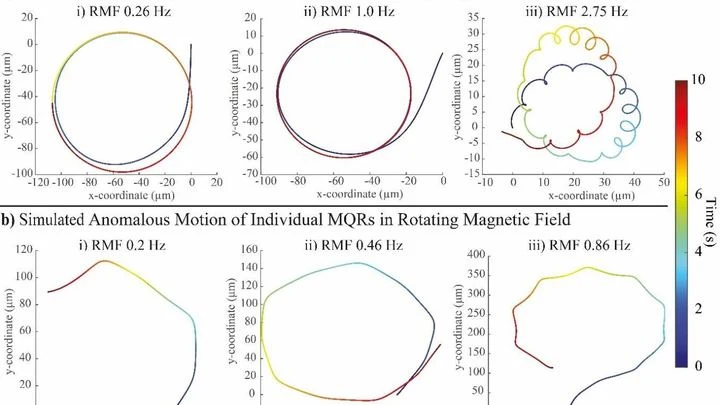
A small ball with an iron core lies on a surface while a magnetic field spins around it. The ball starts rolling like a wheel and usually goes in the direction the field rotates. But sometimes it suddenly turns around and rolls the other way — against the field.
The James Webb Space Telescope is gazing more and more at exoplanets — worlds orbiting alien stars. Some of them are scorching rocky spheres, tidally locked with one side forever facing their star. There, rock melts into oceans of liquid lava. How does this lava move?
Beneath Enceladus's icy crust churns an ocean, acting like a perfect heat pump. It pushes heat from the equator to the poles, spending a thousand times less energy than it transports — like a perpetual motion machine built into the moon. The secret lies in salt.
In summer, the Arabian Sea breathes like a pair of bellows: one moment it pumps heat, the next it exhales moisture over a billion people. But sometimes this breathing stumbles, and the water off the coasts of India and Pakistan runs a few degrees hotter than usual.
A spring compressed to the limit breaks. Likewise, classical gravity theory leads to a singularity — a point where all laws break down. Quantum mechanics turns this end into an elastic bounce.
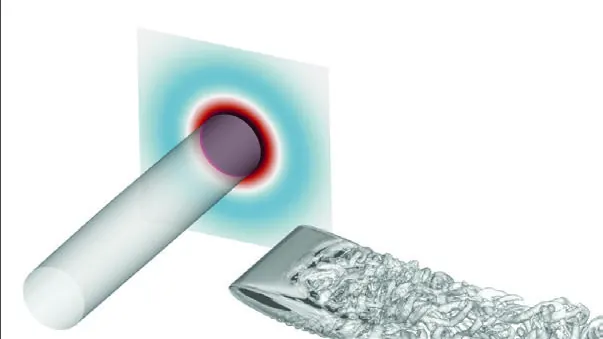
A sudden gust hits a wing, and a huge vortex swirls above it. Such a vortex can abruptly change lift, making the plane's nose dip. Engineers have long sought ways to predict these vortices, but complexity gets in the way: fast airflow is full of small chaotic eddies.
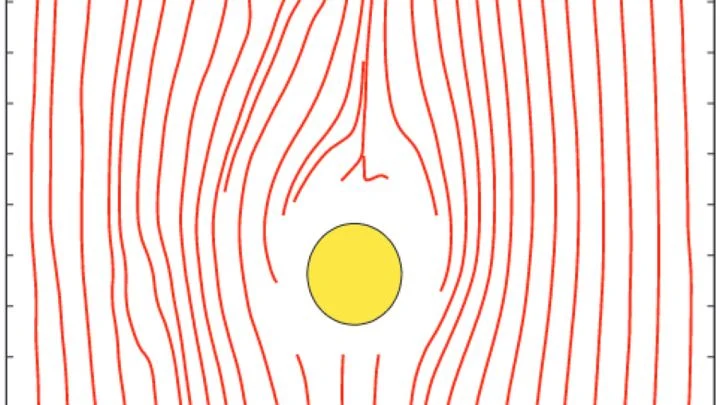
Liquid helium cooled to near absolute zero behaves like two fluids at once: a normal viscous part and a superfluid part that flows without friction. When such a flow hits a cylinder, vortices are born behind it. But sometimes vortices appear in front of the cylinder — where classical laws say they shouldn't be.
Paraglider, hang glider, and glider — three different wings, but in the sky they behave the same. Pilots catch invisible warm air currents, rise on them, then glide to the next. Such flight is like a game of hopscotch: a jump upward, then a glide forward, and again a search for a place to jump.
Scientists analyzed thousands of real routes and found a common law.
The orchestra assembled, the instruments were tuned, but there was barely any music: that's what the 2025 Atlantic hurricane season looked like. The ocean was the fifth warmest on record, and a weak La Niña usually adds strength to storms. But instead of a continuous concert, we got isolated thunderous chords: three Category 5 hurricanes, with silence in between.
Why was the orchestra silent?
According to the laws of the microworld, an electron obeying the Dirac equation trembles even at complete rest. This is Zitterbewegung — an oscillation with an amplitude of trillionths of a millimeter, like a spinning top on an invisible axis.
Imagine an interpreter in a negotiation room who hears the tropics whisper and repeats it too loudly. That is how the neural-network climate model DLESyM behaves when forced with real Pacific sea surface temperatures. The ocean whispers "El Niño," and the atmosphere shouts back as if being shaken by the shoulders.
In winter, air over the Northern Hemisphere does not move haphazardly; it spends days at a time in the same pattern before rearranging itself. These patterns are like rooms in a maze: the system enters, lingers, then finds a door to another room. Each room has its own weather: somewhere over Europe it is warm and humid, while over Siberia it is frosty and clear.
The planet's winds are not free-flowing currents but rather obedient jets that can be nudged from an unexpected direction. The ocean surface, covered with waves, acts like a tuning knob: change its roughness, and giant air rivers shift by hundreds of kilometers.
A forest fire has no "typical" size: a small grass burn and a firestorm covering thousands of hectares are part of the same phenomenon. The same goes for tropical cyclones: the energy they release over their lifetime does not cluster around some average value. Instead, it follows a power law, and this rule holds across all of Earth's oceans.
In the 1920s, British meteorologist Gilbert Walker, trying to forecast monsoons in India, noticed a strange connection: when air pressure rises over the eastern Pacific, it falls over the western Pacific, and vice versa. It was as if a giant air pendulum were swinging along the equator.