A Quantum Duet of Tin and Lithium in a Crystal express
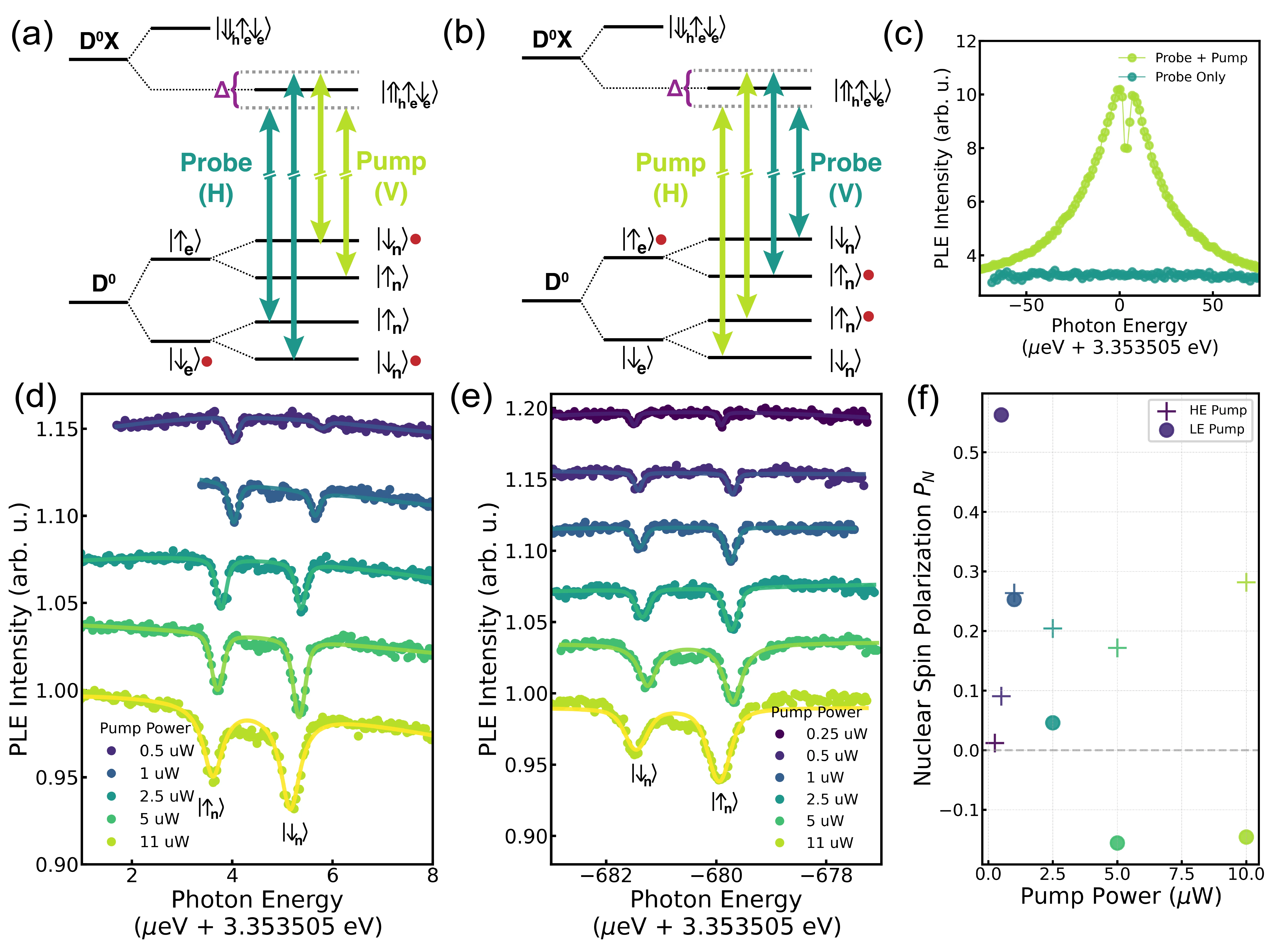
Hidden inside a zinc oxide crystal is a quantum duo: a tin atom and a lithium atom sitting side by side. Their bond is so tight that the electron captured by this pair seems to live on the tin, while the lithium merely plays along. This complex was long sought after, but only now has it been deliberately created and identified by its characteristic glow.
The strength of this coupling has been precisely measured: 392 megahertz. For comparison, in typical donors in silicon, the coupling is tens of times weaker. Such a strong pair allows very fast manipulation of the nuclear spin — literally within billionths of a second. This means quantum information can be written into the nucleus and read out with light.
This work shows that not only single impurities but also their pairs can serve as building blocks for quantum devices. The tin–lithium complex opens a new direction in the design of quantum defects — with a nuclear spin ready for dialogue with photons.
Original abstract
as written by the authors arXiv:2603.05615
Donor impurities in wide direct band gap semiconductors provide a promising platform for spin--photon quantum technologies by combining a donor spin qubit with optically addressable transitions. In ZnO, the shallow donor with the largest reported binding energy has long been associated with the I$$_{10}$$ bound exciton line, but its microscopic origin has remained unresolved. Here we demonstrate the controlled formation and identification of this donor as a Sn--Li complex through a combination of ion implantation, annealing, optical spectroscopy, and first-principles calculations. Resonant two-laser coherent population trapping measurements reveal an electron--$$^{119}$$Sn hyperfine interaction of $$392 \pm 15$$\,MHz, establishing a coupled electron--spin--1/2, nuclear--spin--1/2 system with one of the largest hyperfine couplings reported for shallow donors in semiconductors. Density functional theory calculations show that a nearest-neighbor Sn$$_{\mathrm{Zn}}$$--Li$$_{\mathrm{Zn}}$$ complex has favorable formation energetics, donor character with the electron localized on Sn, and an extrapolated hyperfine interaction consistent with experiment. The large donor binding energy and excited-state structure indicate enhanced thermal robustness of the optical transition relative to conventional group--III donors, while the strong hyperfine interaction enables fast electron--nuclear spin control and prospects for direct nuclear--spin--photon interfaces. We further observe efficient optically induced nuclear spin polarization, highlighting a path toward nuclear spin initialization. More broadly, our results reveal how a donor--acceptor complex can access previously unexplored regimes of shallow donor physics, extending the design space of quantum defects beyond isolated substitutional dopants.
The hyperfine interaction in this complex is so strong that the transition frequency between spin states is comparable to the frequencies at which microwave ovens operate.