A Smart Filter for Rare Particles express
Deep inside a mountain, under layers of rock, lies a germanium crystal the size of a fist. It waits for a rarest of events: an atomic decay that happens once in billions of years. But inside the crystal, something is always ticking — cosmic rays, traces of radioactivity, thermal noise. Separating a true signal from this background is like hearing a whisper at a rock concert.
Previously, physicists listened only to individual notes: they measured how fast the signal rose, how much energy was released, and how long it took to fade. Based on these notes, they decided whether an event resembled the sought-after decay. But this approach missed details. Now, a neural network has been put on the entire soundtrack — a transformer that can catch subtle differences in pulse shape. It doesn't just compare numbers; it sees the whole pattern, like an experienced musician hears a wrong note in a chord.
The result surprised everyone: the neural network found 20% more true events than old methods, with the same level of false alarms. And for the most challenging cases, where the signal almost merges with the noise, the gain is even larger. This means we can peer deeper into the mystery of the neutrino — a particle that might be its own antiparticle. If so, the decay the detector catches could reveal why the universe has matter, while antimatter disappeared.
Now the detector listens not only to loud notes but to the entire whisper of the universe.
Original abstract
as written by the authors arXiv:2603.06192
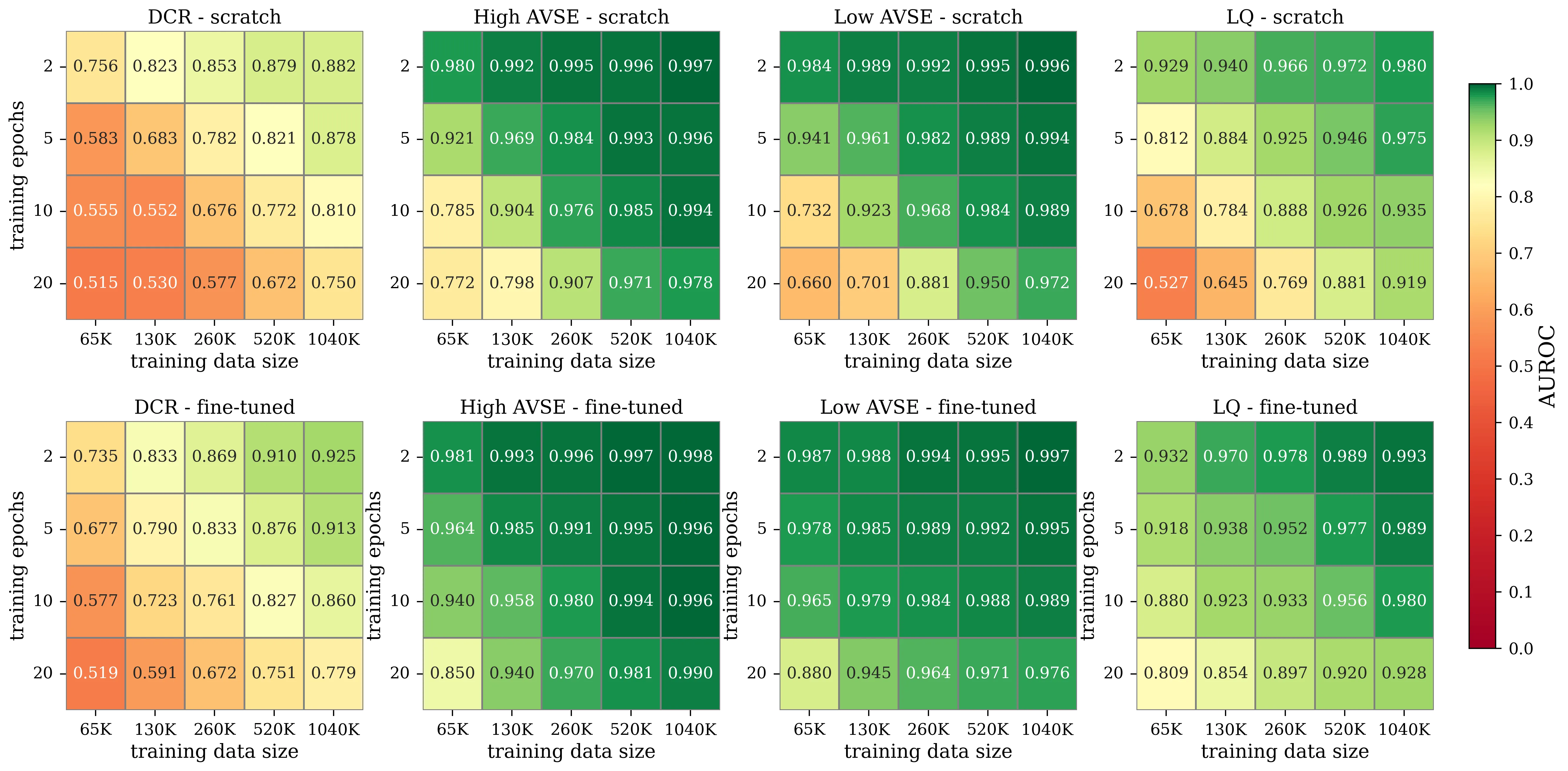
Pulse-shape discrimination (PSD) in high-purity germanium (HPGe) detectors is central to rare-event searches such as neutrinoless double-beta decay (0vBB), yet conventional approaches compress each waveform into a small set of summary parameters, potentially discarding information in the full time series that is relevant for classification. We benchmark transformer-based models that operate directly on digitised waveforms using the Majorana Demonstrator AI/ML data release. Models are trained to reproduce the collaboration-provided accept/reject labels for four standard PSD cuts and to regress calibrated energy. We compare supervised training from scratch, masked autoencoder (MAE) self-supervised pre-training followed by fine-tuning, and a feature-based gradient-boosted decision tree (GBDT) baseline. Transformers outperform GBDT across all PSD targets, with the largest gains on the most challenging labels and on the combined PSD-pass definition. MAE pre-training improves sample efficiency, reducing labelled-data requirements by factors of 2-4 in low-label regimes. For energy regression, both transformer variants show a small common underestimation on the test split, while fine-tuning modestly narrows the residual distribution. These results motivate follow-up studies of robustness across detectors and operating conditions and of performance near QBB.
A germanium crystal for such a detector is grown over months, then kept at liquid nitrogen temperature so thermal noise doesn't drown out weak signals.