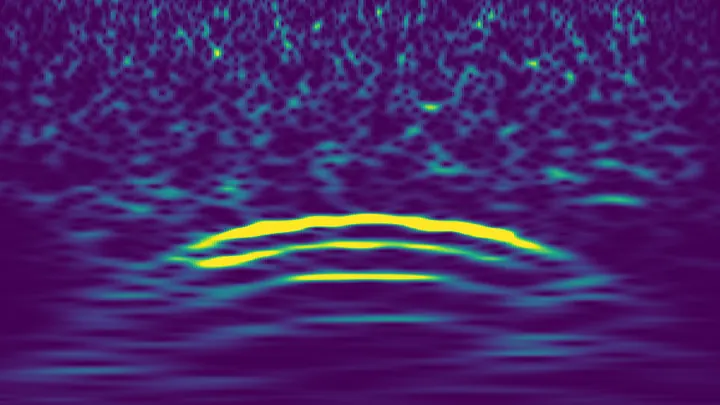
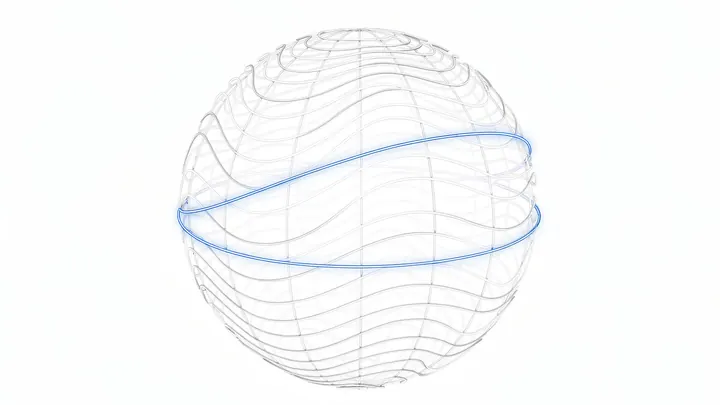
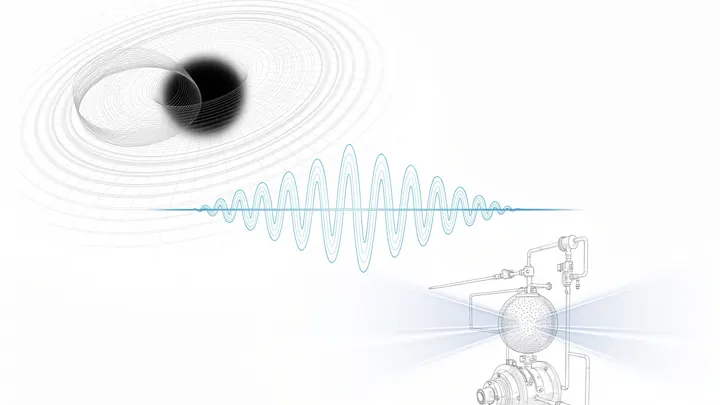
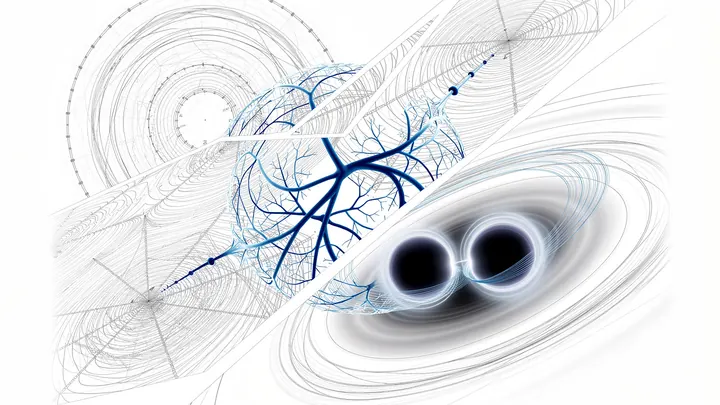
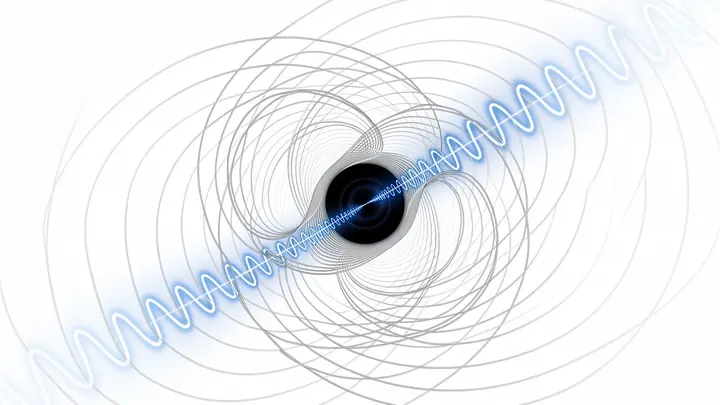
A template is a precomputed model of a gravitational-wave signal, essentially a theoretical prediction of the exact waveform that a specific astrophysical event (like the merger of two black holes) would produce. In gravitational-wave astronomy, detectors like LIGO and Virgo record tiny vibrations of spacetime, but these signals are buried in noise. To find them, researchers compare the detector data against a bank of thousands of templates, each representing a different possible source (different masses, spins, etc.). When a template matches the data closely enough, it signals a detection and also reveals the properties of the source.
History
The concept of matched filtering with templates was borrowed from radar and sonar technology and adapted for gravitational waves in the 1970s by researchers like Kip Thorne and Bernard Schutz. The first direct detection in 2015 relied on extensive template banks built by the LIGO and Virgo collaborations.
How it works
The process is like pattern matching: the detector output is a continuous stream of noisy data. A template is a mathematical function that predicts the expected strain (the stretching and squeezing of space) over time for a specific event. The data and each template are cross-correlated — essentially, the template is slid along the data and the overlap is calculated. If the overlap exceeds a statistical threshold, it indicates that the signal is present. The best-matching template then provides the parameters of the event, such as the masses and spins of the merging objects.
In practice
Templates are the standard method for detecting gravitational waves from compact binary mergers, enabling the discovery of dozens of events and the study of black hole populations.
Fun fact
The template bank for LIGO contains over 250,000 individual waveforms, each computed from general relativity, to cover all possible binary configurations.
A quantum detector is like a sensitive pendulum suspended in empty space. If a sharp gravitational wave passes by, you might expect the pendulum to swing. But the calculation shows otherwise: the wave doesn't swing it: it damps any existing oscillations.
Imagine a simultaneous interpreter in a room where two people are speaking: they must keep up with both meaning and intonation, but if the speech is too fast, only a paraphrase remains. That's roughly how scientists feel as the stream of gravitational waves from black hole and neutron star mergers grows, while precise signal calculations lag behind.
When a star many times heavier than the Sun dies, it collapses and explodes as a supernova. This is not just a flash of light — the entire process, from core collapse to the ejection of the outer layers, makes space itself tremble. These ripples are called gravitational waves.
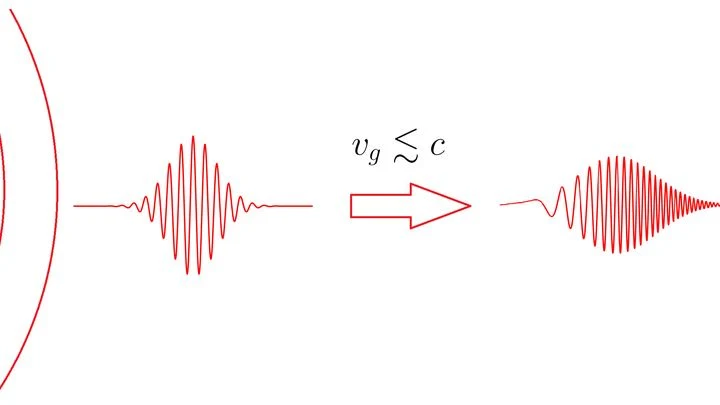
You could send a short radio pulse toward a black hole and wait for the reflected echo. Intuitively, the shorter the signal, the better it would probe the finest details of spacetime right at the horizon: that region from which even light cannot return.
A noisy café. You're trying to make out two quiet conversations: one from the table by the window (black hole mergers), the other a barely audible whisper from the far corner (echoes of the universe's birth). But the hiss of the espresso machine and street noise (detector jitter) drown everything out. New work teaches a computer to separate these sounds.
In the first moments of its life, the universe resembled a boiling cauldron. Matter wasn't spread evenly — clumps and voids were brewing within it, and their violent motion gave rise to a trembling of space itself: gravitational waves.
A huge bowl of water. Drop a stone into it — ripples spread across the surface. The fabric of spacetime works much the same way: when two massive stars merge, they create ripples — gravitational waves. These waves travel to Earth and are picked up by giant detectors like LIGO and Virgo.
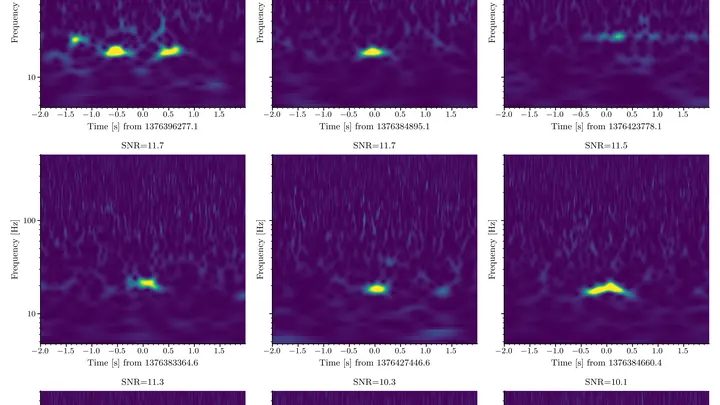
In 2019, the LIGO facility recorded a gravitational waves, a ripple in the fabric of spacetime, whose time-frequency map resembled a strange comb. Each such signal from a black hole merger leaves a unique pattern, like a fingerprint.
An experienced detective doesn't calculate a criminal's path using the laws of physics: he checks a file of similar cases. The new prediction method works the same way: instead of complex equations, it has a vast archive of trajectories that have already happened — planetary motions, currency exchange rates, signals from space.
Gravitational-wave detectors are like sensitive microphones, listening for the whispers of distant cataclysms. But every now and then, a sharp crack bursts in — a brief noise spike known as a glitch.
The cosmic microwave background is the first light that pierced the dense fog of the early universe. Its spectrum, like a frozen score of a cosmic symphony, preserves the tiniest density fluctuations from which galaxies grew.
In the ocean of space, every storm of birth or merger of supermassive black holes generates ripples — gravitational waves traveling at the speed of light. Over billions of years, these waves superimpose, merging into a low-frequency hum, like a distant surf.
Isolating the signal from a single pair of supermassive black holes is like hearing a dancer's footsteps amid the roar of a hurricane. Somewhere in space, these monsters spin in a slow gravitational tango, distorting spacetime itself.
A runner on the middle of a track suddenly switches to a walk — not speeding up or slowing down, but maintaining a constant pace. Something similar may have happened to the universe itself shortly after the Big Bang.
A pair of neutron stars, locked in a gravitational embrace, traces invisible circles in the void. A century ago, Albert Einstein described this dance as waves of curved geometry, but for a long time we could only catch glimpses — through the feverish flicker of radio pulses.
A gravitational wave observatory is like a set of microphones scattered across the Earth. When a signal arrives from space (say, from a black hole merger or a supernova explosion) each microphone hears something slightly different.
A hum resonates across the universe. It is not sound, but a trembling of space itself — the gravitational wave background. It is produced by pairs of supermassive black holes circling each other at the centers of distant galaxies. Each pair is like a bass instrument in a vast orchestra.
Pulsars are dead stars spinning with flawless rhythm. Their radio blips are more precise than atomic clocks. However, gravitational waves — ripples in the fabric of spacetime, predicted by Einstein — disrupt that rhythm.
Astronomers listen to the cosmos like an old radio: they twist the knob not to find a particular station, but to catch any unusual noise. This approach breaks the mold: instead of hunting for gravitational waves using memorized patterns, they catch everything — without bias.
In the first moments after the Big Bang, the universe was a boiling cauldron. But then, according to a new hypothesis, it suddenly cooled dramatically — far more than previously thought. In this icy world, dark matter particles, like tiny pendulums, froze and did not begin their oscillations.
Usually, black holes inch closer gradually, circling in a tightening spiral. This dance births a long ripple of gravitational waves — a tremor in the very fabric of spacetime. Detectors LIGO and Virgo routinely catch such mergers.
But GW190521 is the exception.
Spacetime is not a passive void but a dynamic membrane capable of elastic deformation. When neutron stars (ultra-dense objects the size of a city, where matter is compressed to nuclear density or black holes) regions with gravity so strong that even light cannot escape their bounds collide, the membrane shudders, generating…
Back in the 1960s, physicist Joseph Weber tried to catch gravitational waves using aluminum cylinders: they were supposed to tremble like tuning forks from the ripples of spacetime.
When black holes collide, the very fabric of spacetime trembles. That rumble, gravitational waves, gets picked up by detectors, but decoding the signal used to take hours of computer simulation.
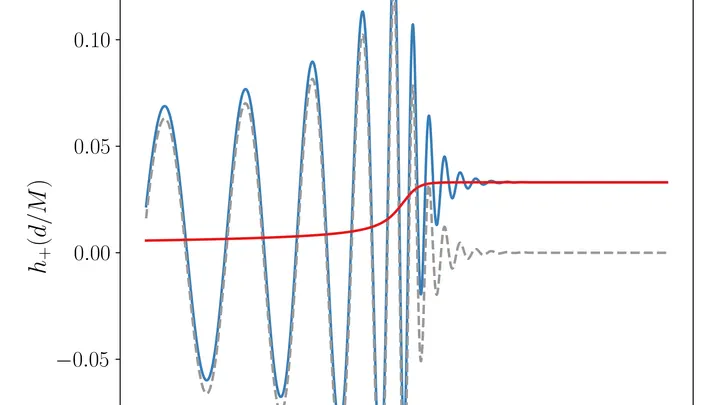
A black hole collision isn't just a burst of gravitational waves; it also leaves a lasting trace: an eternal curvature of spacetime — gravitational memory. Like a boat on water leaves a lingering wake, the cosmos 'remembers' the catastrophe.
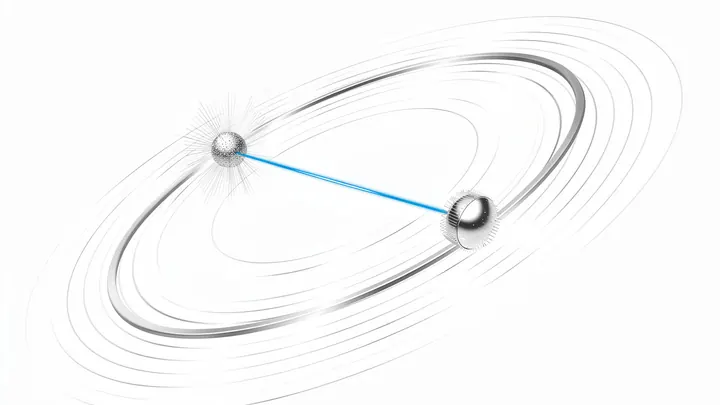
Two heavy balls orbit on the surface of a pond. Ripples spread from them: these are gravitational waves. As the balls spiral closer, the waves carry away energy, and the ripples become more frequent.
The fabric of space bends under weight, like a stretched trampoline. Gravitational waves — ripples spreading from cosmic cataclysms, such as merging black holes. If such a ripple encounters a massive galaxy or invisible dark matter, they act like a magnifying glass: bending and amplifying the signal.
Right after the Big Bang, space rippled with gravitational waves, like those from a thrown stone. These tremors in the very fabric of the cosmos, predicted by Alan Guth, stretched across the entire universe. The ripples slightly compressed primordial matter in some places and thinned it out in others.
The term 'wormhole'—coined for physics by John Archibald Wheeler in 1957—still teases the imagination. It's a hypothetical tunnel through curved spacetime, connecting distant regions of the Universe or even different universes.
When black holes or neutron stars merge, they disturb the very fabric of spacetime, producing gravitational waves — ripples predicted by Einstein in his general theory of relativity.
The trembling of space sounds like an orchestra. Gravitational waves caught by the LIGO and Virgo detectors tell of black hole collisions. Sometimes the music carries off-key notes — tiny deviations from Einstein's score. They might whisper of new physics or simply of dust on the bows.
When two supermassive black holes circle each other before merging, they shake spacetime itself, like a speedboat racing across a lake leaves waves in its wake. These waves are called gravitational waves. They travel through the Universe and pass through everything, even the Earth.
An album with hundreds of family photos holds countless stories. If you look at each picture on its own, you might easily decide that Uncle is a real giant: that day he happened to stand a step higher than everyone else. But flip through the whole album, and it becomes clear — his height is perfectly ordinary; it's just that a step showed up in a couple of frames.
In the headphones used to listen to a distant orchestra, there is an occasional crackle. The crackle can be so loud that it drowns out the music or even blends in with it.
When a planet passes in front of a star, the light pierces its atmosphere and absorbs the flavor of gases. Each gas leaves its color fingerprint in the light — a bitter or sweet stroke. Scientists try to read this recipe: what substances and in what proportions are mixed in the air of an alien world.
The universe wasn't born in silence. Primordial gravitational waves — ripples in spacetime — still carry the echo of that event. Scientists try to hear it in two ways. Low 'notes' are captured in the Big Bang's afterglow — light emitted 380,000 years later.
Deep inside a mountain, under layers of rock, lies a germanium crystal the size of a fist. It waits for a rarest of events: an atomic decay that happens once in billions of years. But inside the crystal, something is always ticking — cosmic rays, traces of radioactivity, thermal noise.
Gravitational waves are ripples in space, born, for example, when pairs of supermassive black holes spiral around each other. To catch them, scientists monitor pulsars — dead stars that emit radio pulses with clockwork precision.
The proton is not a smooth ball but a tangle of quarks and gluons in constant motion, exchanging energy. Finding out exactly how energy, pressure, and spin are distributed inside it is impossible to do directly: measurements yield only sparse, noisy points. It's like trying to guess a face from a few blurry photos taken from different angles.
In August 2017, gravitational wave detectors caught a signal from the merger of two neutron stars — the ultra-dense remnants of exploded stars. At that very moment, life on Earth was business as usual: planes were landing, cars were driving, and navigators were plotting routes.