The Radiation Scalpel Gets Sharper express
Radiation therapy is like shooting at a small target with a very large-caliber rifle: even a precise shot hits a large area around it. The thickness of the 'trace'—called the penumbra — is 2–3 millimeters in standard machines. For a tumor in the lung, that's not a big deal, but next to a nerve or a blood vessel, those millimeters decide whether a person stays healthy.
Physicists from the clinic and the university tried an unconventional approach: they lowered the beam energy from 6 to 2.5 megavolts and moved the patient four meters away from the source instead of the usual one. Individually, these steps worsen the beam, but together they produce an unexpected effect — the penumbra shrinks to one millimeter. At the same time, the beam still reaches tumors at a depth of ten centimeters.
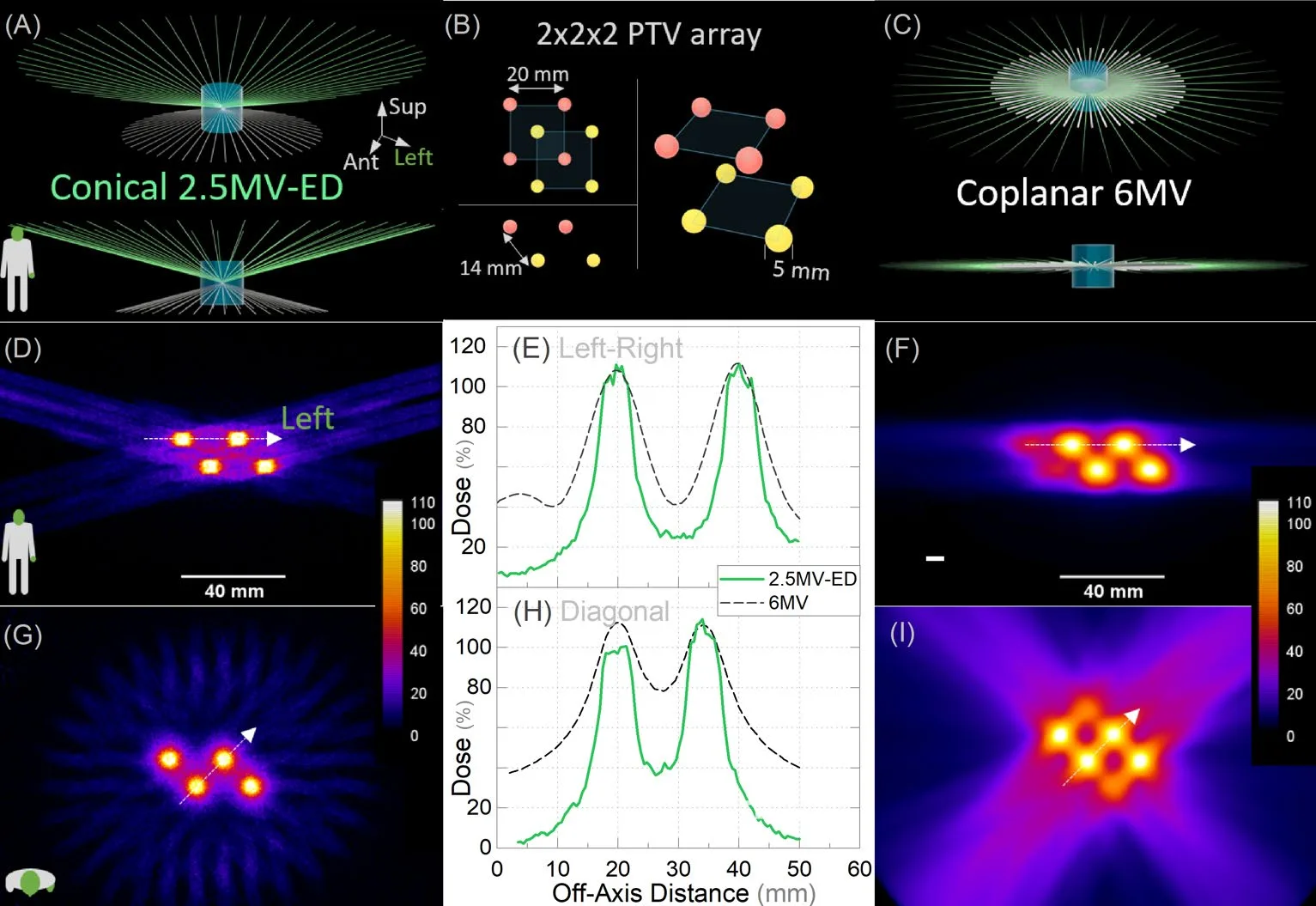
To test the idea, the researchers built a setup where the patient sits upright and the radiation sources are arranged around them in a cone. In a computer model, this scheme gave a 1.7 times more contrast dose distribution than the standard one. In one example, irradiating spheres with a diameter of 5 millimeters inside a tumor, the contrast between 'hot' and 'cold' spots increased from 2.6 to 4.5.
This means a doctor could burn out tiny nodules inside a tumor without touching the healthy tissue between them. For the patient, there is less risk of skin burns and damage to neighboring organs, and for cancer treatment, it's a step toward making the radiation knife a truly surgical instrument.
Original abstract
as written by the authors arXiv:2603.07103
Standard 6 megavolt (MV) radiotherapy is limited by source size and secondary electron range to minimum radiological penumbra widths of ~2-3 mm. This study investigates sharper beams via upright radiotherapy with lower energies and extended source-to-patient distances. A 2.5 MV beam from a clinical linac was delivered at a 4 m source-to-phantom distance (2.5 MV-ED). Lateral profiles and percent depth doses were measured in a solid water phantom with radiochromic film and an ion chamber. These single beam measurements were used to benchmark TOPAS Monte Carlo simulations. The validated 2.5 MV-ED model was then used to simulate upright deliveries with a conical beam geometry. These simulations were compared against equivalent plans generated for standard 6 MV-FFF coplanar deliveries at 1 m from the source. The 2.5 MV-ED single 28x28 mm^2 beam produced a measured 80%-20% penumbra of 1.0 +-0.1 mm, compared to 2.4 mm Jaw-defined penumbra for a standard 6MV-FFF beam. The doses at 10 cm depth were 52% vs. 56%, and the surface doses were 22% vs. 38% for the 2.5MV-ED and standard 6 MV-FFF respectively. Conical geometry Monte-Carlo simulations using the 2.5 MV-ED beams demonstrated significantly sharper composite dose fall-off in all cardinal directions compared to coplanar 6MV-FFF plans. For a spatially fractionated lattice example plan with 5 mm diameter high dose spheres, the 2.5 MV-ED conical approach achieved a peak-to-valley dose ratio of 4.5-5.2, compared to the 2.6-2.9 achievable with a standard 6 MV-FFF clinical system. Low-energy, extended-distance photon beams can provide sharper penumbra and lower surface dose, while maintaining comparable depth-dose penetration as standard 6 MV setups. Combined with upright patient setups, ultra-sharp dose distributions with enhanced treatment conformity, reduced toxicity, and higher-fidelity dose modulation are possible.
The penumbra is the distance over which the dose drops from 80% to 20% of the maximum. For the new beam, it's just one millimeter — thinner than two human hairs stacked together.
In science fiction, ray weapons are often depicted as thin light sabers. The new technology makes that image almost real for medicine: the beam can be sharpened to a millimeter edge.