Soft X-rays are X-rays with relatively low photon energies, typically below a few kiloelectronvolts (keV). Unlike their harder, more energetic cousins, they interact strongly with matter, making them ideal for probing the structure of materials and biological samples at the nanoscale. In astrophysics, soft X-rays are key to studying the hot, tenuous gas in the solar corona, the atmospheres of stars, and the accretion disks around black holes, where temperatures are millions of degrees.
History
The existence of X-rays was discovered by Wilhelm Röntgen in 1895, but the distinction between soft and hard X-rays emerged later as scientists developed sources and detectors capable of probing different energy ranges. The term 'soft X-ray' became common in the mid-20th century with the advent of synchrotron radiation sources.
How it works
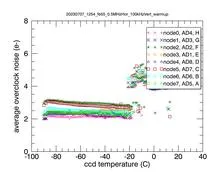
Soft X-rays are produced when high-energy electrons are decelerated or transition between atomic energy levels. Their low energy means they are easily absorbed by air, so experiments must be conducted in vacuum. Detectors, such as CCDs or microchannel plates, capture the photons and convert them into electrical signals, revealing the spatial and spectral distribution of the source.
In practice
Soft X-rays are used in X-ray microscopy to image biological cells without staining, in X-ray astronomy to study the Sun's corona and other cosmic sources, and in lithography for fabricating nanoscale electronic components.
Fun fact
The Sun's corona emits most of its light in soft X-rays, which is why it can be observed from space but not from the ground.
Tuning a string to the right note: the laser pulse is adjusted so that harmonics play in unison at kiloelectronvolt frequencies.
Visible light oscillates at hundreds of trillions of times per second.
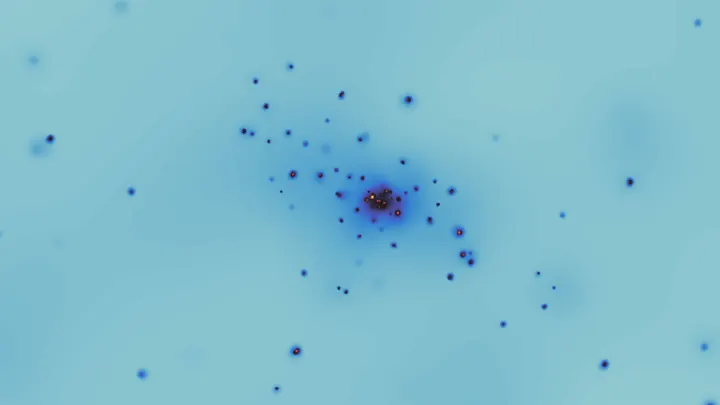
A little monster hides in a dwarf galaxy, and its neighbor feeds it. The satellite galaxy is slowly merging with a massive companion, and gas from the outer regions falls toward the center, where a black hole sits. By cosmic standards, it is not large: only 800 to 5000 solar masses, but its appetite is ferocious.
A globe sits on a table, and a ruler lies beside it: one is curved, the other straight. X-ray telescopes have lived with this mismatch for years. Their mirrors gather light onto a curved surface, like the globe, while the detectors that catch that light have been flat, like the ruler.
The XMM-Newton X-ray telescope stared at galaxy Mrk 1044 for two straight hours. Inside it, a black hole is surrounded by a swirling disk of superheated gas. This gas glows in X-rays, and its light flickers — brighter, then dimmer.
For the first half hour, the flickering of soft and hard X-rays was in step.
In astrophysics, some numbers seem random yet recur with the persistence of a spell. One such number is the ratio of X-ray brightness to H-alpha hydrogen emission in turbulent gas tails. From galactic winds to ‘jellyfish’ slicing through clusters, this ratio steadily holds at around three.
If you shrank an ordinary black hole to the size of a grain of sand, it would shine like a tiny star and quickly vanish in a flash. That's Stephen Hawking's prediction: the event horizon acts like a hot surface emitting particles.
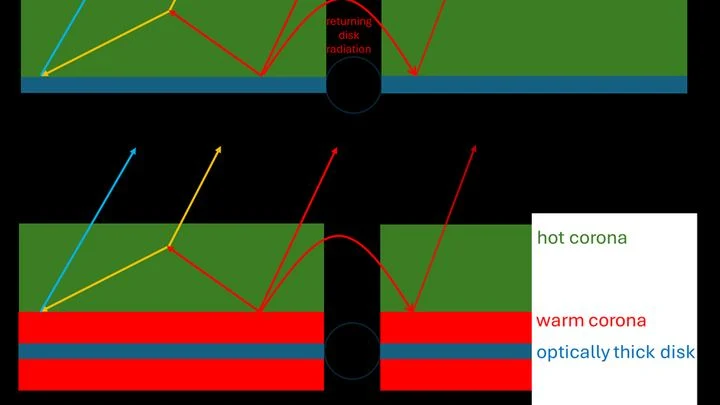
The black hole Cygnus X-1 is one of the most studied in our galaxy. It pairs with a normal star, pulling matter from it. The gas spirals into a glowing disk, like water down a drain, and above the disk hangs a scorching corona — a cloud of electrons at temperatures of hundreds of millions of degrees.
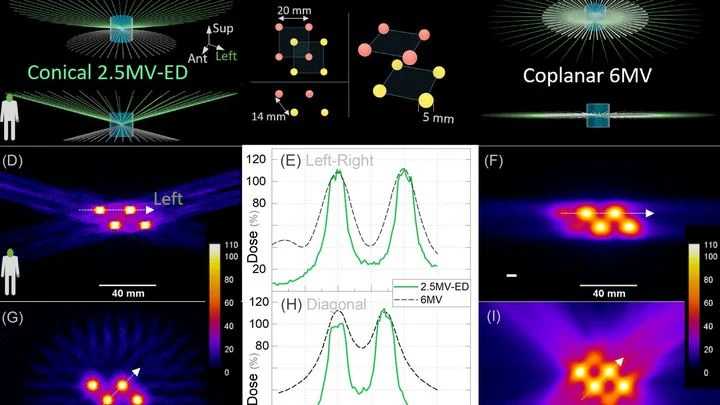
Radiation therapy is like shooting at a small target with a very large-caliber rifle: even a precise shot hits a large area around it. The thickness of the 'trace'—called the penumbra — is 2–3 millimeters in standard machines. For a tumor in the lung, that's not a big deal, but next to a nerve or a blood vessel, those millimeters decide whether a person stays healthy.
An electron beam can be compared to the light from a laser pointer: if it diverges, the spot on the wall quickly spreads out. In the lab, physicists created such a narrow beam that it remained thin over a long distance, like the beam of a good pointer.
The solar corona, the Sun's outer atmosphere, stretches millions of kilometers, yet it's visible only during a total eclipse or with specialized instruments. Typically, we gauge the corona's density by how it scatters white light, but that method relies on simplifications that can skew the results.
The night sky is full of beacons, but some shine in a way that makes them nearly invisible. Astronomers have discovered a new class of objects: ultrasoft X-ray sources. They are so "cool" by X-ray standards that their emission falls at the boundary between ultraviolet and soft X-rays, where ordinary telescopes are almost blind.
Astronomers observed seven times how a black hole tears apart a passing star. They measured the flares with high precision in X-rays and noticed: the more energetic radiation always outpaced the soft by 500 seconds. It's like a sound echo in the mountains — first you hear the direct shout, then its reflection off a cliff.
The ARCADE2 radiometer on a high-altitude balloon detected an excess radio emission, while the ground-based EDGES experiment found an anomalously deep trough in the hydrogen spectrum at 21 cm. Both signals do not fit the standard cosmological model and point to an unknown source of soft photons.