An ultraviolet (UV) laser is a laser that emits light in the ultraviolet spectrum, typically with wavelengths between 10 nm and 400 nm. Because UV light has a shorter wavelength than visible light, it carries more energy per photon, allowing it to interact more strongly with matter. This makes UV lasers exceptionally effective for precision cutting, drilling, and micromachining of materials that are difficult to process with longer-wavelength lasers, such as polymers, ceramics, and certain metals. The high photon energy can break chemical bonds directly, a process known as photochemical ablation, which results in cleaner cuts with minimal thermal damage to the surrounding material.
History
The first UV laser was demonstrated in the 1970s with the development of the excimer laser, which was initially explored for nuclear fusion research. Its potential for material processing was recognized soon after, and by the 1980s, excimer lasers were being used in semiconductorlithography.
How it works
UV lasers operate on the same fundamental principles as other lasers: a gain medium is excited to produce a population inversion, and stimulated emission amplifieslight within an optical cavity. However, the gain media for UV lasers are often different, such as excimer gases (e.g., argon fluoride or krypton fluoride) or frequency-converted solid-state crystals. Excimer lasers produce UV light directly through transitions in excited dimers, while solid-state lasers (like Nd:YAG) can generate UV by passing their infrared output through nonlinear crystals that double or triple the frequency, effectively shortening the wavelength. The focused UV beam is then absorbed by the material's surface, where its high photon energy either vaporizes or chemically breaks down the material, leaving a precise edge.
In practice
UV lasers are widely used in semiconductor manufacturing for photolithography, in eye surgery (LASIK) for precise corneal reshaping, and in industrial cutting of materials like plastics and thin metals where minimal heat-affected zones are critical.
Fun fact
UV lasers can cut through materials as thin as a few micrometers without melting the edges, which is why they are used to manufacture the tiny holes in baby bottle nipples and the intricate patterns in smartphone screens.
A gas target is like a funnel: the steeper its walls, the stronger the flow. But in this funnel, it is not water that flows, but ultraviolet light, born when a powerful laser pulse passes through a cloud of argon. The efficiency of this conversion is usually minuscule, about 0.001%: out of a thousand laser photons, only one turns into useful ultraviolet.
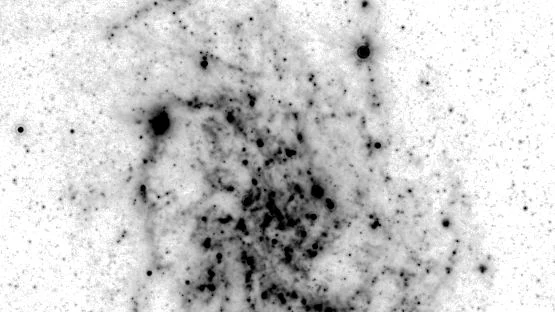
The night forest is full of fireflies, but before, we only saw those that happened to be in the beam of a flashlight. That was the case with ultraluminous X-ray sources: points in other galaxies that shine in X-rays more brightly than a stellar-mass black hole can steadily emit. Telescopes looked at galaxies chosen for other purposes, missing most of the fireflies.
Light that never reaches the camera still leaves its mark on it. That's how the new imaging method works: you illuminate the object with one color, and the picture is assembled from another. Inside the crystal, light waves mix, and information about the invisible transfers to a visible beam.
In the experiment, they used a silver thiogallate crystal.
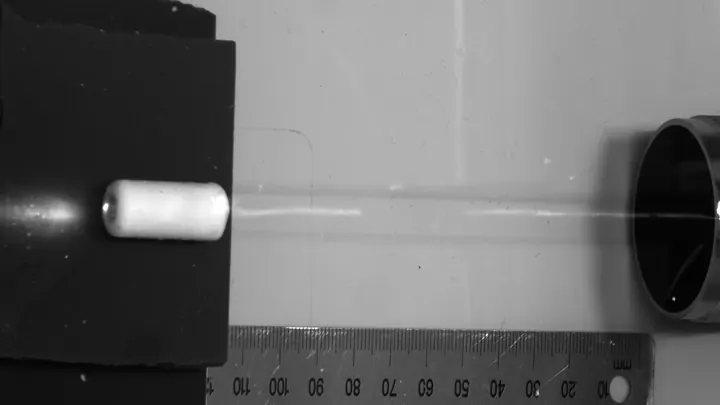
An ordinary flashlight shines in all directions, and after just a couple of dozen meters its beam fades so much it barely lights a wall. The atmosphere scatters light, and wind and heat currents distort it even more. But if you lay an invisible pipe for light right in the air, the beam will travel through it like water through a hose.
The galaxy is not a smooth lake but a pond with ripples. These ripples are created by ultralight dark matter (particles billions of billions of times lighter than an electron).
Within a field of view the size of a grain of sand held up to the eye, hundreds of galaxies lie hidden, smeared into arcs by the massive cluster Abell S1063.
A pendulum that almost nothing can knock off balance (not shaking, not heat, not magnetic fields) because it is hidden in the very heart of the atom. That is the kind of pendulum physicists used when they first switched on a nuclear clock. Previously, the best clocks, optical ones, relied on electron transitions.
In 1963, Maarten Schmidt unraveled the nature of quasars — distant active nuclei outshining entire galaxies. Since then, we've learned that at their hearts lurk supermassive black holes, converting infalling matter into blinding light.
Dark matter is an invisible substance that reveals itself only through gravitational effects: it bends the light of distant galaxies, much like an unseen window that alters the path of light rays.
Listening to the cosmos requires patience and a finely tuned ear. Astronomers chose the most sensitive low-frequency instrument for this: the OVRO–LWA antenna array — 352 dipole antennas scattered across two and a half kilometers of California desert.
When the James Webb Space Telescope turned its gaze deep into time, astronomers expected to see familiar galaxies. Instead, the images were dotted with a scattering of bright, incredibly compact red dots.
A spotlight shines ever brighter, but at some limit the bulb suddenly burns out, and no more light comes through. Astrophysicists have seen something similar in the distant blazar Markarian 421. This is an active galaxy whose jet of superheated plasma points almost straight at Earth, like the beam of a cosmic lighthouse.
The ionosphere at an altitude of 70 kilometers acts like a giant mirror for radio waves. Ground antennas constantly beam signals into it and listen for the reflection. When a solar flare occurs on the Sun, a stream of X-rays reaches Earth in 8 minutes and compresses the lower layer of the ionosphere.
Frozen cake batter is dotted with tiny raisins. If the batter is uniform, all the raisins will puff up evenly, and the cake will be smooth. But if the batter has denser spots (some sweeter, some more bland) the raisins will be distributed unevenly: dense in some places, sparse in others.
The universe is permeated by an invisible substance, dark matter, whose gravitational influence is obvious, but whose composition remains a mystery. One hypothesis suggests it consists of ultralight particles so light that they exhibit wave-like behavior, forming a kind of cosmic ripple.
A pendulum swings with such precision that, had it been counting seconds since the Big Bang, it would have drifted by only half a second by today. That is the stability of the new portable ultraviolet laser — the heart of aluminum atomic clocks.
An ordinary laser emits narrow lines, like a string that sounds only one note. For spectroscopy, this is inconvenient: if a substance absorbs light between the lines, you might miss it.
A conventional laser is like an orchestra where musicians must warm up before playing in unison. You first need to pump enough atoms with energy so they 'flip' and are ready to emit light: this is called population inversion. Only then does the beam flash. A polariton laser plays by different rules: its 'musicians'—a mix of light and matter — join in almost without preparation.
A laser beam as faint as a whisper of light has stirred a thorium-229 nucleus into a higher energy state. Most nuclei demand a blast of energy, but thorium-229 has such a tiny energy gap that even this gentle nudge works.
A distant quasar appears as four points of light arranged in a cross. This is how the gravity of a galaxy lying along our line of sight distorts the view: it acts like imperfect glass, multiplying the image. Each point is the same object, but its light travels different paths.
A sheet of graphene is a mesh of carbon atoms one atom thick. Even the slightest contamination shows up on it, like dust specks on eyeglass lenses. Ten years ago, researchers learned to hide graphene between layers of boron nitride, like placing a fragile sheet between two pieces of plastic wrap.
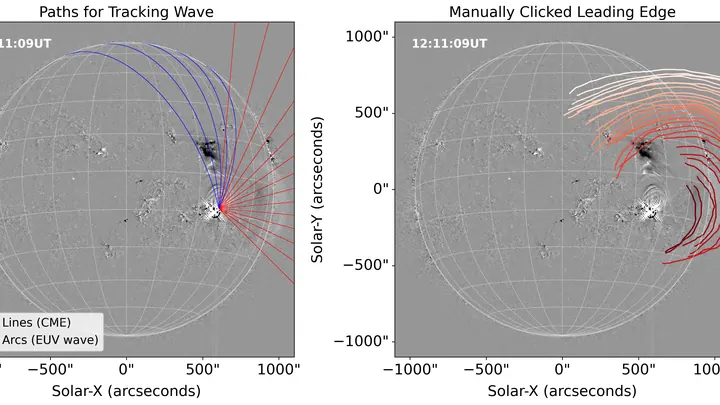
A shock wave in the Sun's corona is like the sonic boom from an airplane, except instead of air there is scorching plasma, and instead of sound there is a jump in density and magnetic field. On March 10, 2024, such a wave swept across the western part of the solar disk.
A tiny laser beam touches a crystal for an instant, and inside, as if by magic, single quantum sparkles light up. This is no trick but a new way to create qubits, the working cells of future quantum computers. The material is silicon carbide, the same one already used in power electronics and LEDs.
Light from distant stars, as it travels through cosmic dust, loses some of its energy. Dust grains absorb and scatter light, and the way they do so at different wavelengths reveals their composition and size. Astronomers call this the dust extinction curve.
A green flashlight beam dives into a pool and reaches the bottom with barely any loss. Water is transparent to green light, which is why it's used for underwater communication. But to send video or sensor data, the light needs to be switched on and off very quickly — billions of times per second. Ordinary lasers are too slow and unstable for this.
A giant cosmic funnel sucks in gas from its surroundings. But not all of that gas falls in — some is spat back out, like splashes from boiling water. That's exactly what the ultraluminous X-ray source NGC 5204 X-1 does: a compact object (likely a black hole) feeds so voraciously that the excess escapes in powerful jets.
Ordinary white light is a jumble of all colors at once, like the noise of a crowd where everyone speaks at their own frequency. But scientists need light where frequencies are aligned with ruler-like precision, like piano keys, where each note sounds distinct and exact.
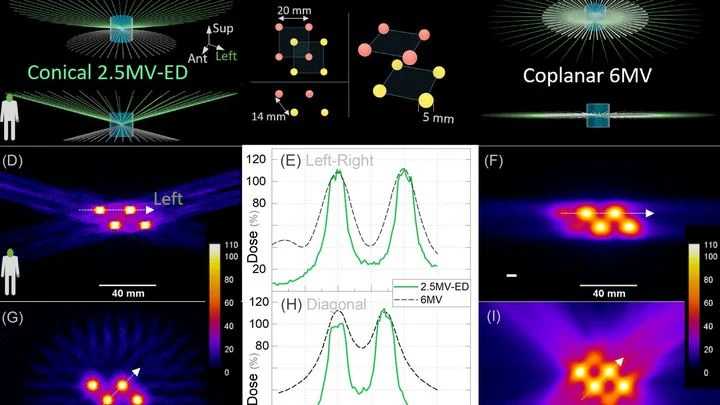
Radiation therapy is like shooting at a small target with a very large-caliber rifle: even a precise shot hits a large area around it. The thickness of the 'trace'—called the penumbra — is 2–3 millimeters in standard machines. For a tumor in the lung, that's not a big deal, but next to a nerve or a blood vessel, those millimeters decide whether a person stays healthy.
Gravitational waves are ripples in the fabric of spacetime, spreading from sources like circles on water from a thrown stone. When a wave passes a galaxy, its path bends, like water ripples meeting an underwater boulder.
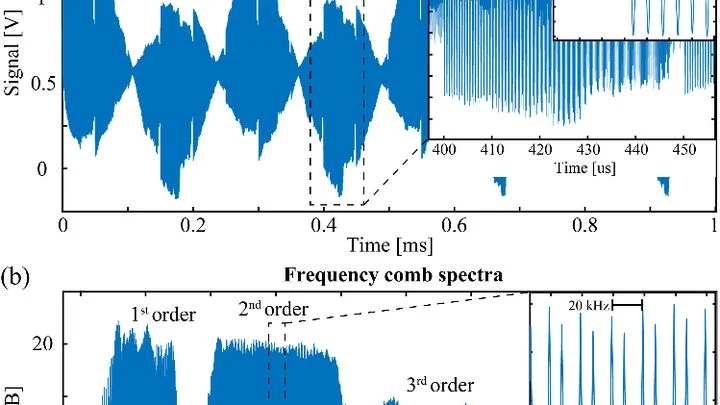
An ordinary comb parts hair into even strands. A laser 'comb' does the same to light: it emits not one color but thousands, spaced at exactly equal frequency steps. Such a tool has already helped measure time to billionths of a second and peer inside atoms.
An electron beam can be compared to the light from a laser pointer: if it diverges, the spot on the wall quickly spreads out. In the lab, physicists created such a narrow beam that it remained thin over a long distance, like the beam of a good pointer.
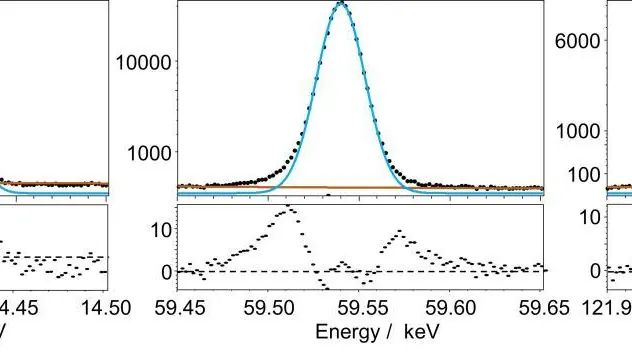
Gamma rays are the most energetic flashes of light born deep within atoms. Their energies are like fingerprints: each radioactive element has its own pattern. But measuring that pattern with high precision is like weighing a grain of sand on a scale sitting on a vibrating truck.
The new setup works like an ultra-sensitive thermometer.
A laser beam usually quivers slightly, like a plucked string. In optical clocks, that quiver turns into timing errors. Engineers swapped the shaky light for steady light, and rubidium vapor clocks started ticking five times more evenly.
Hidden in the nucleus of a gold atom lies a potential future cancer treatment. When a gold target is struck by a gamma ray with an energy of about 30 megaelectronvolts, one of the nuclei loses a proton and a neutron, transforming into a rare platinum isotope — platinum-195m.
A laser beam passes through glass and touches a thin diamond film. At the point of contact, the film turns into a narrow strip that lifts slightly. We place a second strip next to it, and between them remains an empty corridor. That's the channel: its width can be fifty times its height, like a sheet of paper lying on a table.
Ultraviolet light with a wavelength of about 300 nanometers is invisible to the eye, but it can destroy the DNA of microbes, make certain substances glow, and carry information. Until now, lasers in this range were bulky, expensive, or short-lived.
In a particle accelerator, electrons race around a ring at nearly the speed of light. When such an electron collides with a photon, a particle of light, the photon bounces off like a ball hitting a moving truck and flies away with much greater energy.
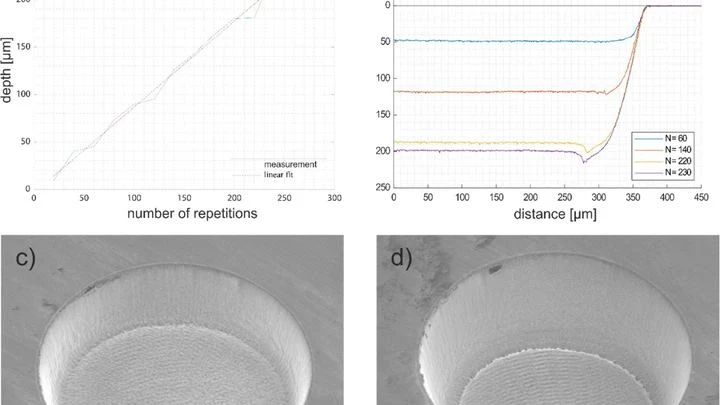
A tiny motor bends with electricity and stretches an invisible spring. Such motors, piezoelectric actuators, are needed to stretch or squeeze quantum dots, making them emit pairs of entangled photons. Previously, they were made using complex methods, but now everything can be cut out with a single laser.
Vanadium oxide is a material that can act as an insulator, not conducting electricity, or as a conductor, like a metal. The switch takes trillionths of a second, and that's what makes it a candidate for ultrafast electronic devices.
But exactly how it happens has long been a mystery.
Light is a great tool for studying tissues, but it fades fast deep inside the body. Within a few millimeters, photons scatter so much that you can't make out anything. Scientists came up with a workaround: instead of shining light from outside, deliver a tiny light source right inside. The challenge is how to power that source without wires.