Proton therapy is a form of radiation therapy that uses a beam of protons to deliver precise doses of radiation to tumors, minimizing damage to surrounding healthy tissue. Unlike conventional X-ray radiation, which deposits energy along its entire path through the body, protons deposit most of their energy at a specific depth — the Bragg peak — allowing clinicians to target a tumor with high precision while sparing organs and tissues beyond it. This makes proton therapy especially valuable for treating tumors near critical structures, such as the brain, spinal cord, or eyes, and for pediatric patients, where reducing radiation exposure to healthy tissue is crucial for long-term health.
History
The concept of proton therapy was first proposed by Robert R. Wilson in 1946, and the first treatments were performed at the Lawrence Berkeley National Laboratory in the 1950s. Early research was largely experimental, but clinical use expanded significantly in the 1990s with the advent of hospital-based facilities.
How it works
Protons are accelerated to high speeds in a cyclotron or synchrotron, then directed through a beamline to the patient. The beam is shaped and modulated to match the tumor's depth and contour. As protons travel through tissue, they lose energy gradually, but the rate of energy loss increases sharply near the end of their range, creating the Bragg peak. By adjusting the beam energy and using scanning magnets, clinicians can paint the tumor volume with the dose, layer by layer. The sharp fall-off of the dose beyond the tumor is what protects healthy tissues.
In practice
Proton therapy is used in cancer treatment centers worldwide, particularly for tumors of the brain, head and neck, prostate, lung, and pediatric cancers. It is also an active area of research, with ongoing studies on combining it with other therapies and improving imaging techniques.
Fun fact
Proton therapy can deliver a radiation dose with such precision that the dose can be 'painted' onto a tumor in three dimensions, layer by layer, like a 3D printer.
Two different orchestras play the same score of damage, but they have different conductors: one brakes before division, the other before DNA replication. Oral cancer and breast cancer receive the same neutron strike, yet respond as if following different conductors.
A sponge slowly watered from a watering can gets soaked all the way through. But if you dump the same bucket of water on it all at once, the middle gets wet while the edges stay almost dry. That's roughly how a material with nonlinear absorption behaves: the more intense the flux, the more it gets stuck at the point of impact.
A proton beam aimed at a tumor cuts through soft tissue like a knife through butter, but its range depends on the subtle properties of water, the stuff we're mostly made of. Water is the body's main component, and how quickly protons slow down in it determines exactly where they deposit their energy.
A fusion reactor is like a super-hot furnace where plasma reaches millions of degrees. The walls are made of tungsten, the most refractory metal there is. But even tungsten needs protection: fast particles from the plasma bombard the surface and knock atoms loose. These ejected atoms enter the plasma and cool it down, like a spoonful of cold milk in hot tea.
The proton beam is like a sniper's bullet: it delivers most of its energy at a precisely set point, barely touching tissues on the way in. But over 4–6 weeks of head and neck tumor treatment, the target shifts: the patient loses weight, the tumor shrinks, posture changes. The sniper aimed at one spot, but the target has already moved.
In boron neutron capture therapy (BNCT), the patient receives an injection of the isotope boron-10, which selectively accumulates in tumor cells. The tumor area is then irradiated with a beam of thermal neutrons.
When you need to see inside the brain, you usually lie in a tight tube of an MRI scanner or get zapped with X-rays. Both methods are costly, bulky, and not always available.
Standard proton therapy is like a precise but light projectile: it hits the tumor dead-on, but it doesn't always pack enough punch. The reason is that protons have a low "killing power" (biological effectiveness), and some tumors manage to repair the DNA damage they inflict.
Researchers have found a way to amplify the blow without changing the beam itself.
Tiny magnets inside atoms, nuclear spins, can 'freeze' for long minutes in a cold crystal. This hinders the quick tuning of quantum sensors: everything takes too long to reach the desired state. Physicists have found a way to nudge them with light.
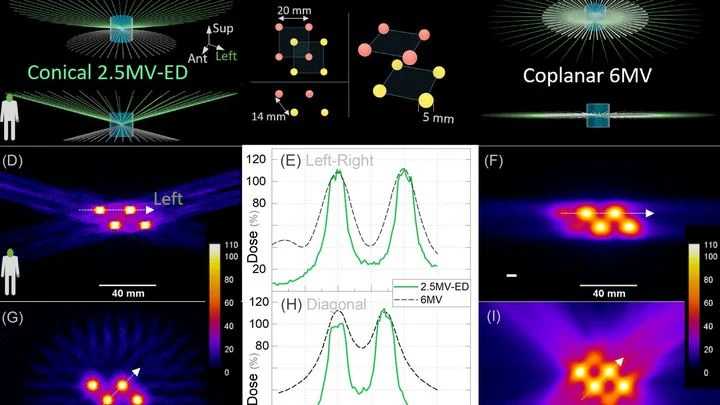
A garden hose shoots a thin, powerful jet. If you sweep it across the yard, you can water the whole bed without flooding the path. That's roughly how the new approach to treating deep tumors works: instead of a broad radiation field, you take a narrow beam of electrons accelerated to nearly the speed of light and scan it across the tumor like a jet of water.
When a carbon ion beam enters the body, it doesn't release energy all at once but rather at the end of its path, like a runner who gives their all on the final stretch. Doctors need to know this finish point to avoid damaging healthy tissue. But how can you look inside the body without making an incision?
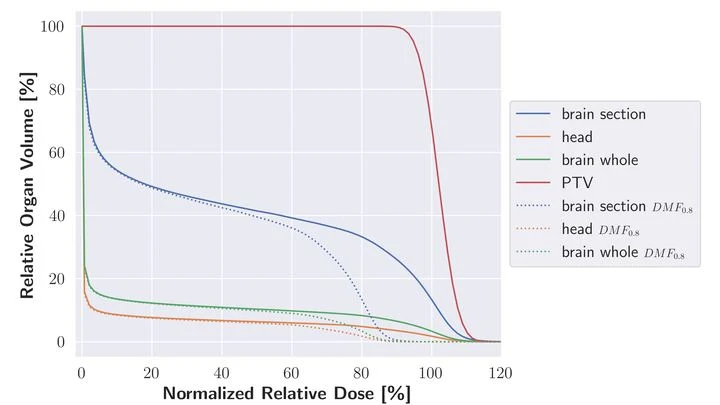
When a person's brain tumor is irradiated, some of the energy also hits healthy cells. A few months later, MRI scans of some patients show bright spots — places where tissue has changed due to radiation. Doctors call them "radiation-induced contrast enhancements." These spots aren't always dangerous, but they show where the brain took the hardest hit.
The radioactive isotope terbium-149 acts like a tiny homing bomb: it latches onto cancer cells and detonates with alpha particles that destroy the tumor from within, barely touching healthy tissue. But this bomb has a quirk: it also glows with positrons, and that glow can be captured by a special camera.
A beam of carbon ions strikes the tumor precisely, like a surgeon who can only see the skin. Inside the body, the beam stops, and exactly where used to be a mystery. Now, helium is mixed into the same beam: it passes through the body like an X-ray, and its trail shows where the carbon went.
Radiation therapy is like shooting at a small target with a very large-caliber rifle: even a precise shot hits a large area around it. The thickness of the 'trace'—called the penumbra — is 2–3 millimeters in standard machines. For a tumor in the lung, that's not a big deal, but next to a nerve or a blood vessel, those millimeters decide whether a person stays healthy.
A beam of light passing through a transparent plate usually keeps its color. But if you stack the plate from thin alternating layers, it becomes a grating that reflects and transmits waves selectively. This has long been used in lasers and optical filters. Now such gratings have been made to vibrate, and light started changing color.
A lightning bolt strikes an anthill. Some ants die instantly, some freeze, and a few days later the survivors start rebuilding the tunnels. That's roughly how a tumor behaves after electroporation — a method where short electric pulses are passed through tissue to poke holes in cancer cell membranes and kill them.
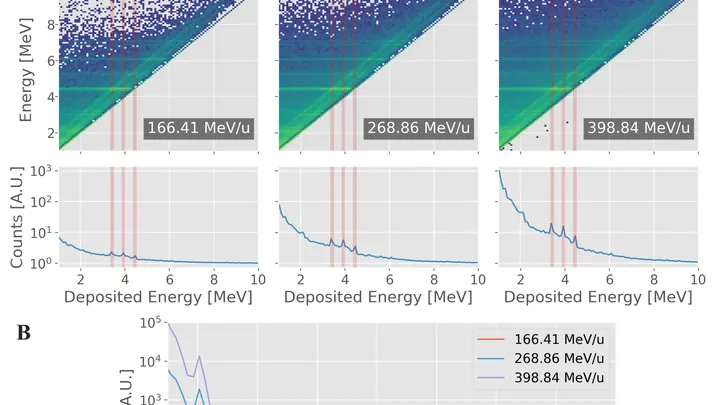
When a proton beam enters a patient's body, it slows down and generates a stream of neutrons, like a pebble thrown into water scattering droplets. Doctors use these neutrons to check at what depth the protons stopped, ensuring the irradiation hits the tumor precisely and spares healthy tissue.
Treating cancer with a proton beam is a bit like archery: you need to hit the bull's-eye without hitting anything else. Protons release their energy at the end of their path, so healthy tissues are largely spared. But to make the shot safe, every treatment plan is checked in advance — measuring the dose the tumor will get and what the surrounding organs will receive.
After a mastectomy, a woman often gets an implant, and then the chest is irradiated to kill any remaining cancer cells. Proton therapy is great because it hits the target precisely and spares the heart and lungs. But in some patients, a dense scar capsule forms around the implant: it squeezes the implant, making the breast hard and painful. This is called capsular contracture.
Igniting a miniature sun is a long-held dream of humanity. Typically, scientists try to confine scorching plasma (a gas of charged particles) at temperatures of hundreds of millions of degrees. But plasma tends to escape magnetic traps, and confinement comes at enormous cost.
Glioblastoma, a brain tumor, is a tricky foe: in some patients, the drug temozolomide works, while in others it barely helps. The difference often lies in a small stretch of DNA — the MGMT gene. If this region is chemically switched off (methylated), the tumor is worse at repairing its cells, and the drug hits harder.
Primary human cells, taken straight from the body, are the most honest material for studying diseases and testing drugs. But getting foreign genetic material into them is tricky: cells don't like intruders. Standard methods either damage the cell or work unevenly, especially when the sample is heterogeneous — which it almost always is.
The new platform tackles this with a vortex flow.
Every cell is a miniature tuning fork. A sharp magnetic pulse makes it 'ring', and the decay of that sound depends on what's inside: viscosity, density, composition. A tiny diamond with a structural defect acts like a hypersensitive microphone, picking up magnetic echoes from individual cells.
Four cesium atoms hang in vacuum, held by laser tweezers like beads on an invisible thread. Around them is a ring resonator, a closed loop of mirrors where light circulates without obstacles. When a probe beam strikes this tiny chain, something strange happens: the atoms scatter light not uniformly in all directions, but predominantly in one direction.