How the Brain Packs a Picture express
Neurons in the brain and nodes in artificial neural networks don't just fire with simple yes/no signals; they also handle smoothly varying quantities, like where an object is and how big it is. But neural responses are finicky: the same stimulus triggers slightly different bursts of activity each time. How does precise information get extracted from this jumble?
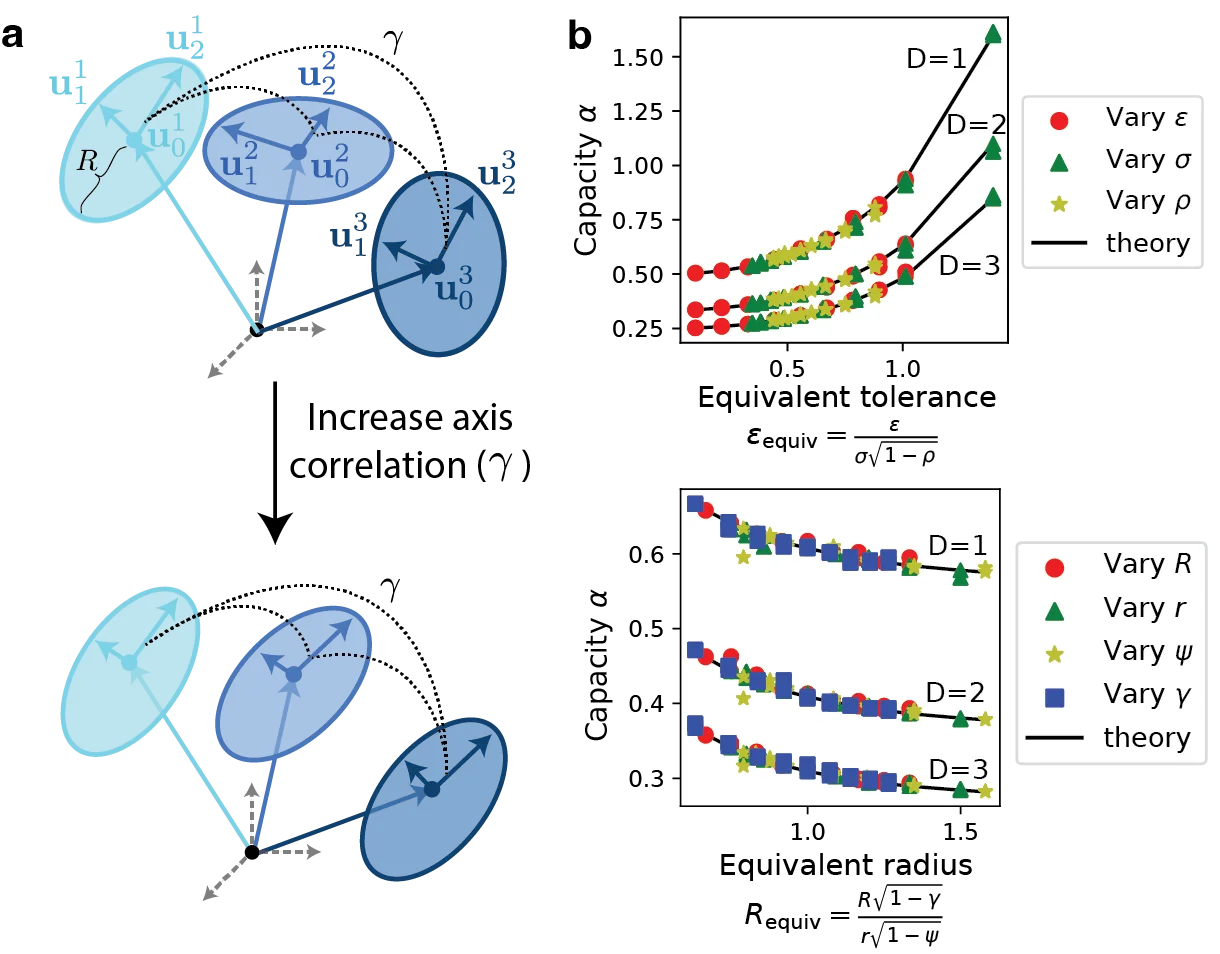
The activity of a group of neurons is like a drawing in the sand. The wind (that is, noise) constantly blurs the lines. The task is to guess from the blurred picture what was drawn: where the object stood and how large it was. The authors developed a mathematical framework that estimates how well this can be done, based on how the 'drawings' for different positions and sizes are arranged relative to one another. The farther apart and more clearly separated these patterns are, the more reliable the decoding.
The theory was applied to real recordings of neural activity from a macaque's visual cortex. It turned out that as the signal moves from primary visual areas to higher ones, the ability to decode an object's position and size grows. The brain seems to gradually 'untangle' the information, making it more accessible for reading out.
The result is a bridge between raw neural activity and behavior: the geometry of neural responses is directly linked to how accurately the brain can report what it sees.
Macaques have a visual cortex similar to humans, so these experiments help us understand how we ourselves judge the position and size of objects.