Quantum Arrows for DNA: A New Speed Record express
DNA is a long carbon necklace made of four types of beads. Biologists often need to compare two strands to find differences. Normally this requires a lengthy brute-force search. Researchers came up with a clever trick: encode each bead as an arrow that rotates based on its neighbors. The idea came from language models, where words also 'know' context.
The RotorMap method, using lightning-fast computation on GPUs, outperforms standard tools by 50–700 times. For quantum computers, a version was created where arrow directions determine particle states. The algorithm was tested on Quantinuum quantum machines, reading data via spectroscopy — analysis of emitted radiation.
Original abstract
as written by the authors arXiv:2603.22245
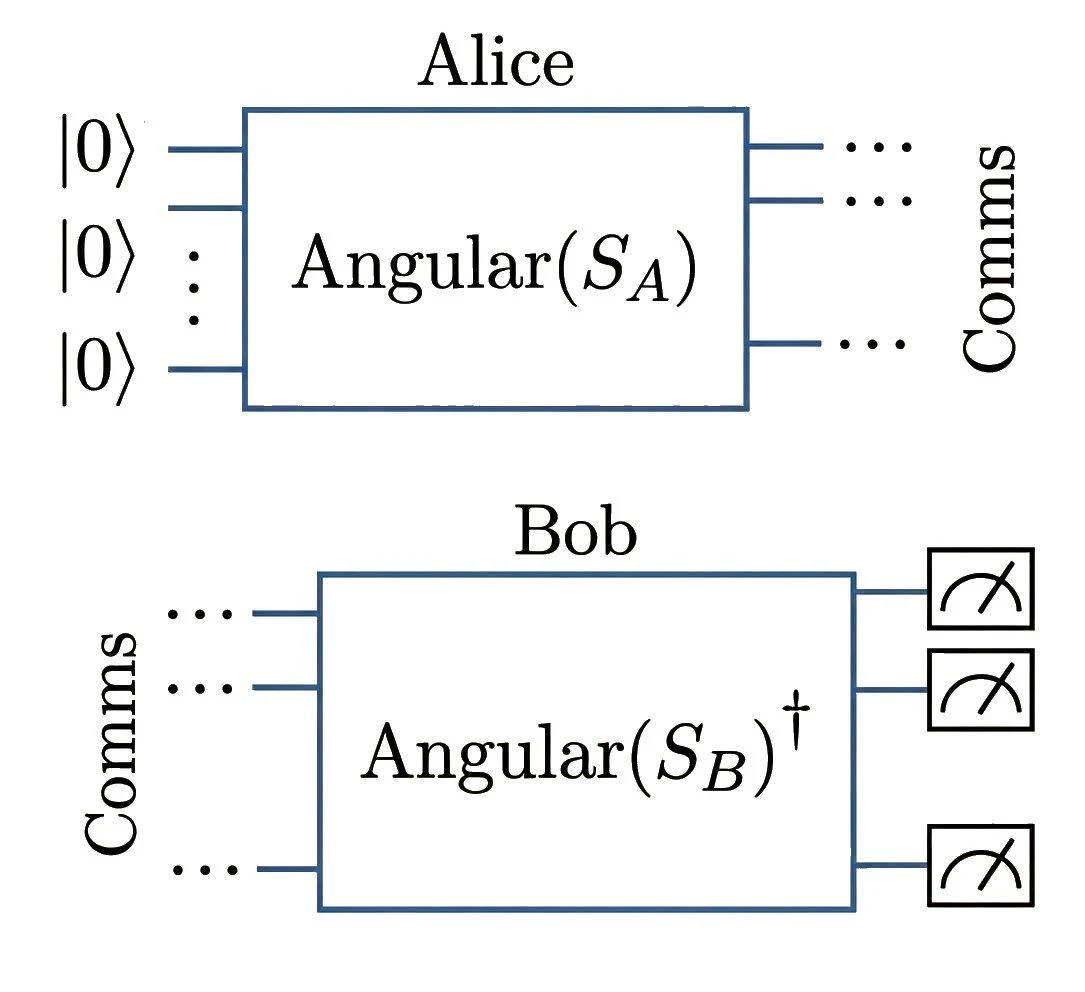
For strings of letters from a small alphabet, such as DNA sequences, we present a quantum encoding that empirically provides a strong correlation between the Levenshtein edit distance and the fidelity between quantum states defined by the encodings. It is based on the principles of Rotary Position Embeddings (RoPE), employed in modern large language models. Classically, this encoding yields RotorMap - a GPU-accelerated DNA mapping algorithm that achieves speedups of 50-700x over single-thread Minimap2 in proof-of-concept tests on human and maize genomes. For use on quantum devices, we introduce the Angular encoding, which is built from RoPE and directly outputs state preparation circuits. To verify its properties and utility on NISQ devices, we report results of experiments conducted on quantum computers from Quantinuum: the 56-qubit H2-1, H2-2 and the latest 98-qubit Helios-1. As a potential application, we consider a quantum DNA authentication problem and conjecture that a quantum advantage in one-way communication complexity could be achieved over any comparable classical solution.
The human genome is 3 billion letters. Comparing two genomes used to take hours, now it takes seconds.
Quantum DNA signatures resemble technology from 'Gattaca', but with protection that can't be hacked.