From Brain Scans to Brain Function express
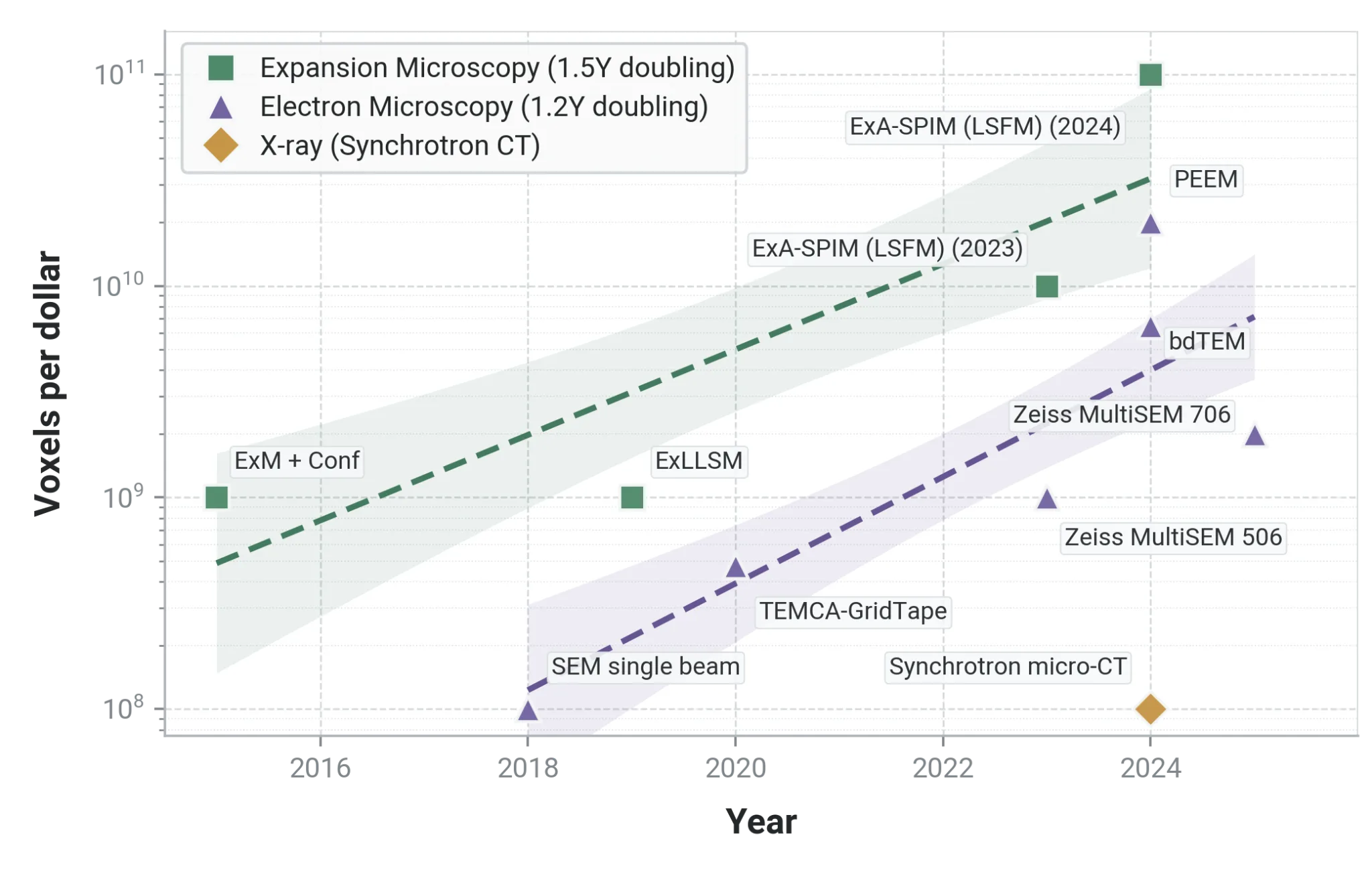
Modern microscopes see the brain in exquisite detail: not just the synapses themselves, the contact points between neurons, but also the molecules they are made of. Such images are becoming more common and cheaper to produce. But there's a catch: a pretty picture doesn't tell you how quickly a cell transmits a signal or how strongly one neuron influences another.
The authors propose building a "translator"—a program that takes a molecularly labeled image and outputs a set of numbers describing how the neuron works: synaptic strength, channel conductance. They call this translator a compiler: just as a program turns code into an executable file, this tool turns structure into dynamics.
Then biological simulations become more accurate: instead of hand-tuning parameters, researchers can load real connectivity maps and run the model right away. This is a step from simply describing "what is connected to what" to predicting "how this network will think."
It all started with pretty pictures. Now they promise to become a working tool, like a blueprint from which you assemble a functioning mechanism.
Original abstract
as written by the authors arXiv:2603.25713
High-resolution brain imaging can now capture not just synapse locations but their molecular composition, with the cost of such mapping falling exponentially. Yet such ultrastructural data has so far told us little about local neuronal physiology - specifically, the parameters (e.g., synaptic efficacies, local conductances) that govern neural dynamics. We propose to translate molecularly annotated ultrastructure into physiology, introducing the concept of an ultrastructure-to-dynamics compiler: a learned mapping from molecularly annotated ultrastructure to simulator-ready, uncertainty-aware physiological parameters. The requirement is paired training data, with jointly acquired ultrastructure from imaging, and dynamical responses to perturbations from physiological experiments. With this data we can train models that predict local physiology directly from structure. Such a compiler would support biophysical simulations by turning anatomical maps into models of circuit dynamics, shifting structure-to-function from a descriptive program to a predictive one and opening routes to understanding neural computation and forecasting intervention effects.
The cost of mapping synapses is falling so fast that soon a detailed map of a brain region will cost no more than a routine lab test.