Data processing is the computational transformation of raw information into a structured, meaningful form. It sits at the heart of nearly every modern scientific discovery, from decoding neural signals in the brain to simulating chemical reactions in a test tube. The concept is broad: it includes cleaning noisy measurements, compressing large datasets, extracting patterns, and converting signals into images or decisions. In physics, data processing is what turns a stream of sensor readings into a map of the body, a spectrum of a star, or a prediction about a material's behavior.
History
The term gained prominence with the advent of electronic computers in the mid-20th century, though the concept of systematic data handling dates back to earlier tabulating machines. No single inventor; it evolved with computing pioneers like John von Neumann and Alan Turing.
How it works
At its core, data processing involves a pipeline: raw data is first digitized and cleaned (removing noise or artifacts), then transformed via algorithms (such as Fourier transforms, filtering, or machine learning models), and finally interpreted. The specific operations depend on the data type—time series, images, or text—but the goal is always to reduce complexity while preserving the essential signal. Modern processing often uses parallel computing and specialized hardware to handle massive volumes in real time.
In practice
Used everywhere: from medical imaging (reconstructing MRI scans) to particle physics (filtering collision events at the LHC) and climate modeling (assimilating satellite data).
Fun fact
The first 'data processors' were human computers—people, often women, who manually calculated ballistic tables during World War II.
Quantum computers make mistakes. Each qubit is like a ball balanced on the tip of a pencil: a slight tremor in the hand and it rolls off. To keep the balls from falling, you need someone to notice the wobble and correct it in time.
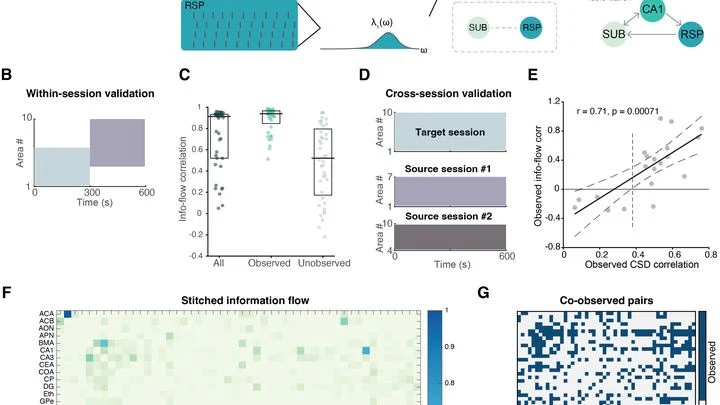
The brain doesn't just react to the world: it's constantly guessing what will happen next. This principle is called predictive coding: neurons compare expectations with reality and update their internal picture when an error occurs. But how such a complex system could be wired into the living tissue of the cortex remained unclear.
A patchwork quilt where each patch is a recording of activity from a small brain region. One patch was stitched on Monday in London, another on Tuesday in New York, and a third a month ago in Tokyo. This mosaic covers the brain only partially, and there is no common seam to join them.
An orchestra plays without a conductor, and you hear the tempo speeding up and slowing down. All you have is a recording of the sound, not the score. Can you tell from that recording which string to pluck to make the whole orchestra play more steadily?
Molecules float in a test tube. Their abundance (say, the concentration of some protein) becomes the input signal. And the output isn't just a cloudy solution but a clear yes-or-no answer.
The authors build a chemical cascade that does exactly that.
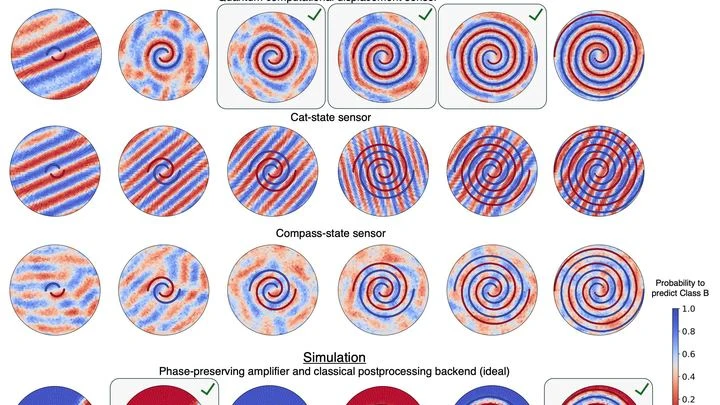
A judge walks into the courtroom but doesn't look at the evidence: he immediately delivers the verdict. That's how the new quantum sensor works: it doesn't measure the signal but directly decides which class it belongs to.
In conventional quantum sensing, it's all like a detective story: first you gather clues (measure the signal), then you analyze them.
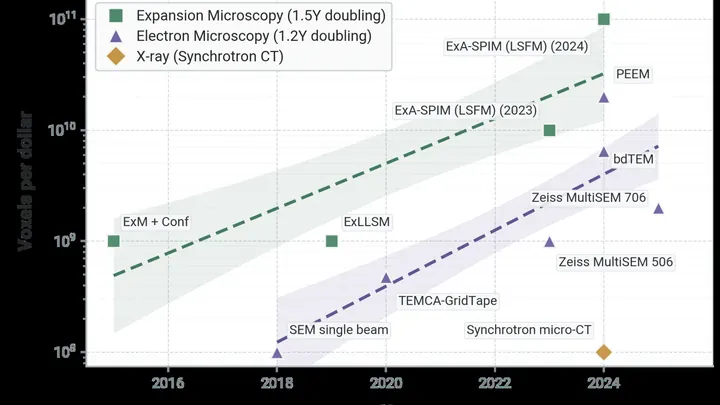
Modern microscopes see the brain in exquisite detail: not just the synapses themselves, the contact points between neurons, but also the molecules they are made of. Such images are becoming more common and cheaper to produce.
A crystal that inside resembles a sponge with a labyrinth of pores turns out to be capable of performing computations. The material, named DUT-8, consists of metal nodes and organic linkers forming an intricate lattice. Under the influence of different gases, this lattice slightly changes shape, like a house of cards that rearranges with a gentle breath.
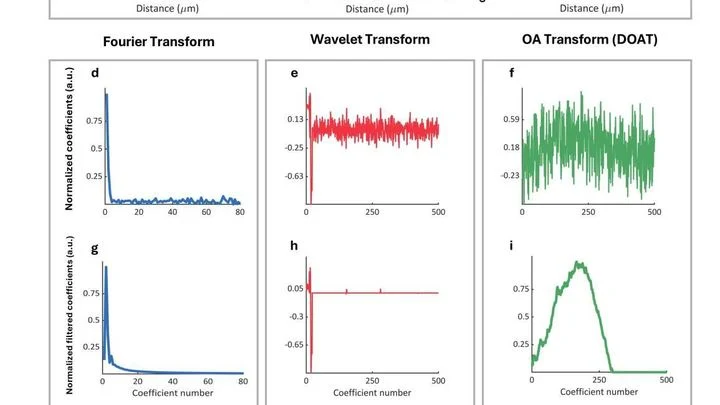
A laser beam hits the skin, and tissues respond with a barely audible ultrasonic echo. From that echo, doctors can see blood vessels and tumors without making a single incision. But before the picture appears on the screen, the signal has to be cleaned of noise, just as a cook skims the foam off a broth to make the soup clear.
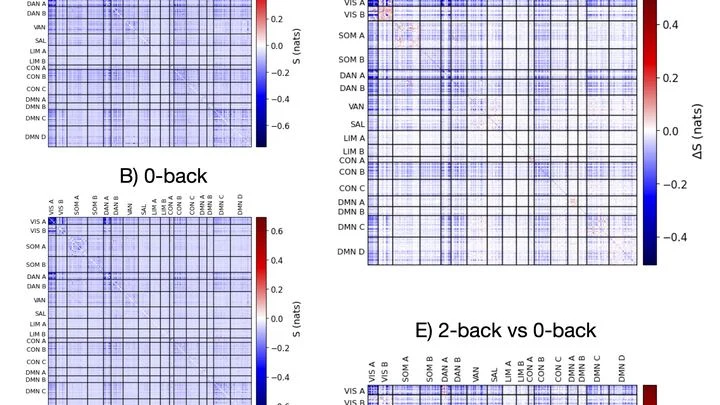
Imagine an office where employees exchange notes. When there are few tasks, everyone works independently. But when an urgent order arrives, some departments start actively messaging others, and the overall work becomes more coordinated. That's roughly how the brain behaves when we try to hold several things in mind at once.
A meteorologist stares at a pressure map, trying to figure out where the cyclone will go. They have a model, but it is flawed, and fresh measurements, but they are incomplete. Merging the two so that the forecast remains physically meaningful is harder than it seems: classical methods sometimes produce negative temperatures or impossible probabilities.
A seismograph records underground tremors: the smooth line suddenly jerks and changes its character. Similarly, functional data, such as ocean temperature maps or brain signals, may shift their shape at some point. The new algorithm FSBS catches such breakpoints, even when each curve is measured at only one point and noise drowns the signal.