Molecular dynamics acceleration refers to using neural networks to dramatically speed up computer simulations of how atoms and molecules move and interact over time. Traditional molecular dynamics relies on solving Newton's equations for every atom at each tiny time step, which is computationally expensive. By training a neural network to predict the forces between atoms based on their positions, the simulation can skip the heavy quantum-mechanical calculations that normally dominate the cost, enabling longer and larger simulations.
History
The idea gained traction in the 2000s with the rise of machine learning in chemistry, but became practical in the 2010s with deep learning architectures like SchNet and DeepMD, which could handle the high-dimensional input of atomic coordinates.
How it works
The neural network is trained on data from high-accuracy but slow quantum chemistry calculations. Once trained, it acts as a 'force field' that maps atomic positions directly to forces, bypassing the need to solve the Schrödinger equation at every step. The network captures complex many-body interactions that simple analytical formulas miss, providing near-quantum accuracy at a fraction of the computational cost.
In practice
Used to simulate protein folding, drug-receptor binding, and the behavior of materials under extreme conditions, such as shockwaves or high temperatures.
Fun fact
These accelerated simulations can model millions of atoms for microseconds—a feat that would take centuries on a supercomputer with traditional methods.
In a nine-story building with a thousand rooms on each floor, some people whisper and others shout. Neighbors pass the message along, but if everyone speaks too softly, the message fades by the third floor. If too loudly, by the top floor it becomes an unintelligible roar. Between these extremes, there is a regime where a whisper makes it all the way through without distortion.
A tennis ball hits a sandcastle. The castle crumbles, but by where and how far the grains of sand fly, you can guess the castle's shape. That's roughly how the method of exploding proteins with X-rays works. The laser beam is so powerful that the protein molecule loses electrons and flies apart into charged fragments, like the castle under the ball's impact.
A drop of ink in a glass of water spreads in intricate swirls. Similarly, a quantum particle exchanging energy with its environment changes its state in a complex and entangled manner. Describing this dance between particle and environment has long baffled scientists.
A cookbook without a shopping list: that's what a scientist faces when looking at a scheme of chemical reactions. The arrows and formulas on paper look neat, but once you start hunting in the lab for molecules that will actually behave that way, a real quest begins.
A cloud of atoms cooled to near absolute zero suddenly starts behaving like a brain. One excited atom triggers a chain reaction — neighbors light up in turn, and an avalanche of activity sweeps through the gas. Physicists call this Rydberg facilitation: atoms are easier to excite when an excited one is nearby.
Power systems with solar panels and wind turbines are like a chess game: cloud cover and load changes are the opponent's moves, impossible to foresee. To maintain balance, operators used to run through dozens of scenarios (uncertainty) — that took too much time and computing power.
Deep inside a neutron star, matter is squeezed so tightly that familiar protons and neutrons give way to new players. Hyperons are born there — particles that harbor a strange quark.
DFTB is a high-speed train in the world of quantum chemistry: hundreds of times faster than classical DFT, yet still on electronic rails. But its engine — iterative self-consistency of charges — sometimes resembles an orchestra where each instrument starts from an arbitrary note.
A protein in a cell is not a frozen sculpture. It is constantly in motion: bending, breathing, jittering. This motion, its dynamics, determines how the protein works. But peering directly into the dance is hard, and computer simulations often demand enormous computing power.
A new approach, named DynaMode, views protein motion as a musical piece.
The collision of two neutron stars is a cosmic laboratory where matter is compressed to unimaginable densities. In the first moments after the merger, a hot cloud forms and cools by emitting neutrinos. These ghostly particles carry away energy and dictate how much matter is ejected into space and which heavy elements are synthesized.
Geophysics has always sought a language to converse with the depths. Well drilling is a crude alphabet, laboratory core tests are slow decoding. A new approach turns humming porosity into a pure note.
A cell is like a library where thousands of books are copied every day. Molecular machines, polymerases and ribosomes, slide along a template chain and assemble a copy, link by link. These machines have several states: they can slow down, make mistakes, or switch. Previously, calculating such a process took hours.
Inside every cell, construction never stops: molecules constantly cluster together and drift apart. Sometimes they form dense droplets, like oil in water, but without a membrane. These droplets act as temporary storage: they hold proteins, gene copies, or DNA repair tools.
In the scorching heart of a dying star, an invisible stream is born — a neutrino gas. The particles race through matter almost without stopping, but when their density is enormous, they start to feel each other. Old calculations described this as a jostle in a crowd: each shove changes direction, but no connection arises between passersby.
An orchestra plays without a conductor, and you hear the tempo speeding up and slowing down. All you have is a recording of the sound, not the score. Can you tell from that recording which string to pluck to make the whole orchestra play more steadily?
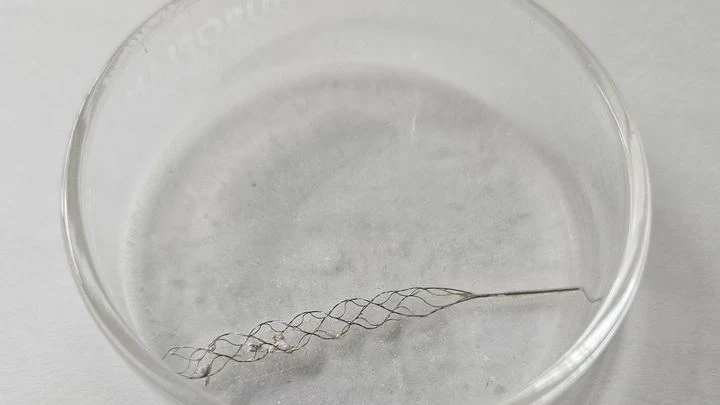
A plumber clears a clog in a narrow, winding pipe — by feel, without seeing inside. That's roughly how a surgeon feels during mechanical thrombectomy, the operation to remove a blood clot from a brain vessel. Time is short, and every move can either save a life or damage the vessel wall.
Imagine a huge garage with hundreds of parking spots. You're driving a tiny car, a future drug molecule, and you want to find the one free bay where it fits perfectly. But these bays aren't concrete; they're woven from DNA or RNA chains, and no one has posted the parking rules.
Inside every cell, life is bustling: tiny protein machines tirelessly haul cargo, read genes, and fix errors. But their work is far from perfect: they often 'spin their wheels,' take backward steps, or get stuck in futile cycles. It's like a city traffic jam where cars dart around aimlessly, burning fuel.
Imagine a factory where hundreds of tiny assembly lines run nonstop. Each line is a molecular motor that converts chemical fuel into motion. To make the motor go faster or in the right direction, an engineer tweaks the settings — the shape of parts, the strength of interactions.
Every carbon atom in a molecule carries a passport — the energy with which its deepest electrons sit in their orbitals. This energy is sensitive to neighbors: add an oxygen nearby or a double bond, and the number in the passport changes. Chemists have long measured such energies with X-rays, but calculating each new molecule takes hours of machine time.
A balloon inflates on its own, even though no one is blowing it up. That's roughly how the accelerated expansion of the universe looks, and to explain it, scientists usually invoke dark energy, an invisible and poorly understood force. But what if the balloon expands because new air molecules are continuously appearing inside it?
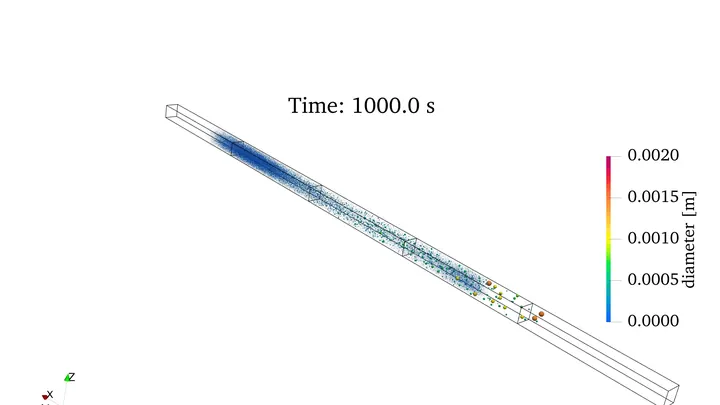
In a cloud, thousands of tiny water droplets hang in the air. For rain to fall, they need to grow: stick together into larger drops and become heavy enough to fall to the ground. But how exactly do droplets find each other in a huge cloud?
Scientists created a computer model that tracks each droplet individually, as if each one had its own little sensor.
A tiny gold star melts under the beam of an electron microscope, its points slowly rounding off. In the past, such a process could only be seen in snapshots taken with long pauses, and the probing beam itself would alter the sample.
Plasma is a gas in which electrons are stripped from atoms, behaving like a soup of charged particles. To predict how such a soup flows and heats up, you need to know how particles collide and exchange energy.
Viscoelastic materials — polymers that, like dough, retain a memory of every touch: their response to impact depends on their deformation history. Maxwell and Boltzmann provided the mathematical description long ago.
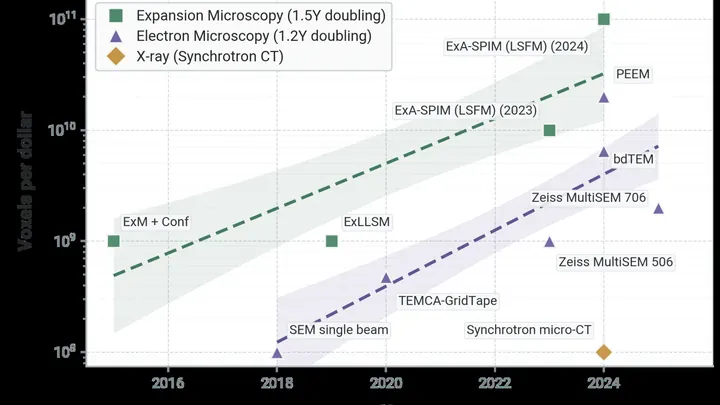
Modern microscopes see the brain in exquisite detail: not just the synapses themselves, the contact points between neurons, but also the molecules they are made of. Such images are becoming more common and cheaper to produce.
Physical systems can compute. If you build a landscape of hills and valleys so that the lowest point corresponds to the answer, the system will roll there by itself, like a ball. The problem is that the bottom is often flat, and the ball crawls around for a long time before settling.
The authors propose nudging the ball to the right place before it even starts.
A seven-metal alloy is like a team where every player is pulling the blanket their own way. Atoms of iron, cobalt, nickel, aluminum, titanium, tantalum, and vanadium can either fall into a strict pattern or scatter into random positions. This determines whether the material will be as strong as steel or as light as aluminum.
Tearing apart an aluminum cube just a few nanometers wide is like trying to watch a droplet fall in slow motion when the camera itself is firing at machine-gun speed. Atoms inside the metal vibrate trillions of times per second, while real deformation in the lab takes minutes.
A laser beam holds a single ion in a vacuum, and that ion behaves like a ball trapped between two cups. The cups aren't pits in the ground but regions where the ion energetically prefers to be. In the classical world, a ball would roll into one cup and stay there.
A tiny particle floats in a laser beam like a speck of dust in a flashlight's glow. Water molecules constantly jostle it — randomly, from all sides. Usually these bumps are a nuisance: the particle twitches, and precise measurements turn into a lottery. But physicists have figured out how to turn the interference into an advantage.
When chemists see how concentrations of substances change, they need to figure out which reactions are behind those changes. It's like trying to reconstruct a recipe from photos of plates at different stages of a meal. Previously, this often involved derivatives — instantaneous rates of concentration change.
Stars on the outskirts of galaxies rotate faster than predicted by the laws of physics if only visible matter is considered. This paradox was uncovered in the 20th century by Vera Rubin and Fritz Zwicky.
A chemist searching for a new drug is like a cook without a recipe: they have a list of desired properties but millions of possible ingredients. Each trial is costly and time-consuming, so you need to experiment wisely.
The new program SEISMO acts like a chef who tastes the dish after every step and immediately decides what to add next.
Finding the largest group of strangers among a crowd is a challenge that pops up in logistics, chemistry, and scheduling. Ordinary computers hit a black hole here: not from lack of power, but because the problem's structure swallows any classical solution.
The new quantum algorithm sidesteps the trap.
Ultrasound in a liquid is like shaking a bottle of soda vigorously: shake it, and bubbles appear. In science, this is called cavitation, and the bubbles don't just float around: they are born, grow, and collapse with tremendous force.
Water in a stream bends around rocks, but the math of that motion hides in a black box: that's how ordinary neural networks work. They give an answer but don't say why. Engineers can't trust a prediction if they can't see its reasoning.
Fluid dynamics now has a transparent model.
Measuring a particle’s energy at the Large Hadron Collider is like trying to catch a whisper in a roaring crowd. When protons collide, a flurry of particles is born, their signals blending into a cacophony. Old-school methods, like a noise-clogged ear, systematically underestimate the energy.
Scientists built a neural network that works right inside the detector.
Two vortex rings launched one after the other pass through each other and swap places. This dance, first seen in the 19th century with smoke rings, has now been reproduced on a quantum processor. Vortices are the actors on a quantum stage where time plays the role of an extra dimension.
In 2023, a group of researchers at Oak Ridge National Laboratory ran a simulation of a 61-qubit quantum circuit on the Theta supercomputer. Storing its state vector would have required 32 exabytes of memory, more than the total capacity of all hard drives on the planet. But thanks to data compression, they fit it into 768 terabytes.