Planet Birth at the Disk's Edge express
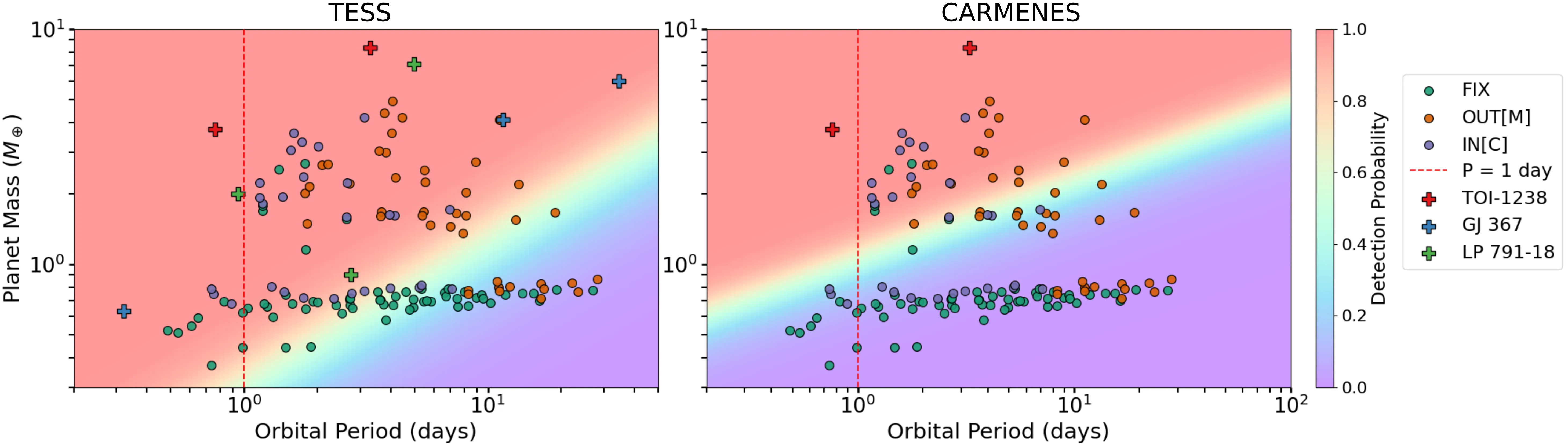
Rocky planets orbit dim red stars. Some of them have a year shorter than an Earth day: these worlds are called ultra-short-period planets. Their surfaces are scorching, and their skies are forever bathed in crimson light. How did they end up so close to their star?
New research tests a simple idea: it's all about the edge of the gas-and-dust disk from which planets are born. This disk resembles a whirlpool of gas and dust around a young star. Its inner edge is the boundary beyond which matter can no longer orbit: the star heats and pushes it away. The authors ran computer simulations with three scenarios for this edge: stationary, moving outward, and moving inward toward the star.
Only two scenarios produced ultra-short-period planets. In the first, the disk's edge remained frozen close to the star, and planets, like pebbles at the edge of a table, piled up right there. In the second, the edge slowly crept toward the star, and the planets followed it, like a wake trailing a boat. The third scenario, where the edge receded, left the planets no chance: they formed far out and didn't have time to migrate.
So the fate of an entire class of planets is decided at the very boundary — where the disk meets the star. A fine-tuning, but it's precisely this that creates the worlds we later find around distant red dwarfs.
Ultra-short-period planets are the fastest known: their year lasts from 4 to 24 hours, and surface temperatures can exceed 2000 degrees Celsius.