Dust dynamics is the study of how microscopic solid particles in protoplanetary disks move, collide, and aggregate to form larger bodies, eventually leading to planet formation. These disks of gas and dust surround young stars and are the birthplaces of planetary systems. The motion of dust is governed by a delicate balance of forces: gravity from the central star, gas drag from the surrounding nebula, and turbulence within the disk. Understanding dust dynamics is crucial because it explains how tiny grains grow into kilometer-sized planetesimals, the building blocks of planets.
History
The modern theory of dust dynamics in protoplanetary disks was developed in the 1970s and 1980s by researchers like Viktor Safronov and Peter Goldreich, building on earlier work by Otto Schmidt on planetesimal formation.
How it works
Dust grains in a protoplanetary disk experience a headwind from the slower-moving gas, which causes them to lose angular momentum and drift inward toward the star. This inward drift can be counteracted by turbulence, which creates regions of high pressure where dust accumulates. In these dense regions, grains collide and stick together through electrostatic forces and van der Waals interactions, gradually growing in size. Larger particles are less affected by gas drag and can settle toward the disk midplane, where they form a thin layer that becomes gravitationally unstable, fragmenting into planetesimals. Magnetic fields and radiation pressure also play roles in shaping the dust distribution.
In practice
This knowledge is used to interpret observations of protoplanetary disks with telescopes like ALMA, which can image dust rings and gaps that indicate ongoing planet formation, and to model the formation of our own Solar System.
Fun fact
Dust grains in a protoplanetary disk can grow from micrometer-sized particles to centimeter-sized pebbles in just a few thousand years, but the next step to kilometer-sized bodies remains a major puzzle in planetary science.
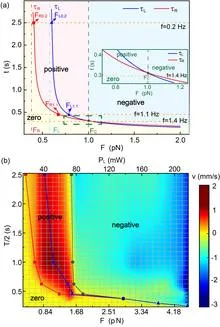
A swing that rocks on a sawtooth hill behaves strangely: without kicks, it gets stuck in the first dip, but with rhythmic pushes it can move uphill, downhill, or stay frozen in place. That is exactly what physicists saw when they placed a single dust grain in a trap with a sawtooth bottom and started pushing it alternately with laser beams.
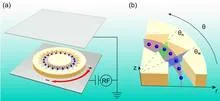
In a ring-shaped channel between two toothed rings, microspheres are suspended: some with a radius of 8 micrometers, others 14. The discharge is switched on, and the particles start moving. The small ones go one way, the large ones the other. It is like a shopping mall where escalators for people of different heights run in opposite directions.
A hydrogen bubble on a platinum electrode behaves like a swimmer trying to surface, but every time it almost breaks free, something below grabs its legs. In the lab, high-speed cameras captured this behavior: a millimeter-sized bubble hangs near the surface, even though buoyancy pulls it upward with a force thousands of times stronger than surface tension can hold.
At the center of an ultra-compact dwarf galaxy, a very dense stellar system spanning tens of light-years, there is a vacuum cleaner at work. But instead of dust, it sucks in gas shed by dying stars. This gas does not fly off in all directions; instead, it spirals into a funnel, a rotating disk that gradually settles onto the black hole.
The JWST space telescope aimed its lens at the scorching rocky world 55 Cancri e, and spotted a dense gas envelope. But the cooler TRAPPIST-1 b, which orbits a dim red dwarf, showed no envelope: just bare rock. The picture came out upside down: hot planets hold onto atmospheres, while cooler ones lose them.
In the dark kitchen of the Taurus molecular cloud, 450 light-years away, dozens of planetary systems are being prepared. Each young star is a chef, and its protoplanetary disk is a counter piled with flour-like dust and steam-like gas.
Around a just-ignited star swirls a vortex of dust and gas. This vortex, the protoplanetary disk, grows by accreting material from the surrounding cloud.
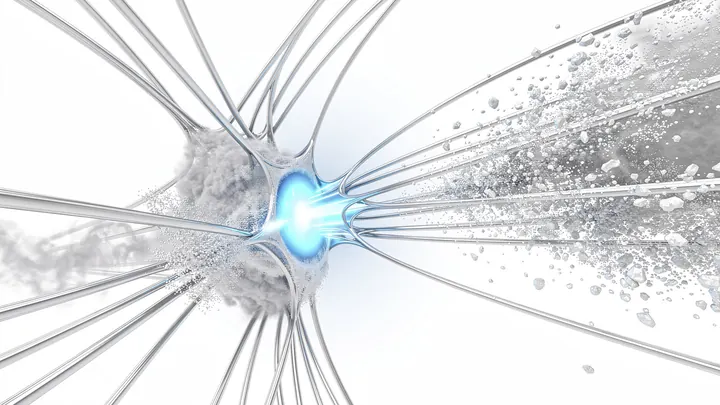
A disk of gas and dust spins around the young star HV Tau C, nearly edge-on to us. The James Webb Space Telescope examined its spectrum and detected the glow of hot molecular hydrogen (H₂). This revealed a wide, bipolar wind blasting from the inner regions far beyond the disk.
Edge of the spotlight. Remove the dazzling light of the central star, and a theater of shadows emerges. The James Webb coronagraph, like a dense curtain, hid the star TW Hydrae — and on a stage 120 astronomical units long (four times the distance to Neptune), its protoplanetary disk came alive.
Seventy-two protoplanetary disks, swirling cocoons of cosmic dust and gas, came under the gaze of the MIRI instrument on JWST. Most of them shoot outflows into space: dense conical structures and narrow, high-speed jets. They blast like fountains. This process is not accidental.
A galactic disk is like a frozen ripple on water: every disturbance leaves a trace that can be read billions of years later. When a dwarf satellite galaxy flies past or a head-on merger occurs, stars in the disk start to oscillate, like bobbers rocked by a wave.
In a single star system, two teams of planets orbit. Some follow neat paths, like figure skaters on an ice rink, avoiding collisions. Others crowd together, their trajectories cross, and sooner or later a cosmic accident occurs — a giant impact.
Around some young stars where star formation has recently ended, there swirl not just dust rings but actual planetary battlefields — extreme debris disks.
Like an exquisite clockwork mechanism, a multi-planet system responds sensitively to the slightest nudge. And when the star at the heart of this mechanism dies, shedding its envelope and turning into a white dwarf, even a modest kick at a speed of 0.75 km/s can trigger a cascade of events, flinging entire worlds into interstellar emptiness.
Massive gas outflows from active galactic nuclei are a key regulator of galactic evolution. They sweep out the interstellar medium, quench star formation, and dictate the growth of supermassive black holes.
A pot of boiling soup is shaken hard — the liquid sloshes, waves crash against the walls. Something similar happens inside a gas planet when it swings past its star on an elongated orbit. The star's gravity excites powerful internal waves in the planet, known as tidal fundamental modes. These waves can completely change the planet's fate.
Stars are born in cold clouds of cosmic dust and hydrogen. Inside these cocoons, protostars — the cores of future suns — were long thought to be just hot clumps. But it turns out many of them are powerful accelerators: they shoot out narrow jets of gas that, slamming into surrounding matter, produce invisible gamma-ray light.
At the center of a distant galaxy, a supermassive black hole is surrounded by a flat, rotating disk of gas and dust — a giant cosmic funnel of matter. A small compact object, such as another stellar-mass black hole, may find itself in this disk.
A planet the size of Neptune, but glowing white-hot. Beneath the clouds lies an ocean of magma capable of absorbing an entire hydrogen atmosphere. The new SEAMIST model is the first to trace how such dissolution changes a planet's fate from birth to old age.
The big surprise is the mechanism of catastrophic boiling.
A thick stew slowly cools in a pot. Suddenly, the flame beneath it flares up, and the stew begins to boil, breaking into many small whirlpools. Much the same happens to the disk of gas and dust around a young star when it experiences a flare — a sudden influx of matter from the disk onto the star.
Putting together the Solar System is like crafting a high-end tasting menu: the recipe isn't always set in stone — sometimes the final ingredient is added while the dish is already cooking.
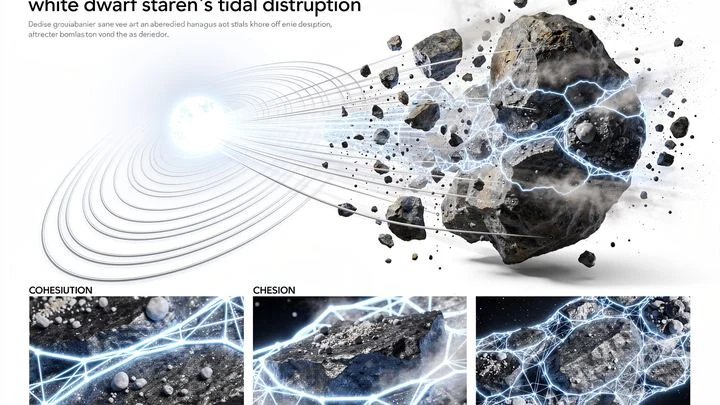
When a telescope catches the light of a distant white dwarf, the spectrograph sometimes fishes out heavy elements — calcium, iron, magnesium. These metals could not have stayed in the thin atmosphere of the stellar remnant; they are the traces of recently fallen planetary debris.
The cosmic accounting has hit a snag. The bookkeeper is balancing the books: in one column, all the planets astronomers have counted in the galaxy; in the other, the stockpile of building material in the dusty cocoons of newborn stars. The numbers don't line up. Even if you gathered every last grain of dust and molded it into planets, there wouldn't be enough material.
In a city park, trees grow faster than in a deep forest — not because the soil is better, but because branches collide and seeds are exchanged more often. Galaxies in the Spiderweb protocluster behave much the same way. This vast clump of matter will become a mature cluster billions of years from now.
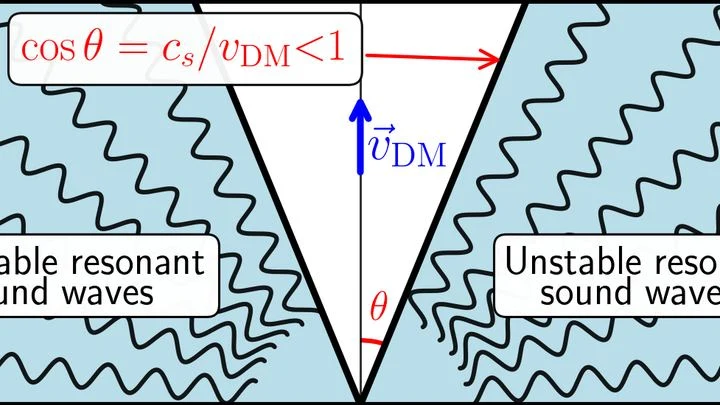
After the Big Bang, dark matter and ordinary matter (mostly hydrogen) went their separate ways in terms of speed. Their gravitational pull acts like a bow gliding across a string: when frequencies match, resonance occurs, and sound waves start to rapidly grow in ordinary matter.
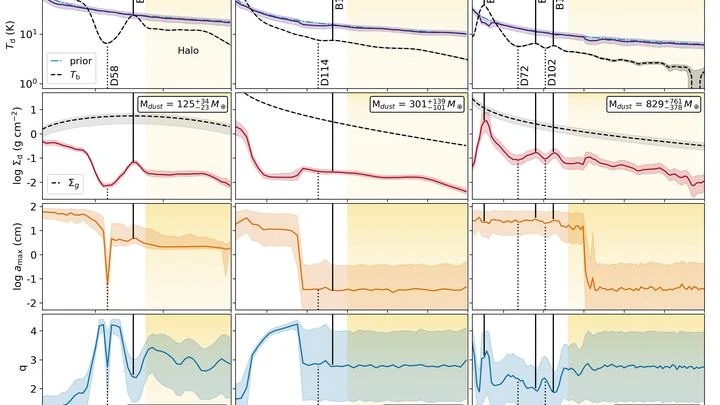
A young star is surrounded by a flat, rotating disk of gas and dust, like pizza dough that's been spun out. Planets are born inside such a disk. But around three stars (Elias 2-24, IM Lup, and DM Tau) astronomers noticed something odd: far beyond the edge of the bright disk stretches a barely visible but enormous dust halo.
In a pot of boiling water, steam bubbles rise and pop. In the quantum world of a superfluid, bubbles behave differently: they can collide and give birth to vortices — tiny swirling flows, like whirlpools in a river.
Scientists modeled such a liquid using a holographic approach.
In a disk of gas and dust around a young star, dust particles behave like sand grains in a stream of water: the gas flows faster, the dust lags behind, and friction arises between them. This friction can rock the magnetic waves that run through the disk. The galaxy is full of such disks: it is precisely in them that planets are born.
Around young stars, flat clouds of gas and dust swirl, like pizza dough from which planets will eventually be shaped. This cloud contains various chemical elements, and sulfur is one of the most elusive: it's hard to catch with telescopes because it hides in solid grains or escapes as gas.
In a cloud, thousands of tiny water droplets hang in the air. For rain to fall, they need to grow: stick together into larger drops and become heavy enough to fall to the ground. But how exactly do droplets find each other in a huge cloud?
Scientists created a computer model that tracks each droplet individually, as if each one had its own little sensor.
In cold clouds of interstellar gas, long, dense filaments stretch out. Inside them, like overcrowded incubators, future stars are maturing. For a long time, it was thought that within such filaments, everything was governed by gravity: matter smoothly flows toward the centers, where density increases and eventually a star ignites.
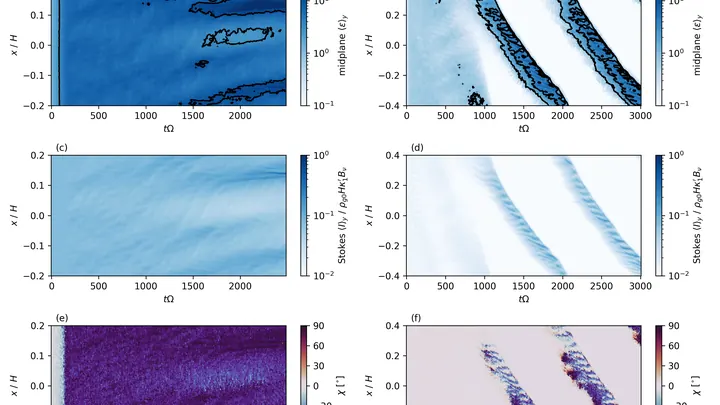
Around young stars, disks of gas and dust swirl — the building blocks for future planets. Inside these disks, dust grains don't just fly randomly: they align along invisible lines of gas flow. Recently, astronomers noticed that dust grains in such disks behave like badminton shuttlecocks — always turning their long side into the wind.
The James Webb Space Telescope is gazing more and more at exoplanets — worlds orbiting alien stars. Some of them are scorching rocky spheres, tidally locked with one side forever facing their star. There, rock melts into oceans of liquid lava. How does this lava move?
The young star HL Tau is surrounded by a disk of gas and dust — the cradle of future planets. Inside this disk, the gas is not static: it orbits the star, but it also trembles and churns, like water in a raging river. Astronomers have now directly measured the strength of this churning for the first time.
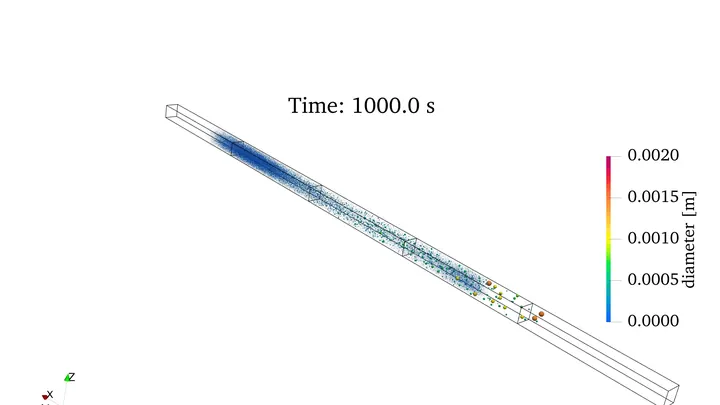
A powder avalanche isn't just a pile of snow sliding down a mountain. It's a cloud racing downhill at car speed. Inside, snow doesn't lie still: it flies: thousands of tiny particles are caught up in air vortices. Until now, no one had seen what actually happens to each snowflake in this chaos. Now scientists have the first footage.
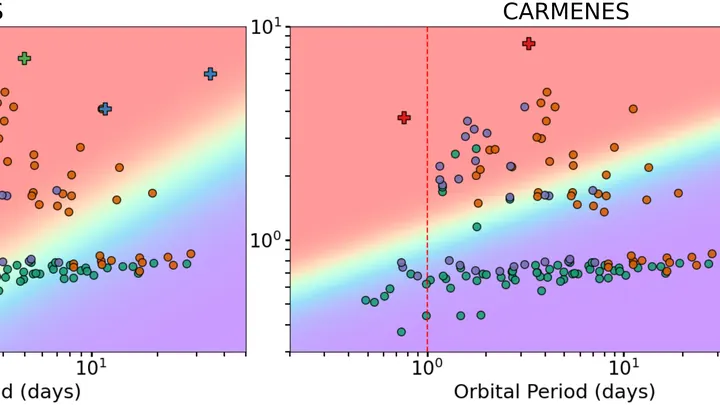
Rocky planets orbit dim red stars. Some of them have a year shorter than an Earth day: these worlds are called ultra-short-period planets. Their surfaces are scorching, and their skies are forever bathed in crimson light.
In the cold outer reaches of the Solar System, water is considered the main building material for ices. But some comets and distant icy bodies have an unusually high ratio of carbon monoxide (CO) to water, as if a scoop of ice cream suddenly had too much syrup. The authors of a new study set out to find where this imbalance comes from.
A drop of ink falls into a glass of water, and ripples spread out from it. Water seems simple, but if you look inside, each molecule isn't just moving forward: it's also spinning like a tiny top. Physicists call this intrinsic rotation spin. Usually, it goes unnoticed: in calm water, the tops spin every which way, and their rotation doesn't affect the fluid's overall motion.
In the cold gas clouds where giant stars are born, everything is churning with motion. Gas compresses, swirls, and fragments into clumps — the future stars. For a long time, it was thought that the magnetic field brought order here: like invisible threads, it stretched clumps perpendicular to itself. But new observations showed the opposite.