Planetary interior refers to the layered structure of a planet — from its crust and mantle down to its core — and the physical and chemical processes that shape it, such as heat flow, convection, and magnetic field generation. Understanding a planet's interior is essential for explaining its surface features, its atmosphere, and its evolution over time. For example, the presence or absence of a magnetic field depends on the state and motion of the core, while the thickness and composition of the mantle influence volcanic activity and plate tectonics.
History
The modern study of planetary interiors began in the early 20th century with the discovery of Earth's core by Richard Oldham in 1906 and the development of seismology. Later, spacecraft missions extended these methods to other planets, starting with the Moon and Mars in the 1960s and 1970s.
How it works
A planet's interior is studied through indirect methods: seismic waves (on Earth), gravitational field measurements, magnetic field observations, and comparisons with theoretical models of material behavior under extreme pressure and temperature. Heat from radioactive decay and residual formation energy drives convection in the mantle and core. This convection can generate a magnetic field via a dynamo mechanism, as in Earth's liquid outer core. The balance between heat production and heat loss determines how a planet cools and whether it remains geologically active.
In practice
Knowledge of planetary interiors is used to interpret data from space missions, such as the InSight lander on Mars and the Juno orbiter at Jupiter, and to assess the habitability of exoplanets by estimating their internal heat and magnetic field potential.
Fun fact
Earth's inner core is a solid iron-nickel sphere about the size of the Moon, yet it is hotter than the surface of the Sun — around 5,400°C — and it is growing by about 1 millimeter per year as the outer core slowly crystallizes.
Deep inside a sub-Neptune, where pressures reach a hundred thousand bars and temperatures hit four thousand degrees, rock behaves like boiling soup. Heavy vapors of silicon and magnesium rise, cool, and fall back as a rain of solid particles.
A planet in the habitable zone is no guarantee of life. Like a conductor leading an orchestra, a star dictates the tempo and character of planetary atmosphere evolution over billions of years.
When the JWST telescope breaks the light of a distant exoplanet into a spectrum, it reads a chemical chronicle. But this chronicle is not a monolithic truth; it's an atmosphere constantly rewritten by the star's radiation.
For almost a century, seismology has been the planet’s chief X-ray, probing the interior through elastic waves. But neutrinos, ghost particles predicted by Wolfgang Pauli, offer a different perspective.
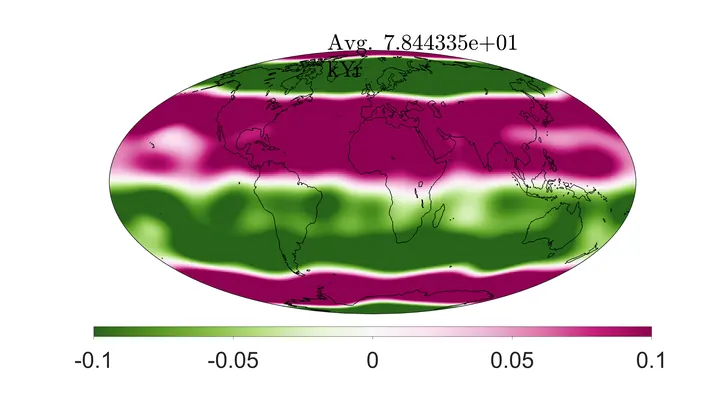
Earth's magnetic field is like an invisible shield that protects us from cosmic radiation. But if you look closely at its long-term averaged pattern, you'll notice that this shield isn't perfectly smooth: it has its own "seams" and "patches." New research using computer simulations of the geodynamo shows that…
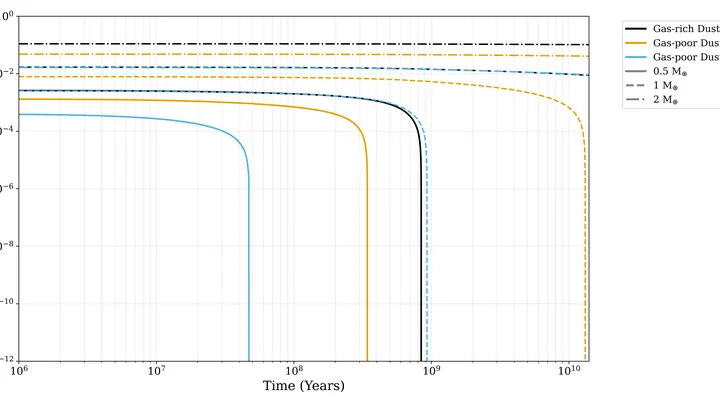
A scorching rocky planet is like a pot of boiling soup, except its lid is the atmosphere. Gases escape from the magma, wrap the world in a thick blanket, and in turn influence how quickly the celestial body cools. For GJ 1132 b, which orbits so close to its star that a year lasts just one and a half Earth days, this connection is especially important.
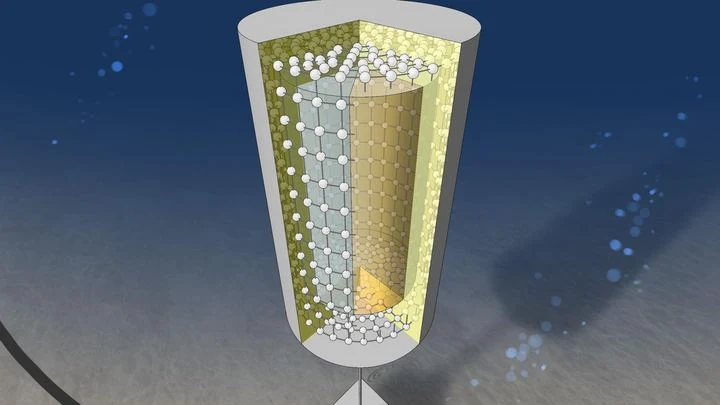
In the depths of the ocean, where light never reaches, a plan is taking shape to capture particles that barely interact with anything. Geoneutrinos, tiny messengers from the scorching mantle, are emitted during the decay of uranium and thorium. Their flux carries information about how much heat lies hidden beneath our feet.
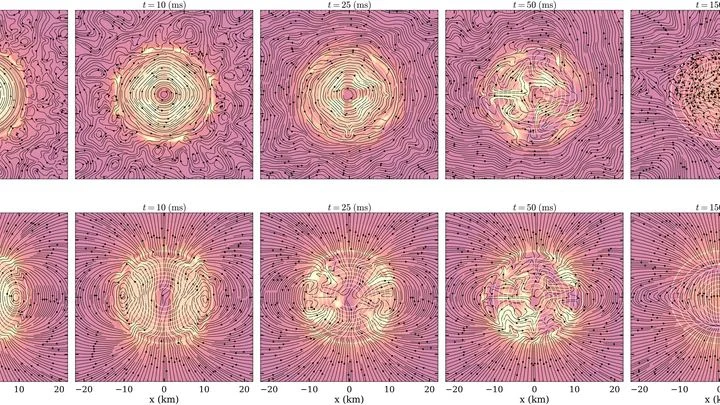
A neutron star is a sphere the size of a city but with the mass of an entire Sun. Its magnetic field can tear atoms apart from thousands of kilometers away. Yet until now, it was a mystery how this field is arranged inside: whether it is twisted into tight ropes or more like neat lines radiating from the poles.
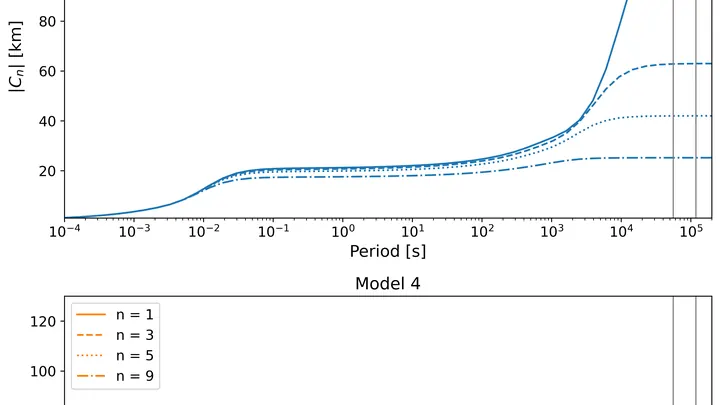
Enceladus is a tiny moon of Saturn, covered in a thick crust of ice. Beneath it sloshes a salty ocean, and deep down, a hot, porous core may be at work, like a sponge soaked with water and heat. But how do you see through tens of kilometers of ice? No need to drill: you can use an electromagnetic "echo."
A person with a metal detector walks along a beach.
If you don’t stir a layered cocktail, the heavy syrup sinks to the bottom. A young planet is much the same — a seething ocean of molten rock. As it cools, minerals crystallize: some, like iron, get heavy and sink, while others float. You’d think a dense layer would pile up at the core.
A planet's magnetic field is like an invisible shield: it catches charged particles from the solar wind and stretches out behind the planet into a long tail, like a fluttering scarf.
Magnetic fields on the surface of the Sun appear as dark spots and bright faculae. But they are born deep inside, where flows of hot gas act like a giant dynamo. The question is whether sunspots on the surface can predict what will happen inside the star years from now.
The authors applied a mathematical theorem similar to the rule linking the area of a shape to its boundary.
In a large gas cloud where stars are born, the magnetic field lines are roughly aligned in one direction, like the fibers in a piece of felt. But look inside, into the dense clumps that will eventually become stars, and the picture changes: there the lines are twisted every which way, like a ball of yarn after a kitten has played with it.
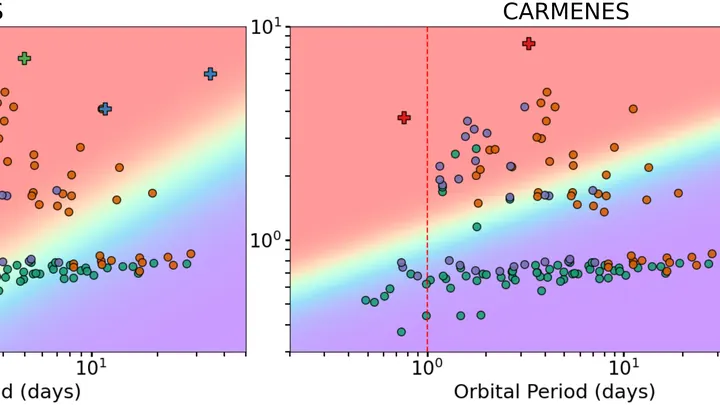
Rocky planets orbit dim red stars. Some of them have a year shorter than an Earth day: these worlds are called ultra-short-period planets. Their surfaces are scorching, and their skies are forever bathed in crimson light.
The Sun sometimes produces giant clouds of plasma that try to escape into space. But often they fail: an invisible magnetic cage keeps them near the surface. Such failed eruptions are called "trapped."
Scientists built a computer model to understand exactly how this cage works.
When a baker kneads dough, the grains of flour can tell you which mill they came from. It's the same with Earth: the composition of iron in its depths preserves a memory of where the pieces that assembled the planet were born.
Deep beneath our feet, at the very center of Earth, lies a solid iron core. But it's not pure iron — there are lighter elements too, such as hydrogen. Exactly how hydrogen is distributed within the core has long been a mystery.
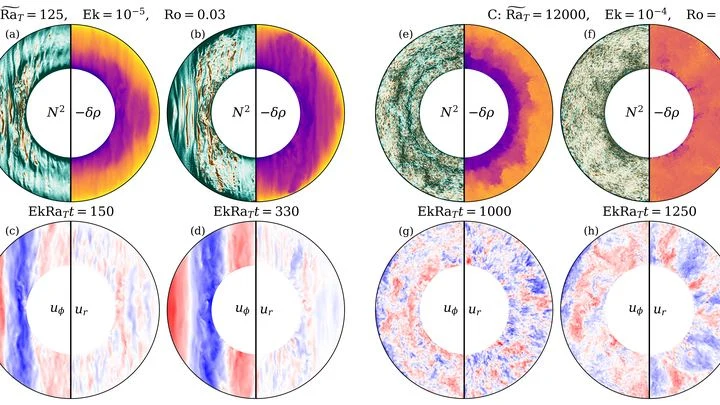
Inside giant planets like Jupiter and Saturn, heat doesn't always rise freely. Heavy elements, which are more abundant in some layers than others, prevent hot fluid from floating up. This creates semiconvection — a type of mixing where heat and composition spread at different rates.
Pour a handful of dry sand: it will spread into a neat cone. Now grab a box of star-shaped pasta: the pile will stand almost vertical. Why? It's all about particle shape.
Physicists built cylindrical piles from particles of different geometries — from smooth spheres to 'polypods' with several arms, like a sea star.
Many planets around other stars — exoplanets — have elongated orbits. With each close approach, the star’s gravity squeezes and stretches them, like kneading dough. Friction heats up the interior to the point where rock melts, creating underground oceans of magma.
A young sub-Neptune is a pressure cooker where hydrogen and rock simmer in the same pot. Six Earth masses, three percent hydrogen by mass, and interior temperatures above 4000 K. At that heat, silicate melt and hydrogen don't just coexist: they mix completely, forming a single supercritical fluid. There is no boundary between core and envelope.