Kaon Under the Lens: How a Particle Responds to Light express
If you place a kaon in an electric field, it stretches slightly, like a balloon rubbed on wool. This response, the electric polarizability, shows how rigidly the particle is built inside. For the charged kaon, it has been measured for the first time, and the number is about one ten-thousandth of the volume occupied by a proton.
The calculation was done on a supercomputer, dividing spacetime into a tiny grid, as if freezing moments to examine each one. In this grid, the kaon is not a point but a cloud of quarks, and its response to the field has two parts. The first is elastic: the particle behaves as a whole, and its size was already known from electron scattering. The second is inelastic: the field makes the internal quarks oscillate like strings, and this part was isolated by subtracting the first from the total response.
The result is still modest in precision: the uncertainty is more than half the value itself. But it proves the method works for particles with a strange quark. In the future, with more computing power and including virtual quark pairs, physicists hope to obtain a number that can be compared with experiments.
Original abstract
as written by the authors arXiv:2604.13269
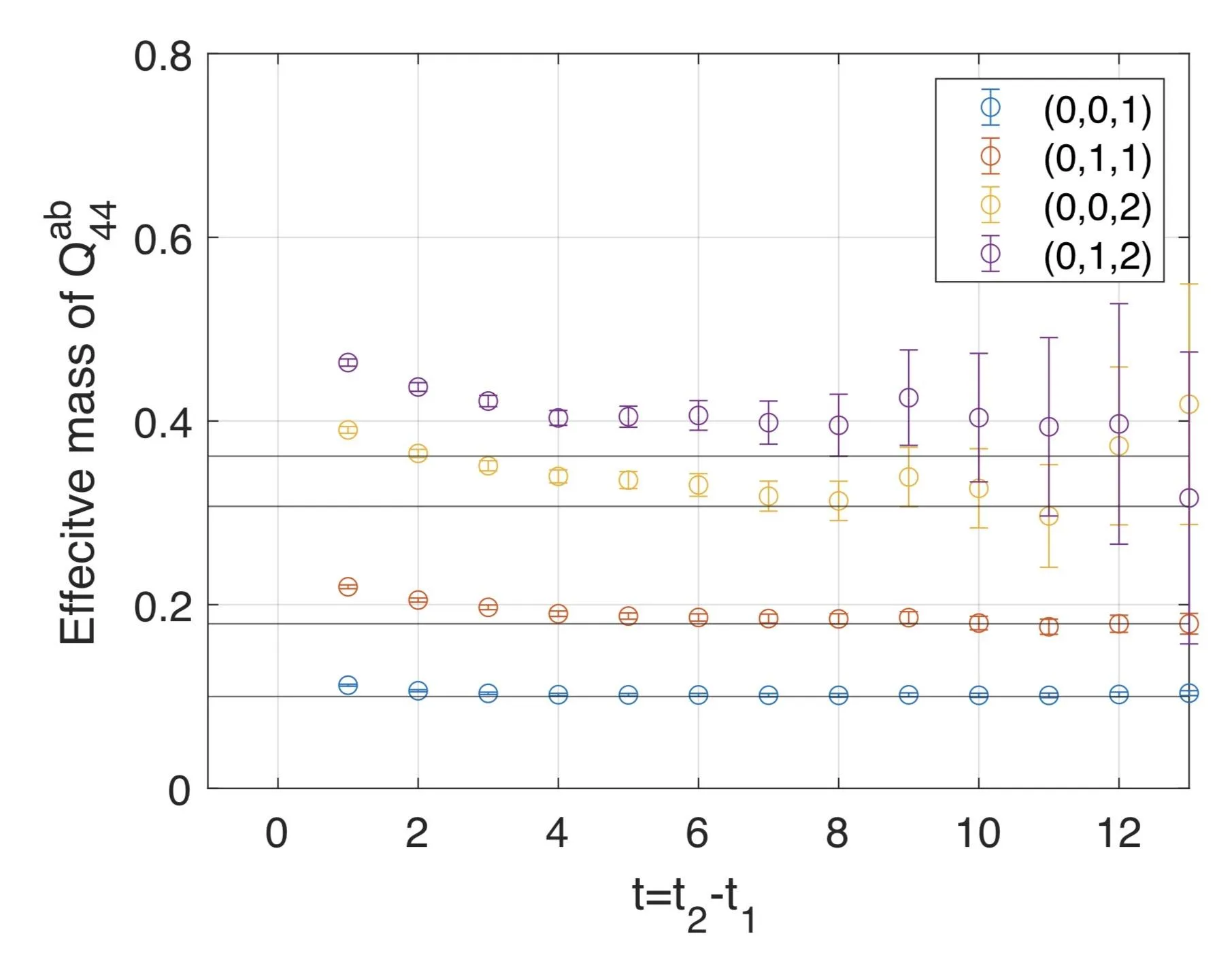
We present a lattice QCD calculation of the electric polarizability of the charged kaon using a four-point function approach, which is the Euclidean analog of low-energy Compton scattering. In the case of the charged kaon, the polarizability is separated into an elastic (Born) term, determined from the charge radius extracted via the kaon electromagnetic form factor, and an inelastic (non-Born) term obtained from the time-integrated difference of four-point correlation functions. Our study employs 500 configurations of Wilson quenched $$24^3\times 48$$ lattices, and we compute connected diagrams as a proof of principle. From this analysis, we obtain values for the charged kaon electric polarizability of $$\alpha_E = (0.988 \pm 0.534) \times 10^{-4}\;\mathrm{fm}^3$$ as well as $$\langle r_E^2\rangle =0.3303\pm 0.0028\;\mathrm{fm}^2$$ for the squared kaon charge radius, after extrapolation to the physical pion mass. The study demonstrates the applicability of the four-point function framework to strange mesons, extends previous four-point function polarizability studies, and provides a foundation for future calculations with increased statistics, dynamical fermions, and improved control of systematic uncertainties.
The kaon is one of the few particles that can turn into its own antiparticle and back, and this transformation first showed that combined parity is not always conserved in nature.
In Liu Cixin's novel "The Three-Body Problem," aliens use subatomic particles for superluminal communication — similar exotic properties of kaons inspire science fiction writers with ideas about manipulating matter.