A polaron is a quasiparticle that forms when an electron moves through a crystal lattice and distorts the surrounding ions. The electron's negative charge attracts the positively charged atomic nuclei, pulling them slightly inward, while the electron itself gets trapped in the resulting potential well. This combined entity — the electron plus its self-induced lattice distortion — behaves as a single particle with a larger effective mass and altered properties compared to a free electron.
History
The concept was introduced by Lev Landau in 1933, who proposed that an electron moving through a crystal could polarize its surroundings and become self-trapped. The term 'polaron' was coined later by Solomon Pekar in the 1940s.
How it works
When an electron enters a crystal, its electric field displaces nearby ions from their equilibrium positions. This distortion creates a local potential minimum that further confines the electron, reinforcing the distortion. The electron and the lattice deformation move together as a coupled unit. The strength of this coupling determines whether the polaron is 'large' (extended over many lattice sites, weakly bound) or 'small' (localized to a few sites, strongly bound).
In practice
Polarons play a key role in organic semiconductors, metal oxides, and perovskite solar cells, where they influence charge transport and recombination rates, directly affecting device efficiency.
Fun fact
In some materials, polarons can form 'polaron pairs' that act as temporary bridges for electrical current, a phenomenon that has been observed in certain organic crystals.
An empty dance floor where people occasionally appear. Each moves on their own, chaotically, with no connection to the others. But when the right music starts and the hall cools down a bit, the dancers suddenly begin to form long chains and move in unison. That's roughly how electrons behave in a dilute three-dimensional gas.
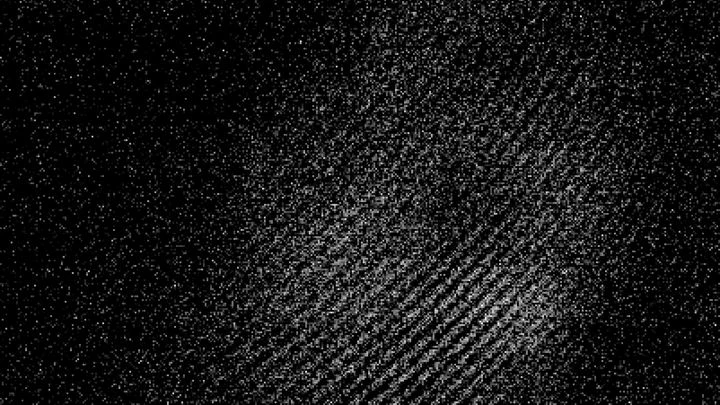
In 1984, the world of crystallography was turned upside down: sharp diffraction peaks with fivefold symmetry were discovered in an alloy of aluminum and manganese – as if nature had mocked the strict theorems forbidding repeating patterns from having axes of order 5, 8, 10, or 12.
Quantum matter rarely treats us to the spectacle of self-motion. Where the classical world teems with starling murmurations, fish schools, and bustling bacteria, quantum thermodynamics long remained serene.
An electron and its antiparticle — the positron, predicted by Дираком, — upon meeting, momentarily form позитроний: a tiny pair circling each other, like in an atom but without a nucleus. Almost instantly it decays, emitting two photons that turn out to be mysteriously linked.
The solar wind rushes from the Sun to Earth, but the magnetosphere bends the flow and sculpts it into plasma tails. The same motif plays out at the heart of galaxies: jets from accretion disks around black holes are twisted by the invisible hand of a magnetic field.
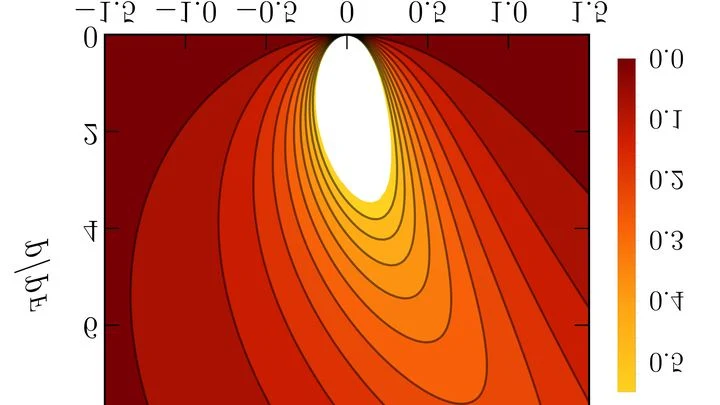
A pebble falls into a pond, and ripples spread across the water. In the quantum world, the pond is not made of water but of many identical particles, and the pebble is also a particle, just a foreign one. Such a foreign particle is called a Fermi polaron.
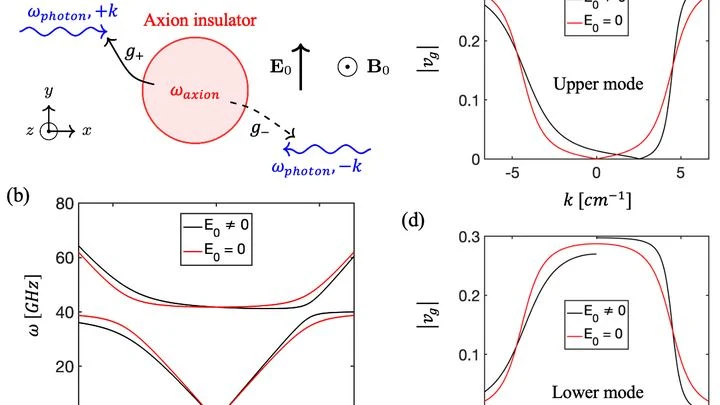
A regular flashlight shines equally forward and backward. But in magnetic crystals, a axion appears — a ghostly excitation, like a wave going around a stadium: atoms pass a magnetic impulse to each other. When light meets an axion, a hybrid forms, whose fate depends on electric and magnetic fields.
Even Jocelyn Bell Burnell, who first detected the strict periodicity of radio signals, noticed that some pulses would suddenly vanish. Today we know: variability is not a whim, but the voice of intricate electrodynamics.
Imagine a spinning top the size of a city, weighing more than the Sun and making hundreds of revolutions per second. That's a neutron star — the remnant of an exploded star. Occasionally, its rotation suddenly speeds up, as if something inside has switched. Astronomers call these jumps glitches and suspect that invisible vortices in the star's superfluid interior are to blame.
Two neutron stars (the remnants of dead stars, compressed to the size of a city but weighing as much as the Sun) spiral around each other and eventually collide. At that moment, something between a black hole and a super-powered magnet is born: a field billions of times stronger than that of the most powerful MRI machine.
Tile a floor with identical triangles, and you get a boring repeating pattern. But what if you want the pattern to never repeat, yet use just one tile? For a long time, mathematicians were sure it couldn't be done: you'd need at least two different shapes. The famous Penrose mosaic is a case in point: rhombi with acute and obtuse angles arrange into an infinitely varied but strictly ordered pattern.
Two thin sheets with honeycomb patterns were stacked and slightly rotated, creating a new pattern — a moiré, like the shimmer of silk. The electrons in the experiment behaved similarly: they arranged themselves into two layers, with one layer rotated exactly 30 degrees relative to the other.
A light carousel spins not people but electrons. Instead of wooden horses, there are invisible blades of light. This is exactly the kind of 'carousel' physicists built to give electrons a spin.
Usually, to twist an electron beam into a vortex, you need a tiny mask — a stencil with slits carved on the atomic scale. Fabricating it is extremely challenging.
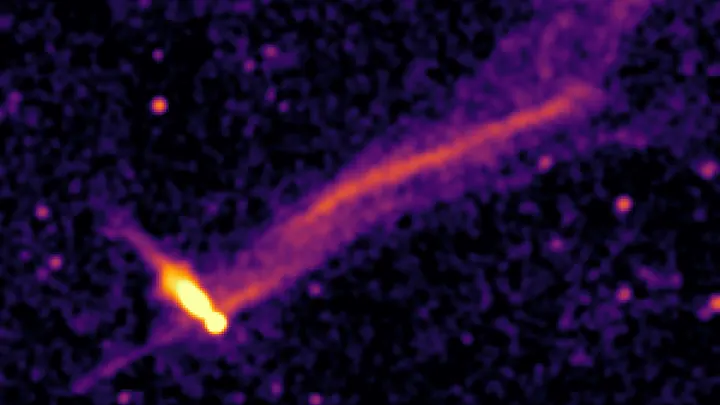
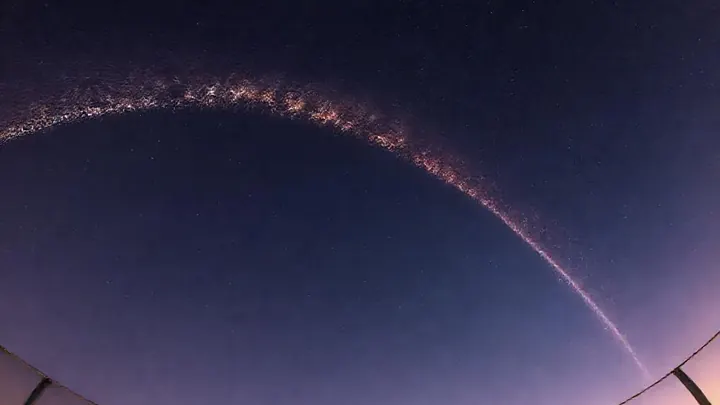
Deep in space, a rapidly spinning neutron star, a pulsar nicknamed the Lighthouse, speeds through tenuous gas. Like a motorboat cutting through water, it leaves a glowing trail of charged particles behind. In X-rays, this trail appears as a bright tail and a thin filament stretching over many light-years.
A piece of magnetite, an ordinary iron stone, behaves strangely. At room temperature, it conducts electricity, but cool it below minus 150 degrees, and its resistance jumps sharply. This jump, discovered back in 1939, physicists could not explain for nearly a century.
A new study offers a solution.
According to the Standard Model, the vacuum is not emptiness but an ocean of virtual ghost particles. An ultra-strong electromagnetic field, like a storm, yanks electron-positron pairs into reality.
Vacuum is not silent emptiness, but a boiling cauldron of quantum fluctuations, born from nothing and vanishing in billionths of a second. This invisible symphony acts like a constant wind, pressing an atom against a wall — as if a powerful bass note pushes a light ball.
Ordinary light scatters in all directions, like water from a shattered glass. But in some crystals, light waves can bunch together into narrow beams and flow in a single direction, like water in a trough. Physicists studied such a material: layered vanadium oxide α-V2O5.
In this crystal, atoms vibrate differently along and across the layers.
When particles collide at enormous speeds, they produce a shower of new particles. Among them are antiprotons — twins of ordinary protons but with the opposite charge. Each of these particles has its own spin, like a tennis ball sent with a twist. But whether antiprotons are actually spun up at birth has never been checked.
If you place a kaon in an electric field, it stretches slightly, like a balloon rubbed on wool. This response, the electric polarizability, shows how rigidly the particle is built inside. For the charged kaon, it has been measured for the first time, and the number is about one ten-thousandth of the volume occupied by a proton.
Near black holes and neutron stars, plasma churns like water in a boiling kettle. But this 'kettle' has no walls — only magnetic fields that twist and tear. At the tears, thin sheets form where magnetic field lines reconnect, giving particles a kick like a surfer catching a wave.
A barium titanate crystal is like a crowd where everyone holds a pointer. Normally, the pointers face in random directions, but when you apply an electric field, they all snap to point the same way. This ordered state is called ferroelectric: it stores information the way a compass needle stores direction.
In a thin layer of liquid crystal (a substance that flows like a liquid but has molecules arranged in order, as in a solid) vortices smaller than the thickness of a human hair are born. These vortices resemble tiny spinning tops: they can move without breaking apart and behave almost like real particles.
In a crystal made of europium, zinc, and phosphorus, electric current behaves like a car on a bumpy road. Electrons don't run freely but drag magnetic clouds, polarons, behind them.
A quantum dot the size of a virus, squeezed between mirrors, gives birth to two photons in a short flash of light. These photons fly out as a pair, and their polarizations, the directions of wave oscillation, are linked such that knowing one instantly tells you the other.
Two tiny emitters, each about the size of an atom, can together do what neither can do alone. We're talking about light scattering — when light hits particles and bounces off in all directions. Usually, a pair of particles scatters light only slightly more than a single one.
A crystal the size of half a matchbox was grown in a furnace, where a molten zone slowly crept along a rod, leaving perfectly ordered layers behind. Inside this crystal, copper ions sit at the nodes of a triangular lattice, but the triangles are slightly skewed, as if someone pressed on one corner. Each copper ion behaves like a tiny magnetic needle that can point up or down.
When light knocks an electron out of a molecule, the remaining electrons don't just sit still: they rearrange, like passengers in a train car when one gets off at a stop. In ordinary molecules, this rearrangement is barely noticeable, but in chiral molecules, mirror images like left and right hands, it can make the orbitals rotate.
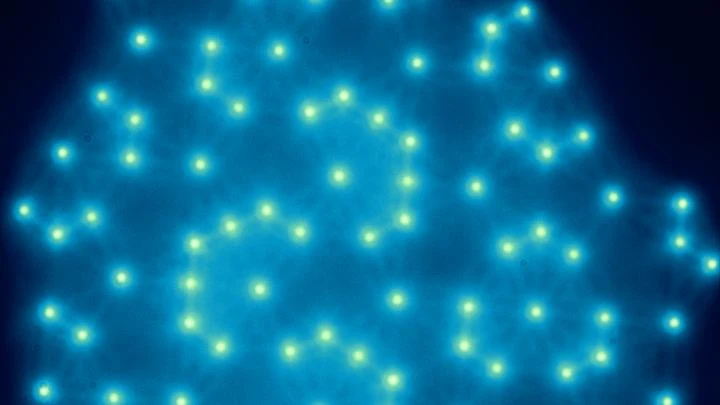
In a container the size of a coin, light behaves like water: it gathers into a single quantum fluid. When energy is added, whirlpools, quantum vortices, spin up on their own. Each vortex is like a tiny whirlpool that cannot simply disappear.
Physicists illuminated this fluid with a laser and took snapshots.
A flashlight beam in fog spreads out within a couple of meters. Light particles scatter in all directions, like a crowd in a square. But sometimes they can march in formation — without spreading, without mixing. That's exactly the kind of march achieved in a tiny perovskite crystal.
The crystal was placed between two mirrors.
A magnesium oxide crystal is like a row of soldiers: atoms stand in neat lines, and an electron runs along them. But if the electron lingers, the nearest atoms shift slightly from their positions, like neighbors in a rank turning their heads. The electron finds itself in a dip made of displaced atoms and can no longer move freely.
A material just one atom thick and of record purity — only one foreign atom per million — becomes the setting for a remarkable phenomenon. When cooled to near absolute zero, the electrons inside, like musicians in an orchestra, freeze into a strict order, forming a crystal. This state, predicted by Eugene Wigner nearly a century ago, has now been observed in detail.
At the heart of every galaxy slumbers a supermassive black hole. When it devours matter, its surroundings flare up: this is an active nucleus. How can we learn about past outbursts if the black hole is silent? The answer lies in light echoes.
Dark matter is the invisible framework of the Universe. It doesn't emit light, but its gravity keeps galaxies from flying apart. A new hypothesis: dark matter consists of dark photons — ghostly particles that are invisible under ordinary conditions.
Two water droplets tremble in sync — because they're connected by a straw. So it is with entangled particles: their unity may be held together by a microscopic wormhole.
Superfluorescence is a crystal’s synchronized exhale of light. Researchers just witnessed its mirror image: superabsorption, a coordinated inhale. They zapped cheap perovskite nanocrystals with laser pulses (spectroscopy) and saw a time-reversed absorption burst.
The cosmic electron spectrum is like fingerprints at a crime scene. Particles arriving from the depths of the Galaxy carry in their energies the traces of those that produced them. For a long time, the picture was blurred: instruments with wide energy bins, like out-of-focus photographs, did not reveal details.