In 1943, David Goldman, a young American physiologist, published an equation that became the cornerstone of modern electrophysiology. Later, Alan Hodgkin and Bernard Katz, working with the giant squid axon, experimentally confirmed its applicability and used it to build a model of the nerve impulse. The Goldman equation looks like this: V_m = (RT/F) * ln((P_K[K⁺]_out + P_Na[Na⁺]_out + P_Cl[Cl⁻]_in) / (P_K[K⁺]_in + P_Na[Na⁺]_in + P_Cl[Cl⁻]_out)). Here, P_K, P_Na, P_Cl are the permeabilities for the respective ions. Note that for chloride, the concentrations in the numerator and denominator are swapped because chloride is a negative ion, and its movement creates a current in the opposite direction. The equation is derived from the assumption of a constant electric field within the membrane (Goldman's condition) and describes the steady-state potential when the net current across the membrane is zero. It is an elegant generalization of the Nernst equation for multiple ions, explaining why the cell doesn't 'choose' a single ion but finds a compromise.
History
David Goldman derived the equation in 1943 while working at the U.S. Naval Medical Research Institute. He sought a way to describe the electrical properties of biological membranes without resorting to complex models with fixed charges. Alan Hodgkin and Bernard Katz in 1949 applied the Goldman equation to analyze the resting potential of the squid axon and showed that it accurately predicted the potential's dependence on external potassium concentration. Later, Hodgkin and Andrew Huxley used the GHK equation as the basis for their model of action potential generation, for which they received the Nobel Prize in 1963. In the 1950s, the equation was extended to account for divalent ions and active transport.
How it works
The Goldman-Hodgkin-Katz equation is used to calculate the resting potential and reversal potential of ionic currents in neurons, muscle cells, and sensory cells. In experiments, ion concentrations and relative permeabilities are measured, then V_m is computed and compared with microelectrode measurements. Limitations: the equation assumes a steady state (no concentration changes over time), a constant field within the membrane, and independent ion movement. It fails at high concentrations when ions interact, and in the presence of electrogenic pumps that generate additional current. For non-steady-state conditions, the full Hodgkin-Huxley system of equations is used.
In practice
Calculation of membrane potential in neurons and cardiomyocytes under normal and pathological conditions. Used in drug development targeting ion channels and in neural interfaces.
Fun fact
The giant squid axon, on which the equation was tested, has a diameter of up to 1 mm—hundreds of times thicker than a human neuron. This allowed researchers in the 1940s to insert electrodes and measure the potential directly, which was impossible with thin cells.
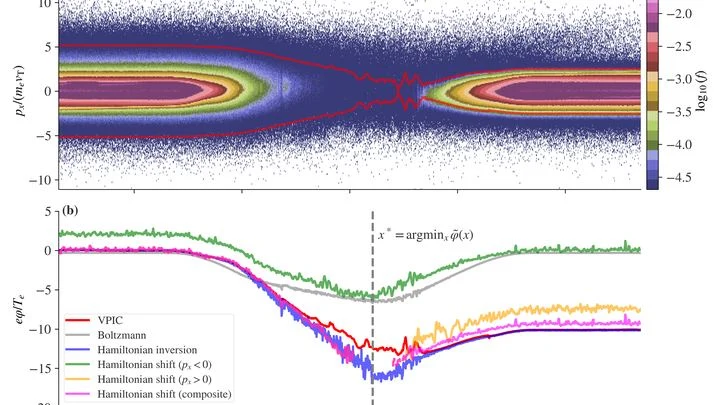
A fusion reactor is like a super-hot furnace where plasma reaches millions of degrees. The walls are made of tungsten, the most refractory metal there is. But even tungsten needs protection: fast particles from the plasma bombard the surface and knock atoms loose. These ejected atoms enter the plasma and cool it down, like a spoonful of cold milk in hot tea.
A neuron transmitting a signal is like a tiny battery that quickly discharges and recharges. For nearly 70 years, it was believed that a special "potassium valve," opening with a delay, was responsible for the recharge phase. New work claims this current is a ghost.
Soil is not a solid sponge but a labyrinth of pores of various sizes. After rain, water does not fill them all at once: first the narrowest ones, then the wider ones. Physicists built a theory of this process based on a simple image — a set of communicating vessels.
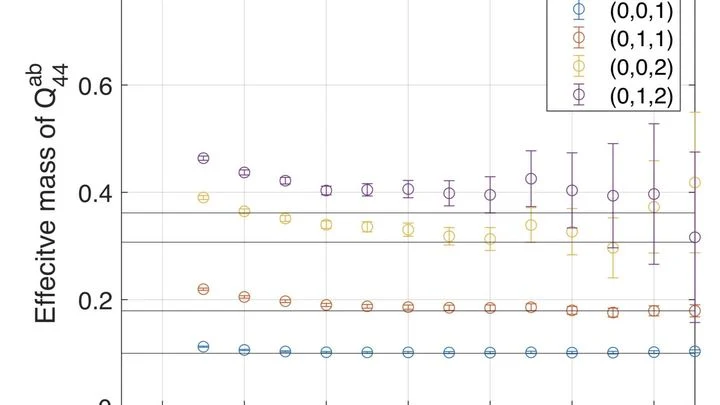
Quantum vacuum resembles a sea, constantly rippling with tiny splashes. An electron in an atom moves in this sea, and its path slightly changes due to the waves. Previously, such corrections were accurately calculated only for hydrogen-like ions with a single electron. But in highly charged ions with several electrons, the picture becomes more complex.
The Moon isn't just hanging in the sky: it leaves behind a long tail of disturbed solar wind. The stream of charged particles from the Sun flows around the rocky sphere, and behind it forms a zone where particles are almost absent. But this emptiness is not simple: electric fields arise in it that push apart the remaining electrons and ions.
In a thin semiconductor channel, electrons behave not like lone runners but like a crowd at rush hour. They constantly bump into each other, and these collisions determine how easily heat and electric current pass through the material.
If you place a kaon in an electric field, it stretches slightly, like a balloon rubbed on wool. This response, the electric polarizability, shows how rigidly the particle is built inside. For the charged kaon, it has been measured for the first time, and the number is about one ten-thousandth of the volume occupied by a proton.
A membrane for water electrolysis is like a sponge soaked with water. Inside it, hydroxide ions, particles that carry electric charge, must move freely. But exactly how they move has long been a mystery: tracking each ion in an experiment is too difficult.
A cell is a city with gates. Each gate is a protein channel in the membrane: through it, ions, sugars, and signaling molecules pass in and out. Some gates are almost always open, while others open and close randomly, like subway doors that let a passenger through one moment and slam shut in their face the next.
An ion channel in a cell membrane is a gate just a few atoms wide. Every second, millions of charged particles, sodium and potassium ions, pass through it. Classical physics said that to get through, an ion must jump over an energy barrier, like a traveler crossing a high mountain pass.
Hydrogen is the lightest fuel, and its conversion into electricity on a metal surface resembles a game of ping-pong: hydrogen atoms alternately attach to and detach from the electrode. But the score in this game depends on solution acidity in ways that were unexpected. Classical formulas predict a smooth change, while experiments show jumps and kinks.
An electron beam strikes a proton like a billiard ball hitting another ball. But between them is no empty space: the particles exchange virtual photons and Z bosons, like players passing a ball behind their backs. This exchange slightly alters the scattering trajectory, and hidden within it is a hint of new physics.