Polarizability is a measure of how easily an atom's or molecule's electron cloud is distorted by an external electric field. When an electric field is applied, the negatively charged electrons shift slightly relative to the positively charged nucleus, creating an induced dipole moment. This property influences how atoms interact with light, other atoms, and surfaces.
History
The concept dates back to the 19th century with the work of Faraday and Maxwell on dielectrics. The quantum mechanical treatment was developed in the early 20th century, with contributions from Schrödinger and others.
How it works
The induced dipole moment is proportional to the applied electric field, with the proportionality constant being the polarizability. In quantum mechanics, polarizability arises from the second-order perturbation of the energy levels by the electric field. It depends on the atomic structure: larger atoms with loosely bound electrons have higher polarizability. The dynamic polarizability varies with the frequency of the applied field, leading to effects like the AC Stark shift.
A fusion reactor is like a super-hot furnace where plasma reaches millions of degrees. The walls are made of tungsten, the most refractory metal there is. But even tungsten needs protection: fast particles from the plasma bombard the surface and knock atoms loose. These ejected atoms enter the plasma and cool it down, like a spoonful of cold milk in hot tea.
A perovskite solar cell is like a young athlete: it performs brilliantly at first, but tires with age. Over eight hours, its performance drops noticeably, with no visible cause like cracks or dust. Scientists took one cell and recorded its performance at 0, 90, 280, and 480 minutes of its life.
A black hole is not a vacuum cleaner. By itself, it doesn't pull everything in more strongly than an ordinary star of the same mass. But if there's a magnetic field nearby and charged particles flying around, an interesting game begins.
On the wall: light and dark fringes. That’s what light looks like when it cancels itself out.
Way back in the 17th century, Christiaan Huygens suggested that light is a wave.
A black hole is not just a dark silhouette against the stars. Its shadow is surrounded by a thin glowing ring of photons that loop around the event horizon before escaping to an observer.
Two grains of salt fall into a glass of water. They dissolve, and sodium and chloride ions spread throughout the volume. The schoolbook truth is simple: like charges repel, opposite charges attract. But recent experiments with tiny spheres in liquids have revealed a picture that breaks this rule.
A palm hovering over a hot stove feels the heat even when the surrounding air seems cool. Something similar happens to electrons in the Aharonov–Bohm effect: the particle senses an electric voltage even though it enters a region where the field has already been switched off.
A drop of water stretches in a strong electric field. The deuterium nucleus, a bound pair of a proton and a neutron, behaves the same way, except here the field comes from a passing gamma ray, and instead of just stretching, the nucleus can simply fall apart.
Vacuum is not silent emptiness, but a boiling cauldron of quantum fluctuations, born from nothing and vanishing in billionths of a second. This invisible symphony acts like a constant wind, pressing an atom against a wall — as if a powerful bass note pushes a light ball.
When particles collide at enormous speeds, they produce a shower of new particles. Among them are antiprotons — twins of ordinary protons but with the opposite charge. Each of these particles has its own spin, like a tennis ball sent with a twist. But whether antiprotons are actually spun up at birth has never been checked.
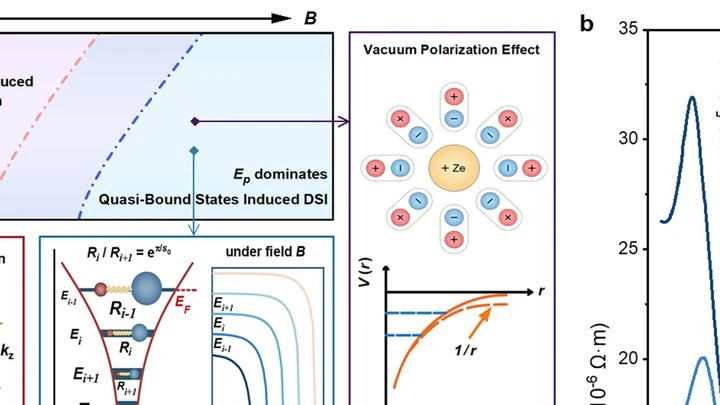
In the crystal HfTe5, electrons behave almost like light: their mass is so small that they obey the laws of relativity. If you place such a crystal in a strong magnetic field, the electrons start to circle in tiny orbits. Their energy then changes not smoothly but in steps, like floors in a building.
A thin film of soap on your hand conforms to the shape of your palm, but clench your fingers and the tension changes unevenly. A monolayer of molybdenum disulfide on a graphite substrate behaves in a similar way.
Light can hold an atom in place, just like a jet of air holds a lightweight ball. But a dysprosium atom is no ordinary ball: inside it has many "gears" (electrons) that respond differently to light of different colors. To catch such an atom and keep it from slipping away, you need to know exactly how strongly the light pulls on it.
You can make a light beam look like a flower with several petals. If you send such a beam through a cloud of cold rubidium atoms and switch on a magnetic field, the petals start to rotate. The angle of rotation is directly linked to the field's strength.
A crystal of calcium ions in a trap, illuminated by a laser, is a tiny model of the matter inside a white dwarf. There, in the depths of a dying star, atomic nuclei arrange into a rigid lattice as the temperature drops.
Two tiny emitters, each about the size of an atom, can together do what neither can do alone. We're talking about light scattering — when light hits particles and bounces off in all directions. Usually, a pair of particles scatters light only slightly more than a single one.
When two different materials are pressed together and then pulled apart, a spark jumps between them. Anyone who has pulled off a wool sweater in the dark or gotten a shock from a doorknob knows the feeling. For a long time, it was thought that charges simply hop from one surface to another due to differences in material properties.
Toss a handful of pebbles into a pond, and the spreading ripples intersect, creating splashes and calms. That’s roughly how gravitational waves, predicted by Einstein, behave. Except it’s not water that’s oscillating, but spacetime itself.
In a giant particle accelerator, where protons traveling at nearly the speed of light smash into a neon target, charmed baryons are born — particles that live for less than a billionth of a second.
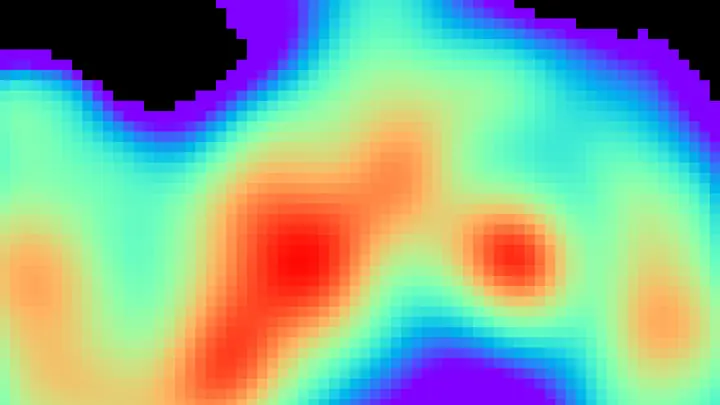
In the dark cloud L43, where stars are born, dust grains twirl like tiny compasses. Light from a young star pushes them, while the magnetic field lines them up in a specific direction. When a grain is turned sideways to us, its heat reaches us polarized, like light passing through a narrow slit.
A beam of circularly polarized light hits a MAPbI3 perovskite crystal. The electrons inside start behaving like tiny spinning tops, their axes aligning along the beam. This phenomenon is known as optical spin orientation.
Terahertz radiation sits between microwaves and infrared light. It passes through clothing, paper, and plastic, but not through metal or water. That's why it's used in security scanners and medical imaging. To see the polarization of such radiation, you need a detector.
Light traveling through an optical fiber is like a runner in a narrow corridor: it can run straight, or it can weave from side to side. The direction of these "weaves" is polarization. Physicists have learned to keep the runner on a straight path: they constantly check its trajectory and gently correct it, not letting it veer off.
A neutron star is the ultra-dense remnant of a supernova explosion, whose existence was predicted by Fritz Zwicky back in the 1930s. Later, Jocelyn Bell Burnell detected them as pulsars — rotating sources of strictly periodic radio signals.
The ACT telescope in Chile's Atacama Desert stared at the sky from 2007 to 2022. Its target: the cosmic microwave background, light that has been traveling toward us for 13.8 billion years. This light is polarized: its waves oscillate in specific planes, like strings stretched in different directions.
Two voices in a molecular duet can sound in unison or cancel each other into silence. In physics, such silence is called a dark state: a quantum excitation that does not interact with light and therefore lives unusually long.
Four cesium atoms hang in vacuum, held by laser tweezers like beads on an invisible thread. Around them is a ring resonator, a closed loop of mirrors where light circulates without obstacles. When a probe beam strikes this tiny chain, something strange happens: the atoms scatter light not uniformly in all directions, but predominantly in one direction.
Six barium ions lined up in a flat hexagon inside a Paul trap, a device that holds charged particles with oscillating electric fields. But a slight change in the shape of the trapping potential made the crystal rearrange: one ion moved to the center, and the other five formed a ring around it.
Niels Bohr insisted: you cannot simultaneously know which path a photon took and see interference. For a long time, this was considered a limitation of knowledge — we simply cannot obtain both types of information at once.