The coulomb (symbol: C) is the SI unit of electric charge. It is defined as the amount of charge transported by a steady current of one ampere flowing for one second. In practical terms, one coulomb is a very large charge — roughly 6.24 × 10^18 times the elementary charge (the charge of a single proton or electron). This unit is fundamental to describing everything from the flow of current in a wire to the forces between charged particles.
History
The unit was named after the French physicist Charles-Augustin de Coulomb, who formulated Coulomb's law in the 1780s. The name was officially adopted by the International Electrical Congress in 1881, and later incorporated into the SI system.
How it works
The coulomb is a derived unit in the International System of Units (SI), built from the ampere (the base unit of electric current) and the second. Because charge is conserved and quantized, any macroscopic charge is an integer multiple of the elementary charge (about 1.602 × 10^-19 C). The coulomb is used in Coulomb's law to quantify the electrostatic force between two charges, and in defining the volt (energy per unit charge) and the farad (capacitance).
In practice
The coulomb is used in battery capacity ratings (e.g., ampere-hours), in specifying the charge stored in capacitors, and in calculations for electrochemistry and semiconductor physics.
Fun fact
A lightning bolt carries about 5 to 15 coulombs of charge, which is enough to power a 100-watt light bulb for about a minute.
Systems:SIThe coulomb is defined as the amount of electric charge transported by a constant current of one ampere in one second.
Water in a glass looks continuous, but it's actually a dance of trillions of molecules constantly breaking and forming bonds. Seeing this dance in full detail was previously impossible: accurate calculations that account for the quantum properties of electrons could only handle tiny droplets of a few hundred atoms. The new model UBio-MolFM changes the game.
In 1994–1995, the LEP accelerator collided electrons and positrons, producing Z bosons that promptly decayed into showers of particles. The DELPHI detector recorded these events, and now, decades later, a new pattern has been found in that data: the electric charge within particle jets is not distributed randomly but follows a simple sine curve.
Electric charge is a slippery thing. You can measure how much there is in the entire universe or in a single particle, but try to point your finger and say, 'Right here, in this cubic centimeter, there is exactly this much charge right now,' and you hit a fundamental wall.
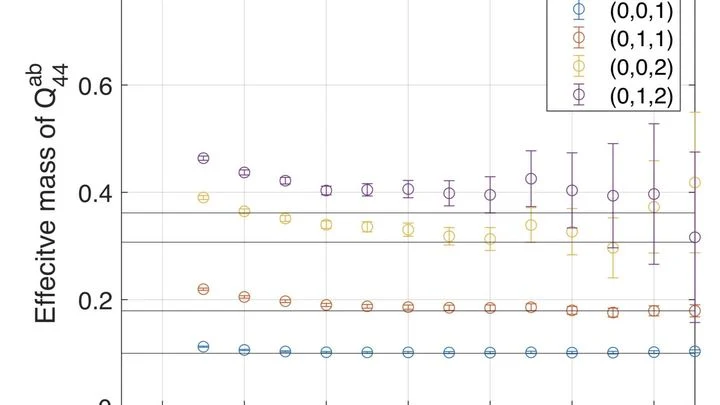
The issue is that total charge, which physicists denote by the letter Q, is nonlocal.
Drop by drop from a faucet, or a steady stream without a single splash. That's roughly what the two regimes of current in a superconducting contact look like. Only here, the role of water is played by Cooper pairs — bound electrons that move without resistance.
When massive bodies accelerate (say, two stars orbiting each other) the space around them doesn't stay calm. It trembles like the surface of a pond after a stone is thrown. These tremors are called gravitational waves. They carry energy away, and the source gradually loses mass.
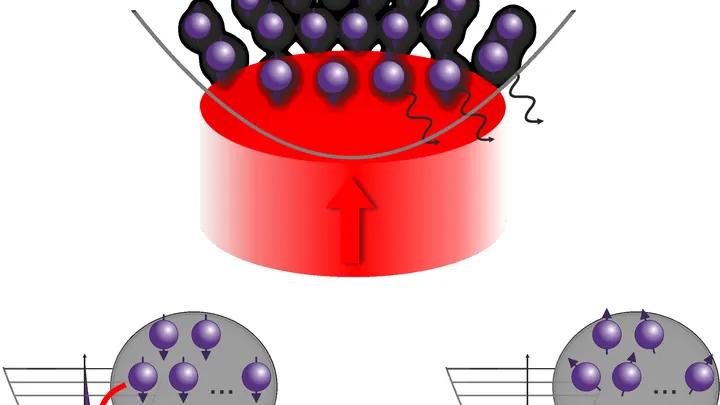
A tiny crystal of charged atoms, trapped in a trap, trembles with heat. Each ion oscillates like a ball on a spring, and these vibrations hinder using the crystal for precise quantum operations. Usually, excess energy is removed with a laser — the beam hits the ions and slows their motion, like a stream of air damping a pendulum.
Atomic nuclei are rarely perfect spheres. More often, they resemble a slightly squashed ball — the electric charge inside is unevenly distributed, and protons may shift a bit, creating a tiny 'pear-shaped' bulge.
A firework bursts, and one point explodes into four sparks at once. That's how the Z boson, the particle that carries the weak force, behaves when it decays into four charged leptons (electrons or muons). The process is extremely rare: for every million Z bosons produced, only about five decay this way.
A coin landing on its edge is about as rare as a heavy B meson decaying into a light pion and an electron-positron pair. Over a decade of collider operation, only a handful of such events have accumulated, but physicists have finally managed to spot them.
The decay probability is about 2.4×10⁻⁸.
A drop of water stretches in a strong electric field. The deuterium nucleus, a bound pair of a proton and a neutron, behaves the same way, except here the field comes from a passing gamma ray, and instead of just stretching, the nucleus can simply fall apart.
If you place a kaon in an electric field, it stretches slightly, like a balloon rubbed on wool. This response, the electric polarizability, shows how rigidly the particle is built inside. For the charged kaon, it has been measured for the first time, and the number is about one ten-thousandth of the volume occupied by a proton.
When heavy nuclei collide in accelerators, a multitude of particles is produced, and physicists want to understand how electric charge moves through this chaos. Two trains crash into each other: the passengers (quarks) scatter, but their luggage (charge) may end up far from the crash site.
In 1978, physicists bombarded a target with a beam of ions and measured how quickly they slowed down in matter. Using the Doppler shift of gamma rays, they calculated the lifetimes of excited nuclear states. For iron-58, they obtained a value that did not agree with shell-model calculations.
A tiny glass sphere floats in a laser beam like a speck of dust in sunlight. Inside it is radioactive lead, which decays from time to time. Each decay ejects charged particles, and the sphere loses or gains a tiny electric charge.
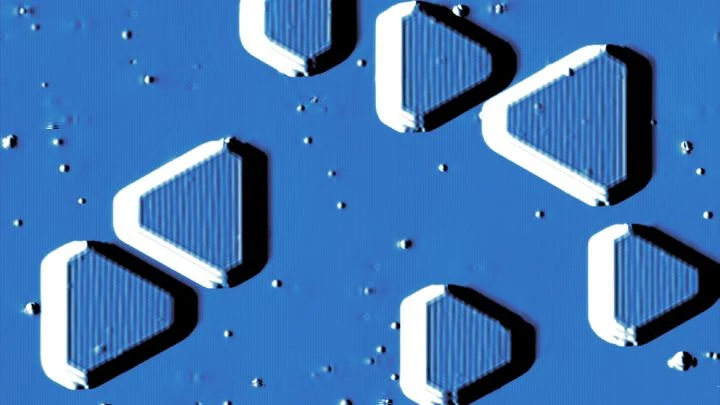
A drop of metal on a semiconductor is like an island in the sea. For an electron to reach that island, it must pay a "toll": overcome a barrier that arises because the island is tiny, and each extra charge significantly changes its energy. This phenomenon is called Coulomb blockade. It underpins single-electron transistors, where current flows one electron at a time.
The nucleus of deuterium, or the deuteron, can be pictured as a microscopic spinning top. If its charge distribution is not perfectly symmetric, then in an external electric field this top experiences a minuscule tilt of its spin axis.
In a giant particle accelerator, where protons traveling at nearly the speed of light smash into a neon target, charmed baryons are born — particles that live for less than a billionth of a second.
An atomic nucleus usually has a well-defined shape — elongated like a melon or flattened like a pumpkin. But silicon-30 behaves differently: it seems unable to make up its mind.
In an accelerator, particles collide, and for a fleeting instant a D meson is born — a particle that lives for less time than it takes light to cross a grain of sand. It promptly shatters into lighter fragments: a kaon, a lepton, and a neutrino.
The neutron is a particle with no charge but with internal structure. Like a ball that looks smooth on the outside but has a complex filling inside. Scientists have long wanted to understand how electric and magnetic forces are distributed inside the neutron. To do this, you need to "feel" it — collide it with its antiparticle and see what happens.
In a quiet lab, a device the size of a microwave oven sits on a table. Inside, a coil glides smoothly up and down while a computer reads electrical signals. This is the tabletop Kibble balance — a machine that links mass to quantum constants.
Previously, such balances occupied a whole room and required a team of engineers.
Diamond is not just a gemstone. This crystal can conduct electricity when free charge carriers, electrons and holes, appear in it. But how fast do they move? In scientific papers, numbers vary by tens of times. One lab reports a mobility of 1000 cm²/(V·s), another 4000.
After an injection under the skin, a drug doesn't just spread out like ink in water. Antibody molecules carry an electric charge, and that charge makes them interact with surrounding tissues — much like a magnet attracts or repels iron filings.
Measured dipole moment of tantalum-181: 3.39 × 10⁻³² e·cm — like spotting a one-atom shift across the entire Solar System. An ordinary atomic nucleus is perfectly balanced, like a spinning top. In tantalum, that balance is broken: the positive and negative charges are slightly offset from each other.