A Solar Prominence Backlit express
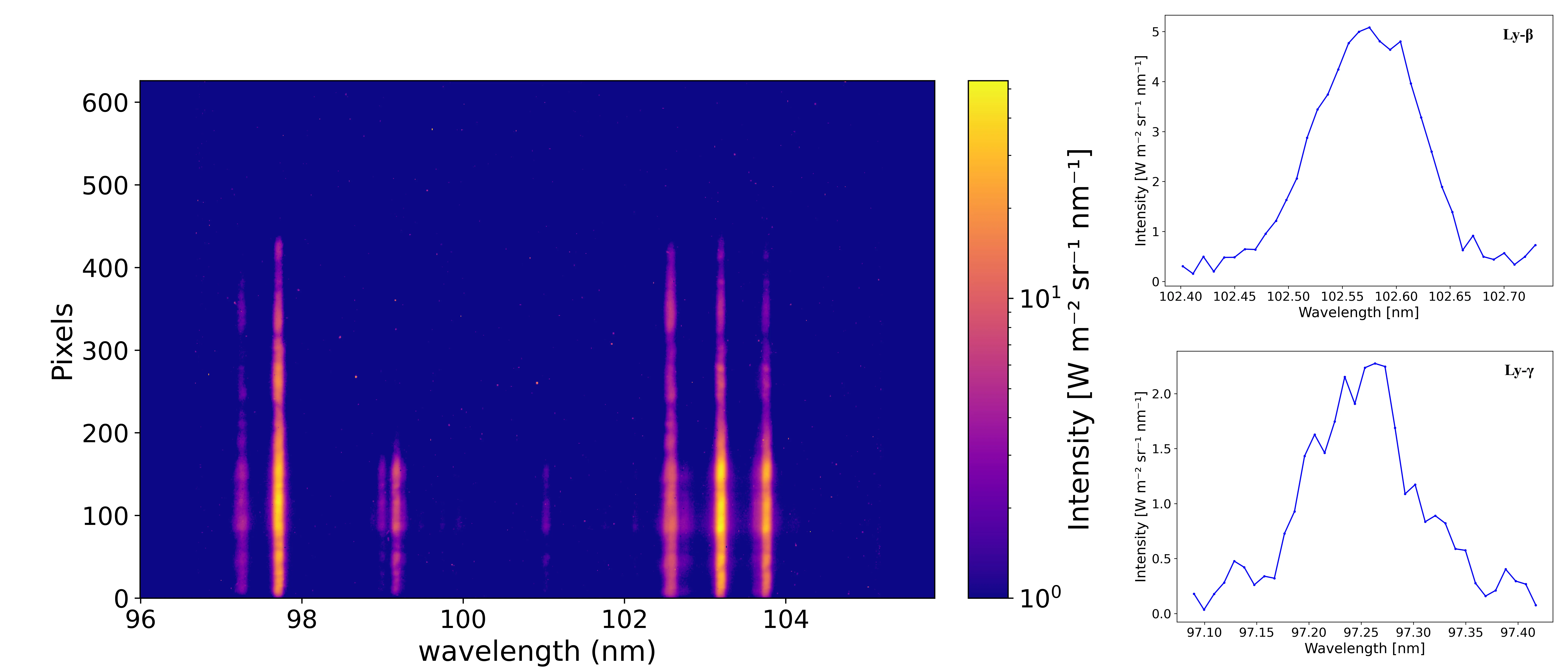
Above the Sun's limb hangs a cloud of tenuous, hot gas — a prominence. It can linger for weeks, then suddenly break loose and fly off into space. On April 15, 2023, the SPICE instrument on the Solar Orbiter probe got its first detailed look at such a cloud in ultraviolet light.
The SPICE spectrometer split the prominence's light into colors, much as a prism splits a white beam into a rainbow. In this spectrum, bright hydrogen lines, Lyman-beta and Lyman-gamma, stand out. Their brightness and width reveal what's going on inside the cloud: how dense, hot, and transparent it is.
It turns out that just before breaking away, the prominence begins to "breathe": density and temperature in different parts change unevenly. Some regions brighten, others dim. It's like the wind picking up and dying down before a storm, but on a scale of hundreds of thousands of kilometers.
Meanwhile, the ground-based GONG telescope was imaging the same cloud in the red light of hydrogen (the H-alpha line). By comparing two images taken at different times, scientists calculated that the prominence was rising at about 30 kilometers per second. That's like driving from Moscow to St. Petersburg in half a minute.
Such measurements matter not only to astronomers. When a prominence breaks off, it becomes a coronal mass ejection — a cloud of charged particles that heads toward Earth and can trigger magnetic storms. The earlier we spot the first signs of detachment, the more accurate our space weather forecasts.
Original abstract
as written by the authors arXiv:2604.13990
The first dedicated observation of an off-limb prominence by the Spectral Imaging of the Coronal Environment (SPICE) instrument on board Solar Orbiter took place on April 15, 2023. Our aim is to provide an overview of the potentiality of the diagnostics using these data. We show that we can derive the changes in the physical parameters of the pre-eruptive and eruptive prominence using the Lyman lines. We investigate the integrated intensity and line widths of the Lyman $$\beta$$ and Lyman $$\gamma$$ lines, finding variations between the prominence, disk, and coronal regions. The results reflect dynamic changes in density, temperature, and optical thickness. We analyze the spatial and temporal evolution of the Lyman $$\beta$$ and Lyman $$\gamma$$ line profiles. Using a simple geometric model, we obtain the radial velocity of this prominence at the early phase of its eruption with GONG H$$\alpha$$ images. This offers a way of calculating the radial velocity of an eruptive filament from a pair of 2D images. The result helps us understand the potential Doppler effect in line profiles. Overall, the spectral profiles indicate that the eruption enhances spatial and temporal variations in line intensity, reflecting dynamic changes in plasma conditions within the prominence. These findings highlight the diagnostic potential of SPICE observations, and future Non-LTE radiative transfer modeling will help to further constrain prominence plasma parameters.
The Lyman lines are named after American physicist Theodore Lyman, who discovered them in 1906. They arise when an electron in a hydrogen atom jumps from the first orbit to a higher one and back.
In the movie Knowing (2009), a powerful solar flare wipes out life on Earth. Prominences are precursors to such flares, and studying them helps us gauge how real that threat is.