H-alpha is a specific deep-red spectral line of hydrogen, with a wavelength of 656.28 nanometers, produced when an electron in a hydrogen atom drops from the third to the second energy level. In astronomy, it is a crucial tool for observing the Sun and other celestial objects. Because hydrogen is the most abundant element in the universe, H-alpha emission is a common tracer of hot, ionized gas, such as in solar flares, prominences, and nebulae. For solar observations, H-alpha filters allow astronomers to see the chromosphere, a layer of the Sun's atmosphere, revealing dynamic features like filaments, prominences, and flares that are invisible in white light.
History
The H-alpha line was first identified in the 19th century as part of the hydrogen spectrum, with the Balmer series (which includes H-alpha) described by Johann Balmer in 1885. Its use in solar astronomy became widespread in the early 20th century with the development of spectroheliographs and later, in the 1950s, with the invention of the Lyot filter, which allowed narrowband imaging of the Sun.
How it works
When a hydrogenatom absorbs energy—from heat, radiation, or collisions—its electron jumps to a higher energy level. When the electron falls back to the second level (n=2), it emits a photon with a specific energy corresponding to the H-alpha wavelength. In the Sun, this emission is particularly strong in regions of intense magnetic activity, such as sunspots and flares. By using narrowband filters that isolate the H-alpha wavelength, astronomers can block out most of the Sun's bright light and see the faint glow of the chromosphere, where these features are prominent.
In practice
H-alpha filters are used in solar observatories and amateur astronomy to monitor solar activity, predict space weather, and study the Sun's magnetic field. They are also used to map star-forming regions in distant galaxies and to measure the velocities of gas clouds via the Doppler effect.
Fun fact
The H-alpha line is so bright in the Sun that it can be seen during a total solar eclipse as a reddish glow at the edge of the Moon's shadow, which is why solar prominences appear pink.
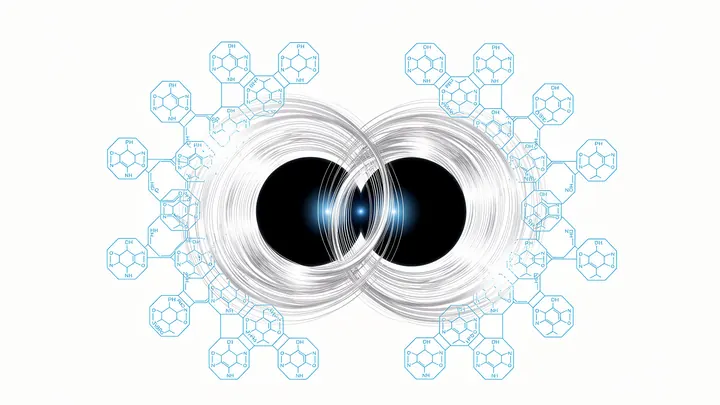
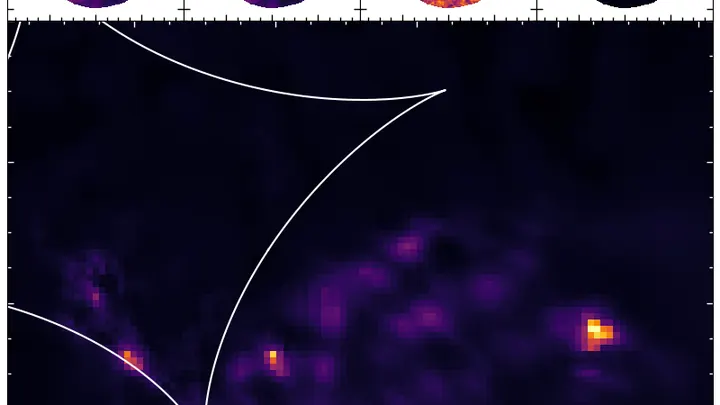
The heart of a black hole beats unevenly. One thump is brighter, another dimmer, and this rhythm encodes the temperature of the electrons swirling right at the horizon. Astronomers call this rhythm the spectral index: a number that shows how much brightness changes as you move from one radio frequency to another.
The Sun's edge looks like a fuzzy fringe: thin jets of hot gas, spicules, shoot upward from it. They live only a few minutes and are constantly changing. In 2024, a balloon-borne telescope managed to spot not only the jets themselves but also their faint glow in hydrogen lines that had never been captured there before.
When stars are born in a galaxy, they make hydrogen glow, like a neon sign, but on a cosmic scale. This light could tell us a lot about how many stars are forming, but on its way to us, it passes through cosmic dust. Dust is like a fogged-up window: it dims the glow and alters its color.
Betelgeuse, the red supergiant familiar from Orion's shoulder, keeps surprising us. After the mysterious Great Dimming of 2019–2020, when the star suddenly dimmed, it didn't just recover; it changed its ways.
Measuring distances in the universe is no easy task. Almost all methods rely on light, which can be absorbed by dust, scattered, or distorted along the way. It's like trying to spot a distant lighthouse through fog and haze. Neutrinos are a different story. These ghostly particles pass through anything without noticing obstacles.
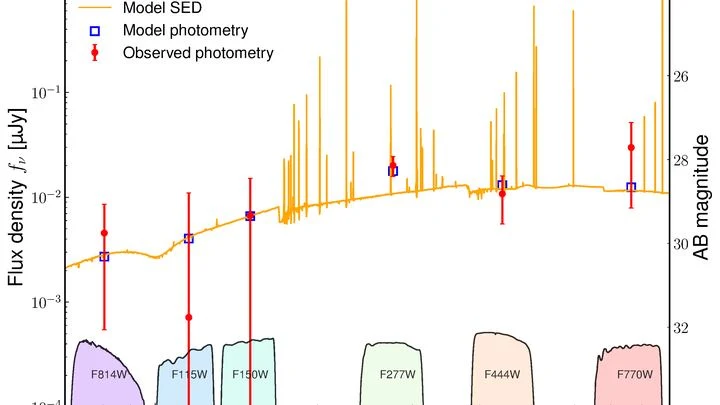
In the deep field of JWST, among thousands of galaxies, astronomers zoomed in on the source JADES-GS 209777 – and saw a cosmic chick. Its "shell" is a thick cocoon of gas and cosmic dust that long hid the growing black hole at its center. But at a redshift of 3,711 (1,8 billion years after the Big Bang), the shell began to crack.
The era of cosmic noon is a time when the Universe was experiencing its stormy youth. Three billion years after the Big Bang, galaxies were giving birth to stars at a frantic pace, and supermassive black holes were growing in their centers.
The Sun is not just a blazing ball, but a colossal orchestra, where the strings are solar filaments — giant arches of dense plasma floating in the scorching corona. They tremble, and each oscillation is an encrypted melody of magnetic fields.
A world where a year lasts just one and a half Earth days, and the star in its sky is hundreds of times larger than our Sun. This is KELT-9 b — a gas giant heated to temperatures at which iron vaporizes. Its atmosphere is not just hot; it is literally boiling away into space, like steam rising from a giant cauldron.
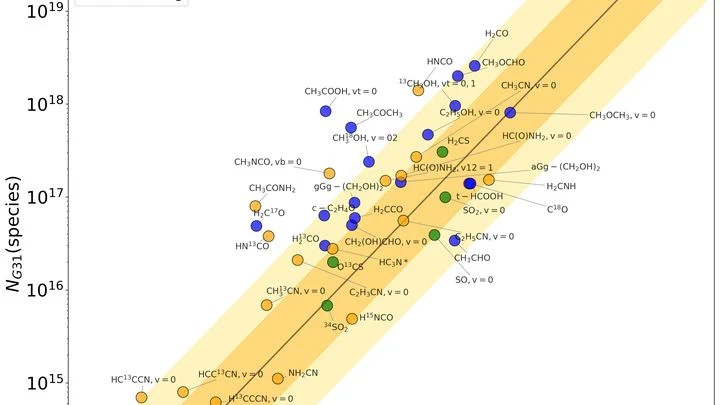
In an oven, a huge loaf of bread is baking. Inside the dough, there is a tiny, hottest spot: that's where the future loaf begins to rise. A hot molecular core (a region the size of the Solar System, where gas is heated to hundreds of degrees and compressed to billions of times the density of ordinary clouds) works in much the same way.
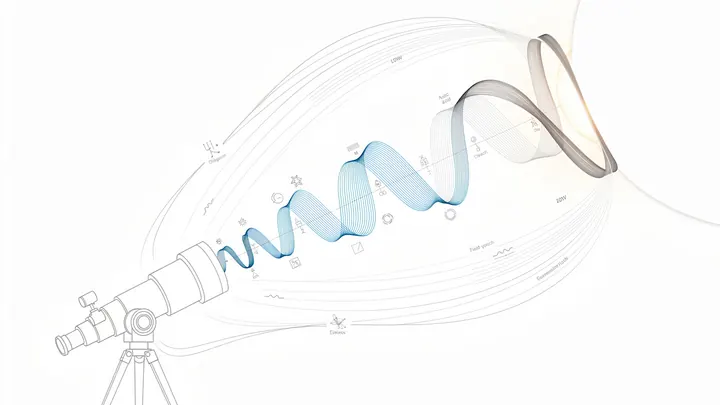
Imagine a packed orchestra, each musician playing their own part, while you try to pick out the quiet voice of a rare flute: its melody drowns in the sound of violins and trumpets. That's what hunting for molecules in interstellar clouds is like: telescopes pick up the 'radio voices' of countless substances, and picking out the signal you want from the noise is no easy task.
A magnifying glass focuses sunlight into a bright point. If the glass has a tiny flaw, the spot of light becomes distorted. Gravitational lensing works in a similar way: a massive galaxy bends light rays from a more distant source, creating an enlarged and sometimes distorted image.
The ionosphere at an altitude of 70 kilometers acts like a giant mirror for radio waves. Ground antennas constantly beam signals into it and listen for the reflection. When a solar flare occurs on the Sun, a stream of X-rays reaches Earth in 8 minutes and compresses the lower layer of the ionosphere.
If you shrank an ordinary black hole to the size of a grain of sand, it would shine like a tiny star and quickly vanish in a flash. That's Stephen Hawking's prediction: the event horizon acts like a hot surface emitting particles.
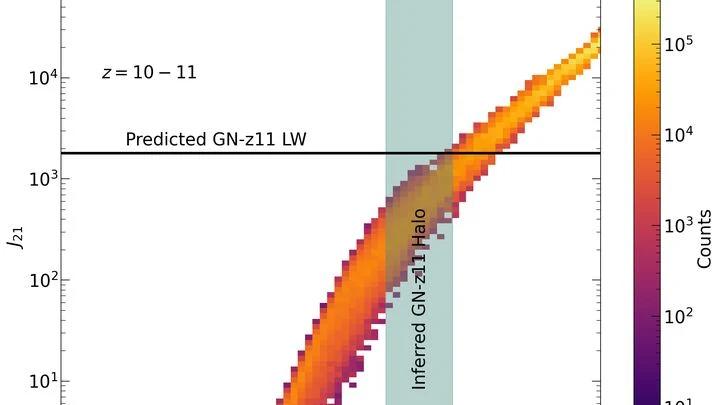
A bonfire built of pure alcohol burns hot and gives off almost no smoke. That's roughly how the first stars shone: they contained no heavy elements, only hydrogen and helium left over from the Big Bang. The James Webb Space Telescope may have caught one such "bonfire" in the galaxy GN-z11.
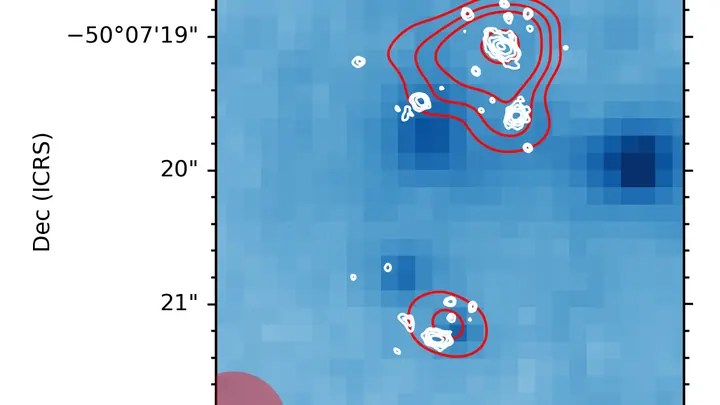
In a dense cloud of gas and dust where giant stars are born, the ALMA telescope has spotted something familiar. Four thin gas jets shoot out from the same region, each leaving behind a chain of bright knots, like a dashed line.
Around young stars, flat clouds of gas and dust swirl, like pizza dough from which planets will eventually be shaped. This cloud contains various chemical elements, and sulfur is one of the most elusive: it's hard to catch with telescopes because it hides in solid grains or escapes as gas.
A pulsar is a dead star spinning at breakneck speed, sending out radio pulses like a lighthouse. But for PSR J1928+1815, the signal sometimes cuts out for 3.6 hours. Something is blocking the beacon. A companion star orbits the pulsar, and its shadow falls on us.
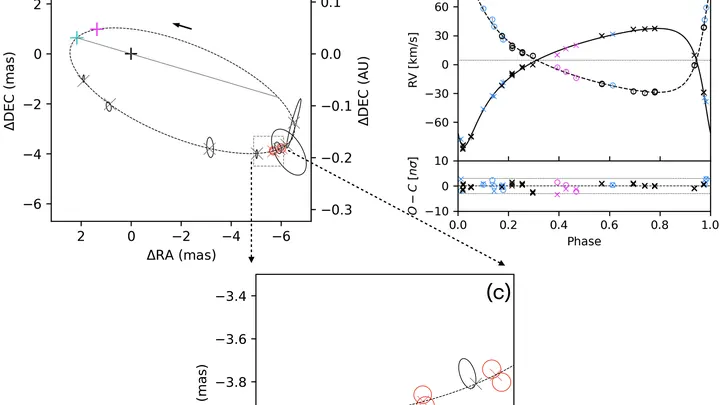
In the constellation Pisces, there is a star that people have seen for thousands of years, but only now have they discerned its inner structure. Alpha Piscium is not one star, nor even two, but a whole family: two pairs of stars bound by gravity. Astronomers had suspected that a third star lurked in the second pair, but they couldn't see it: it was too crowded.
When a star like the Sun runs out of hydrogen, it swells into a red giant, and helium piles up in its core. At some point, the helium ignites — in a few seconds, it releases as much energy as the star had radiated over thousands of years. This is a helium flash.
Dark matter is like an invisible glue that holds galaxies together. It emits no light, but if its particles collide, gamma rays can flash. Scientists hunted for such flashes in dwarf galaxies — small stellar clusters with lots of dark matter and almost no ordinary matter.
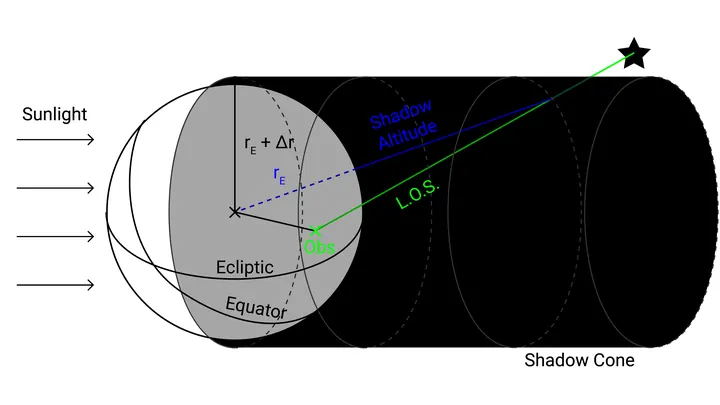
At night, the sky is never completely black. Even far from cities, the upper atmosphere glows faintly: sunlight makes hydrogen atoms emit a reddish glow that astronomers call geocoronal emission. For a telescope, it's like a fogged-up window: it adds extra light and hinders seeing distant galaxies.
In the deep cosmos, more than 12 billion light-years away, the James Webb Space Telescope has spotted a galaxy that looks like a visitor from the dawn of creation. Its light has been traveling to us since the universe was only about two billion years old — a time when galaxies were growing especially vigorously, a period astronomers call the cosmic noon.
A short laser pulse strikes the air, and a tiny lightning bolt flashes at the point of impact. It lives longer than you'd think: the bright glow is visible for half a millisecond, and a faint one for nearly twenty milliseconds.
A river of stars (not a cluster, but a distinctly elongated, glowing ribbon) crosses the outskirts of a distant galaxy. Such a stream was spotted in data from the first survey by the Vera Rubin Observatory. It stretches along the minor axis of the galaxy LEDA 751050, like a scarf streaming from the galactic disk.
The stream is enormous: 130 by 15 kiloparsecs.
The RATAN-600 radio telescope is a ring of hundreds of aluminum panels on a mountainside in Karachay-Cherkessia. In the spring of 2018, its mirror caught radio waves from sixteen red dwarfs — small, dim, but very long-lived stars.