The Lyman-alpha line is a specific wavelength of ultraviolet light emitted by hydrogen atoms when their electrons drop from the first excited state to the ground state. At 121.6 nanometers, it is the strongest hydrogen emission line in the ultraviolet part of the spectrum. Because hydrogen is the most abundant element in the universe, this line serves as a powerful beacon for detecting and studying gas clouds, star-forming regions, and entire galaxies, even those at very large distances.
History
The line was first explained by the American physicist Theodore Lyman, who discovered it in 1906 while studying the ultraviolet spectrum of hydrogen. He found a series of lines in the far ultraviolet, now known as the Lyman series, with the Lyman-alpha line being the most prominent.
How it works
When a hydrogen atom absorbs energy, its electron jumps to a higher energy level. The Lyman-alpha line corresponds to the transition from the n=2 level to the n=1 level, releasing a photon with a specific energy. In star-forming galaxies, massive young stars ionize surrounding hydrogen gas; when the electrons recombine and cascade down to the ground state, they emit Lyman-alpha photons. These photons can travel vast cosmic distances, though they are often scattered by neutral hydrogen gas, making their escape from galaxies a complex process that astronomers study to understand the structure of the early universe.
In practice
Astronomers use Lyman-alpha emission to identify and study distant galaxies, particularly in surveys of the early universe, and to probe the intergalactic medium by observing Lyman-alpha absorption in quasar spectra.
Fun fact
Because the Lyman-alpha line is so strongly absorbed and re-emitted by neutral hydrogen, its escape from a galaxy is a complex process that can make some star-forming galaxies appear surprisingly bright or faint in this specific wavelength, a phenomenon known as 'Lyman-alpha leakage'.
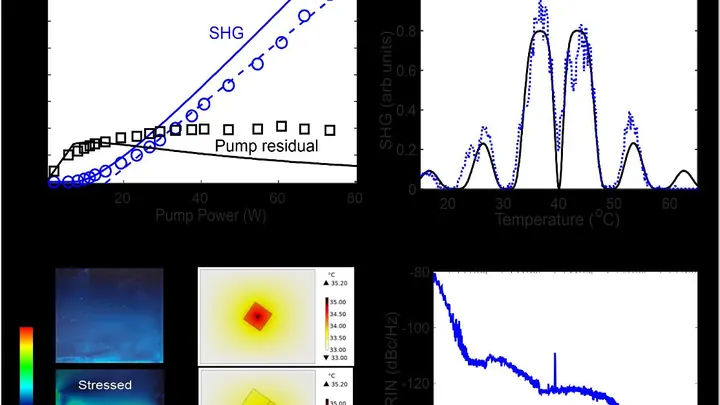
The mirror races along at nearly forty thousand kilometers per second. Light that strikes it bounces back, but changed, like a ball volleyed by a racket in mid-swing. That's exactly the kind of mirror scientists have built inside an ultra-thin glass thread filled with hydrogen.
First, a powerful laser pulse is sent down the fiber.
The Sun's edge looks like a fuzzy fringe: thin jets of hot gas, spicules, shoot upward from it. They live only a few minutes and are constantly changing. In 2024, a balloon-borne telescope managed to spot not only the jets themselves but also their faint glow in hydrogen lines that had never been captured there before.
The night sky is full of deceptive lights. Astronomers were searching for galaxies that ignited in the first few hundred million years after the Big Bang: their light has traveled to us for nearly 13 billion years. Six faint smudges were selected from images taken by the Hubble and Spitzer space telescopes.
When stars are born in a galaxy, they make hydrogen glow, like a neon sign, but on a cosmic scale. This light could tell us a lot about how many stars are forming, but on its way to us, it passes through cosmic dust. Dust is like a fogged-up window: it dims the glow and alters its color.
Imagine a huge stadium packed with people dressed in black. You're standing outside, trying to figure out what's happening inside, even though you can't see a single person. But if two people bump into each other and exchange bright T-shirts, you'd spot a flash of color.
A bright lantern in thick fog seems dim, while a weak flame in clear air can be seen a kilometer away. A similar oddity baffled astrophysicists almost half a century ago.
Light from quasar J0744+2052 traveled to us for almost 12 billion years. Along the way, it bumped into hydrogen clouds that snatched individual lines from the spectrum — like a comb sifting through delicate frequencies. Astronomers call this pattern the Lyman-alpha forest in spectroscopy.
A world where a year lasts just one and a half Earth days, and the star in its sky is hundreds of times larger than our Sun. This is KELT-9 b — a gas giant heated to temperatures at which iron vaporizes. Its atmosphere is not just hot; it is literally boiling away into space, like steam rising from a giant cauldron.
The universe is permeated by invisible mass, dark matter, whose existence was first proposed by Fritz Zwicky in the 1930s, based on his observations of galaxies moving in clusters.
A factory laser that cuts and welds metal on production lines has been made to work as a particle accelerator for the first time. Physicists took a standard ytterbium laser, its heart is a crystal the size of a palm, and turned its flashes into a tool for accelerating electrons to nearly the speed of light.
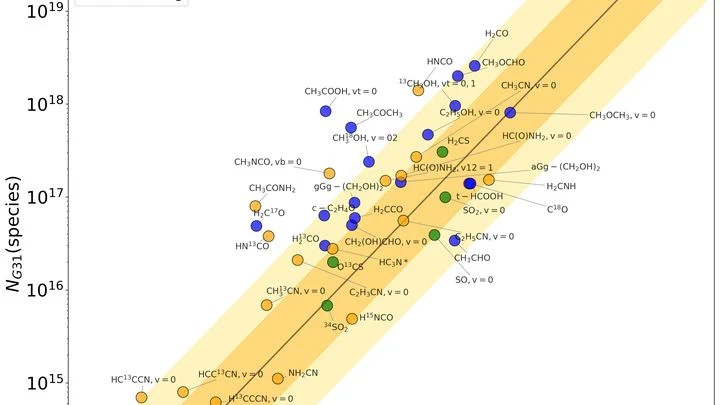
In an oven, a huge loaf of bread is baking. Inside the dough, there is a tiny, hottest spot: that's where the future loaf begins to rise. A hot molecular core (a region the size of the Solar System, where gas is heated to hundreds of degrees and compressed to billions of times the density of ordinary clouds) works in much the same way.
Dark matter is an invisible substance that reveals itself only through gravitational effects: it bends the light of distant galaxies, much like an unseen window that alters the path of light rays.
In the heart of a molecular cloud, a massive star is born. Its ultraviolet light ionizes hydrogen, and the cloud flares in the Lyman-alpha line. But for the photon, this flare is not liberation but imprisonment in a hall of mirrors.
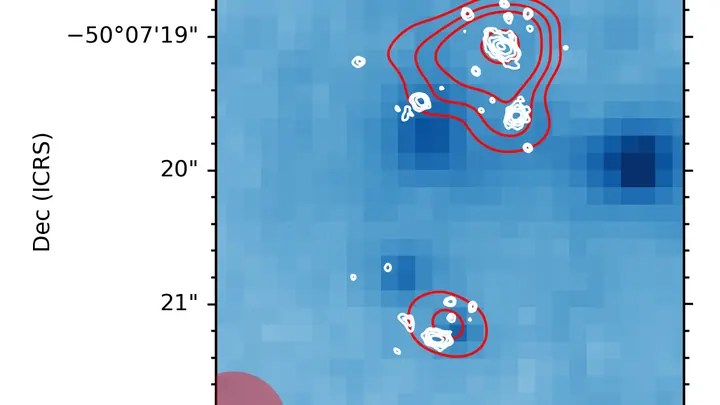
In a dense cloud of gas and dust where giant stars are born, the ALMA telescope has spotted something familiar. Four thin gas jets shoot out from the same region, each leaving behind a chain of bright knots, like a dashed line.
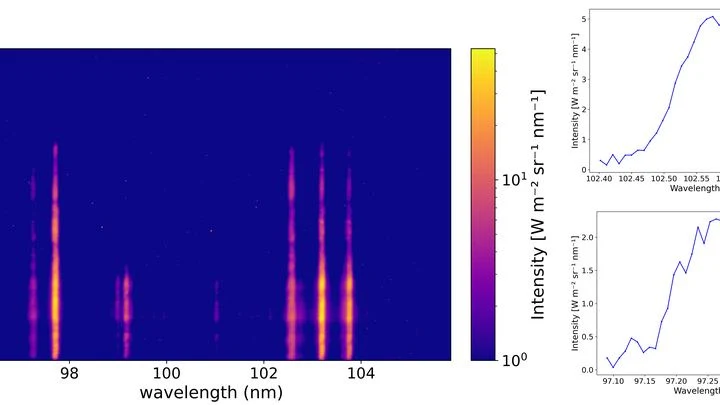
Above the Sun's limb hangs a cloud of tenuous, hot gas — a prominence. It can linger for weeks, then suddenly break loose and fly off into space. On April 15, 2023, the SPICE instrument on the Solar Orbiter probe got its first detailed look at such a cloud in ultraviolet light.
The Fermi telescope spent 17 years recording gamma rays from the active nuclei of galaxies with giant black holes at their centers. The glow of their jets resembles a chaotic cacophony: it constantly changes.
The laser based on diamond converts almost half of the pump energy into bright yellow light — an efficiency of 47.7%, a record for such devices. But the main advantage is not the power, but the exceptional purity of the color: the beam is so monochromatic that it can be compared to a musical instrument playing just one note without the slightest wavering.
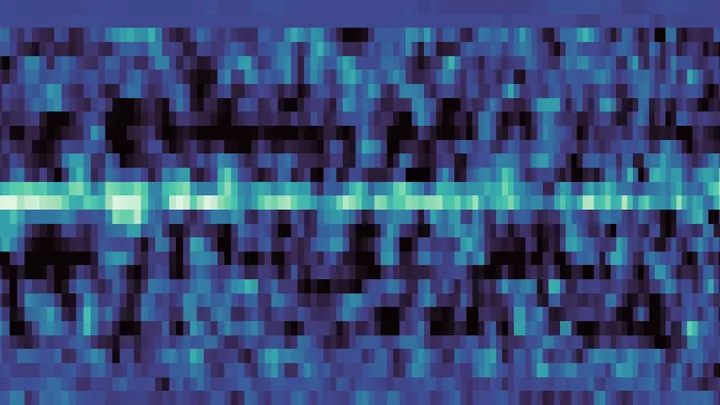
Light from a distant galaxy traveled to us for 13.4 billion years. The James Webb Space Telescope caught it and split it into colors. The spectrum shows a bright hydrogen line, like a fingerprint saying that galaxy GS-z13-1-LA is actively forming stars.
Young hot stars inside the galaxy act like floodlights.
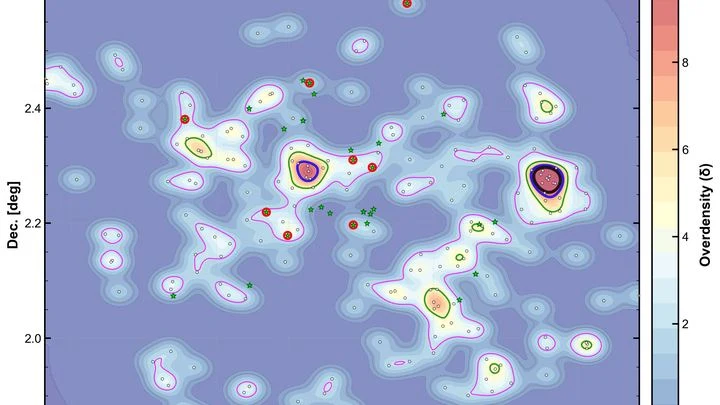
In the vast COSMOS field, where telescopes scrutinize thousands of distant galaxies, a special group stands out: four clumps of young galaxies spread over a patch of sky the size of several full moons. The main clump is so dense that it contains four times as many galaxies as the average across the sky.
A distant galaxy birthing hundreds of stars should glow in oxygen. That's what astronomers thought: hot young stars heat the gas, which then emits a characteristic infrared glow at a wavelength of 63 microns. It's like steam rising from a boiling pot — a sure sign of vigorous activity.
When a star like the Sun runs out of hydrogen, it swells into a red giant, and helium piles up in its core. At some point, the helium ignites — in a few seconds, it releases as much energy as the star had radiated over thousands of years. This is a helium flash.
One night in 2008, something in the core of the distant galaxy J1047+5907 flared sharply in X-rays. That's how the neighborhood of a supermassive black hole sometimes behaves: a scorching cloud of gas above it suddenly blasts out a powerful stream of light. The black hole itself emits nothing, but its surroundings can light up like a neon sign.
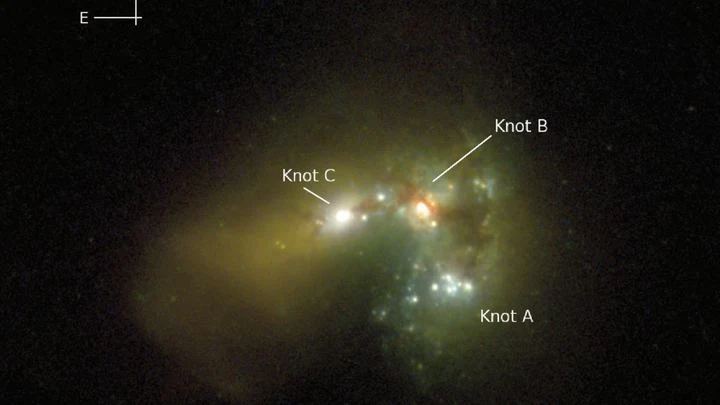
Two galaxies approach each other like a pair of dancers who drift apart and then are drawn back together. At the moment of a particularly close encounter, their gas compresses, and bright ultraviolet light bursts from within. This is exactly what happens in the Haro 11 system — the nearest pair of merging galaxies that lets such light escape.
Ultraviolet light with a wavelength of about 300 nanometers is invisible to the eye, but it can destroy the DNA of microbes, make certain substances glow, and carry information. Until now, lasers in this range were bulky, expensive, or short-lived.
Light from the hottest young stars usually cannot leave its galaxy: hydrogen absorbs it, like a thick curtain blocking a sunbeam. But sometimes the curtain parts, and ultraviolet photons burst into intergalactic space.
Light from the galaxy PAN-z14-1 began its journey when the universe was 400 million years old — a cosmic infancy. The expansion of space made it travel to us for nearly 13.5 billion years.
On October 9, 2022, detectors on Earth recorded a gamma-ray burst of unprecedented power. GRB 221009A was so bright that its radiation ionized the upper layers of the ionosphere, and satellite instruments were temporarily blinded.
High above Antarctica, a balloon carried an instrument that caught electrons from space. These particles come from distant stellar explosions and other powerful events. The instrument measured their energy, like the force of an impact. And in one energy range, there were more impacts than calculations predicted.