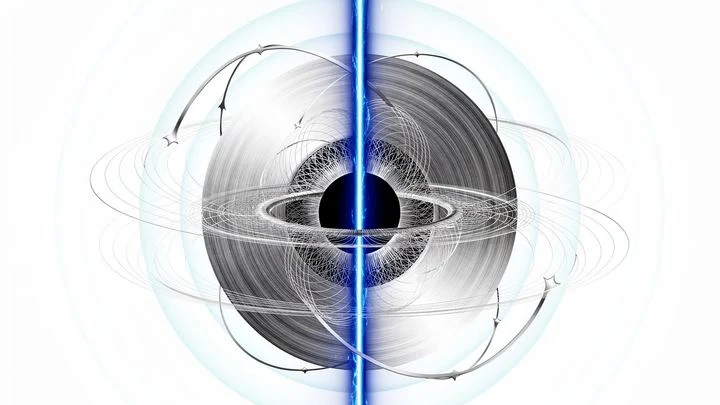
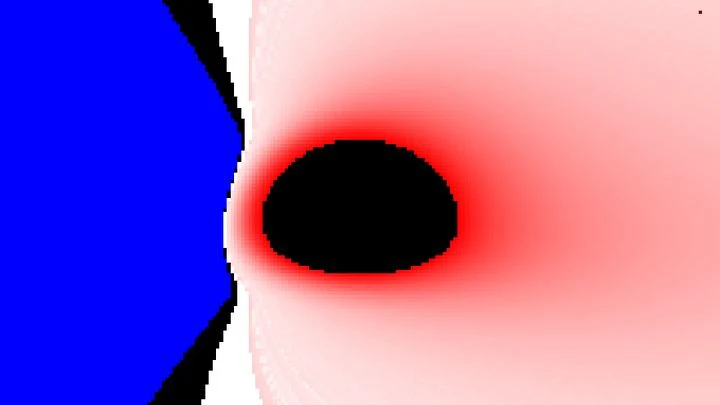
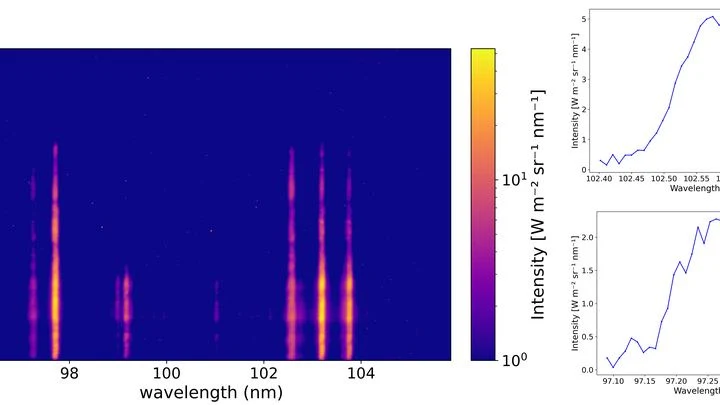
Broad emission lines are spectral lines in the light from an astronomical object that are spread out over a wider range of wavelengths than the narrow lines seen from calm, slow-moving gas. This broadening is a direct consequence of the Doppler effect: if the gas emitting the light is moving at high speeds, some of it approaches us (shifting light to shorter wavelengths) and some recedes (shifting to longer wavelengths), smearing the line. The faster the gas, the broader the line. In the context of black holes, broad emission lines are a key signature of the accretion disk—a swirling disk of hot gas falling into the black hole—where material orbits at a significant fraction of the speed of light.
History
The connection between broad emission lines and black hole accretion was established in the 1970s, following the discovery of quasars and the realization that their enormous energy output comes from supermassive black holes. The specific interpretation of line profiles as evidence for relativistic disk emission was developed by researchers like Donald Lynden-Bell and Martin Rees in the late 1960s and early 1970s.
How it works
The gas in an accretion disk is in rapid orbital motion, with the inner regions moving fastest. When we observe the combined light from the entire disk, the Doppler shifts from different parts of the disk add up, producing a broad, often double-peaked line profile. The width of the line directly measures the orbital speed, and from that speed (using Kepler's laws) astronomers can infer the mass of the central black hole. In some cases, the line shape also reveals relativistic effects, like gravitational redshift and beaming, which are more pronounced for gas very close to the event horizon.
You don't hold a ruler right up to an invisible disk; you measure it across the entire universe. Light from a distant quasar, a blazing gas swirling around a supermassive black hole, passes through a lensing galaxy on its way to us.
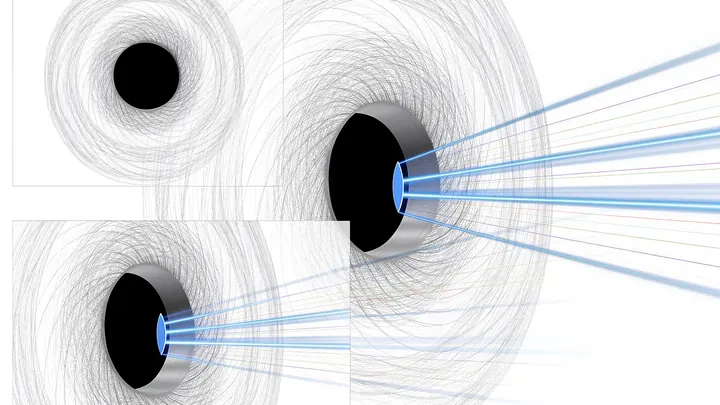
A black hole paired with a star works like a pump: it pulls gas from its companion, swirls it into a glowing disk, and occasionally ejects some of that matter in two narrow jets. In 2021, the system 4U 1543-475 put on such a show.
The night sky looks calm, but in reality, invisible particles, cosmic rays, are constantly flying through us. Among them are electrons and their antimatter counterparts, positrons. When they collide with detectors on satellites or balloons, the instruments record their energy.
A black hole is not an eternal vacuum cleaner. It slowly loses mass by emitting particles, much like a heated stone cooling as it radiates heat. This process, discovered by Stephen Hawking, is barely noticeable for large holes, but for tiny ones, with masses comparable to a mountain, it becomes a violent evaporation.
The cosmic detective story began with a quiet flash in the optical band. AT2019wzc slowly brightened and faded like a smoldering ember. But hidden inside was something more energetic — repeating soft X-ray bursts that astronomers call quasi-periodic eruptions.
These eruptions last minutes to hours and repeat every few hours or days.
In the dark outskirts of our Galaxy, far from bright star clusters, millions of black holes lurk. They are invisible: they don't shine and don't noticeably accrete matter. Conventional search methods, designed for dense stellar fields, are useless here. A different approach is needed.
Astronomers have proposed using the very fabric of space as a detector.
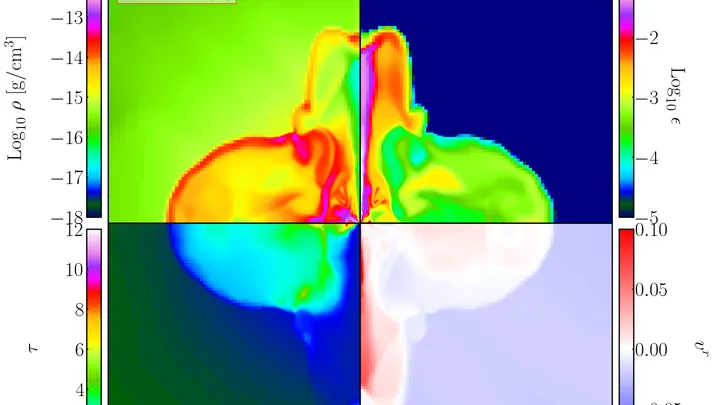
A whirlpool gulps down water, but splashes most of it back out. That's roughly how a black hole behaves when too much matter falls onto it. In a new study, astrophysicists ran 32 computer simulations to understand how a black hole's parameters — mass, spin, and "appetite"—control these cosmic fountains.
A cosmic object spins, but its shadow isn't round. Astrophysicists examined a black hole in an unusual version of gravity — the so-called brane world (where our universe is a three-dimensional surface in a space of higher dimensions).
A bright lantern in thick fog seems dim, while a weak flame in clear air can be seen a kilometer away. A similar oddity baffled astrophysicists almost half a century ago.
A black hole is a place from which nothing can escape. But some theories allow that deep inside, at the quantum level, it might bounce and turn into its opposite — a white hole, which only spews out matter and light.
A group of physicists built a computer model of such a transformation.
Ten billion years ago, the universe was speckled with strange crimson sparks. The JWST spotted them in images at distant redshifts — compact sources blazing like entire galaxies yet no larger than a tiny central region. Astronomers nicknamed them “little red dots.” Their nature long defied explanation.
The event horizon's edge is never calm. Quantum vacuum boils there, and particles sometimes burst out of this foam: that is how Stephen Hawking in 1974 discovered black hole radiation, forever linking gravity with quantum field theory.
It is commonly believed that a black hole is a merciless cosmic vacuum cleaner, sucking in everything indiscriminately. But new research flips the picture: right at the horizon, curvature transforms from a trap into a trampoline.
The cosmos is full of screams we can't hear. Every time a black hole tears a star apart, a blinding flash is born, and often — a narrow relativistic jet, shooting out thousands of light-years. But if that searchlight is aimed away from Earth, we see only a faint afterglow — a radio echo arriving with a delay.
For years, silence reigned in the heart of galaxy 1ES 1927+654: the accreting gas merely whispered in X-rays, leaking slow winds. But in 2022–2025, the picture changed dramatically. Spectra taken by XMM-Newton and Swift lit up with emission lines — a narrow peak at 0.56 keV, likely from OVII oxygen, a broader feature near 1 keV, and a powerful iron band in the 6–7 keV region.
At the heart of massive galaxies, monstrous gravitational 'cocoons' brew — black holes with billions of solar masses, shrouded in a dense veil of gas and dust. But any metamorphosis requires breaking the shell.
In the center of almost every large galaxy lurks a supermassive black hole, whose gravitational abyss was first mathematically described by Karl Schwarzschild. When it swallows gas, a dazzling active nucleus is born — a quasar.
A cosmic ray approaches a black hole almost tangentially. Instead of falling straight in, it lingers on an unstable orbit, like an acrobat balancing on a tightrope over an abyss. After a few loops, the light finally escapes toward a distant observer. Such rays produce multiple images of the same source, known as higher-order images.
Two dead stars circle in a final dance. Their approach creates ripples in space — gravitational waves. But there may be a third, invisible partner in this dance. Its gravity accelerates the pair, and the signal changes pitch slightly, like the siren of a passing car.
Imagine a spotlight: if you look at it from the side, it glows dim red, but if you stare straight into it, it blinds you with white-blue light. That, according to new data, is exactly what the mysterious 'little red dots' in the early universe look like. They are giant black holes, objects with gravity so strong that even light cannot escape, turned edge-on to us.
In the early Universe, tiny black holes could have been born — mountain-mass but atomic-nucleus-sized. Today they could serve as factories for dark matter. There are two mechanisms: the familiar evaporation (Hawking radiation) and the lesser-known superradiance.
A black hole is a place where gravity is so strong that even light cannot escape. But around it there is a glowing ring of gas, and in the center a dark void known as the shadow. The size of this shadow depends on how spacetime is curved.
A black hole is like a pot that slowly boils away. Its surface emits particles, a process known as Hawking radiation. The hotter the pot, the faster it empties. But what if the pot is not ordinary, but has a double bottom — capable of turning into a passage to another place?
The Sun is a boiling cauldron of hydrogen and helium, where scorching gas is caught in magnetic snares. When invisible ropes reconnect, energy comparable to billions of thermonuclear explosions is released. Where does it go?
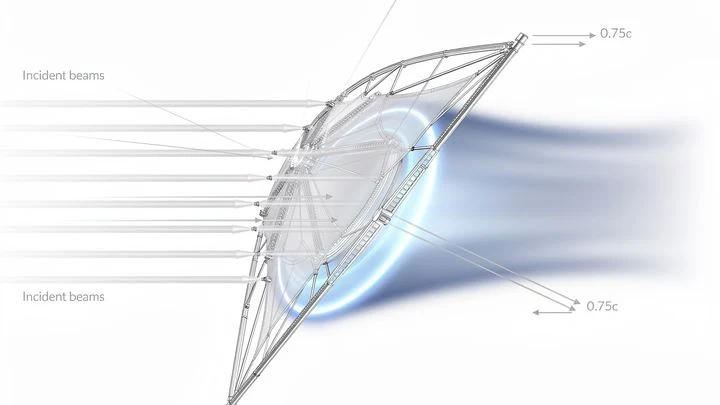
Imagine a three-faced dancer on the crest of a light wave. One face is a catcher, absorbing incoming photons. The second is a perfect mirror, throwing light back. The third is frosted glass, scattering rays in all directions. As long as speed is low, the dance is harmonious. But at near-light speeds, the choreography breaks.
This is like a surfer chasing a wave.
A giant black hole tore apart a star, leaving behind a lopsided disk of scorching gas — like a vinyl record warped by the heat. Now a tiny black hole (or a star) zips around and repeatedly pierces that disk. Each puncture is a bright X-ray flare.
Water plunges into an abyss, but part of it shoots back up — churning and foaming at the very edge. That's roughly how gas behaves as it flows onto a supermassive black hole when its stream becomes too dense. In a new study, scientists traced this picture using computer simulations.
A powerful vacuum cleaner sucks in not only dust but also its own collection bag. That's roughly how a black hole behaves at the center of a 'red dot'—a distant galaxy where the glow comes not from the hole itself but from its dense gas shroud. This shroud is so thick it resembles a puffed-up cool star. And, like many stars, it has a magnetic field.
A flashlight doesn't cast a uniform circle of light; it has a bright spot in the center and a blurred halo at the edges. If you switch it off quickly, the edges are the last to fade, and by how the light dies, you can guess the shape of the reflector.
Photographing the vicinity of a black hole is like shooting a fountain: a short exposure freezes the droplets, a long one blends everything into blurry streaks. Light from the superheated gas swirling around the hole reaches us along different paths. Some rays curve around it in an arc, others make multiple loops due to spacetime curvature.
Hold a magnet near a pile of iron filings, and they line up along invisible lines — the field wraps around the magnet from pole to pole. In a similar way, you can visualize gravity around massive bodies: instead of filings, it's space itself; instead of a magnet, a star or a black hole. The authors propose decomposing gravity into two fields.
A black hole is invisible, but it's betrayed by light from superheated matter swirling nearby. That light is like a double agent: on one side of its orbit, it blueshifts as it races toward us; on the other, it redshifts as it recedes.
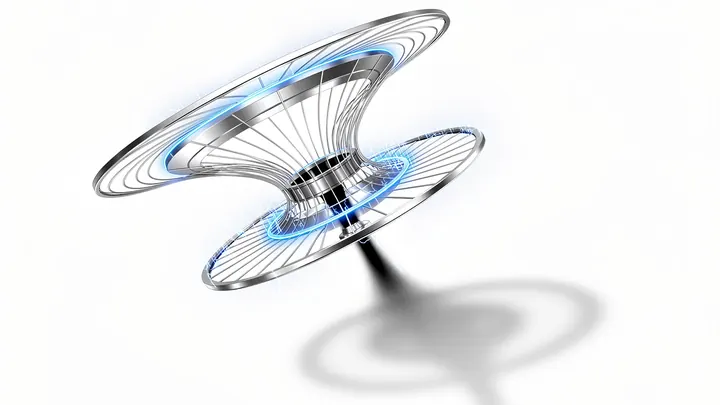
The shadows of supermassive objects at the centers of galaxies, M87 and the Milky Way, have become icons of modern astrophysics. But what if these shadows are not from absorption, but passage? The equations of Einstein allow for traversable wormholes — tunnels in the fabric of spacetime.
A pair of figure skaters spins while holding hands. If their path is a perfect circle, each push from a partner is predictable. But stretch that path into an oval, and the effort becomes uneven: a jerk as they come together, a lull as they pull apart. Something similar happens with two black holes in the final minutes before they merge.
Light passing by a massive body bends around it, like a stream of cars swerving around a deep pothole in the road. The steeper the pothole's slopes, the more the trajectories curve, and the fewer straight paths remain to the observer. That's how a black hole's shadow is born: a region from which light can no longer escape.
Above the Sun's limb hangs a cloud of tenuous, hot gas — a prominence. It can linger for weeks, then suddenly break loose and fly off into space. On April 15, 2023, the SPICE instrument on the Solar Orbiter probe got its first detailed look at such a cloud in ultraviolet light.
In the galaxy NGC 1566, located in the constellation Dorado, there is an active nucleus — a supermassive black hole surrounded by a cloud of fast-moving gas. As the gas falls toward the hole, it heats up and emits bright spectral lines. Sometimes these lines become very broad — a sign of the gas's rapid rotation.
The night sky looks still, but sometimes one of the stars suddenly begins to brighten. That's what happened with the system AT 2019wey: it was spotted by the TESS telescope, which usually hunts for planets around other stars, but happened to be imaging that patch of sky every half hour.
For half a century, astronomers puzzled over the nature of the powerful X-ray emission from Gamma Cassiopeiae — a bright beacon in its constellation whose X-ray glow didn't fit models of single stars. An invisible companion was suspected, but direct evidence was lacking.