Hidden Voids in Metal express
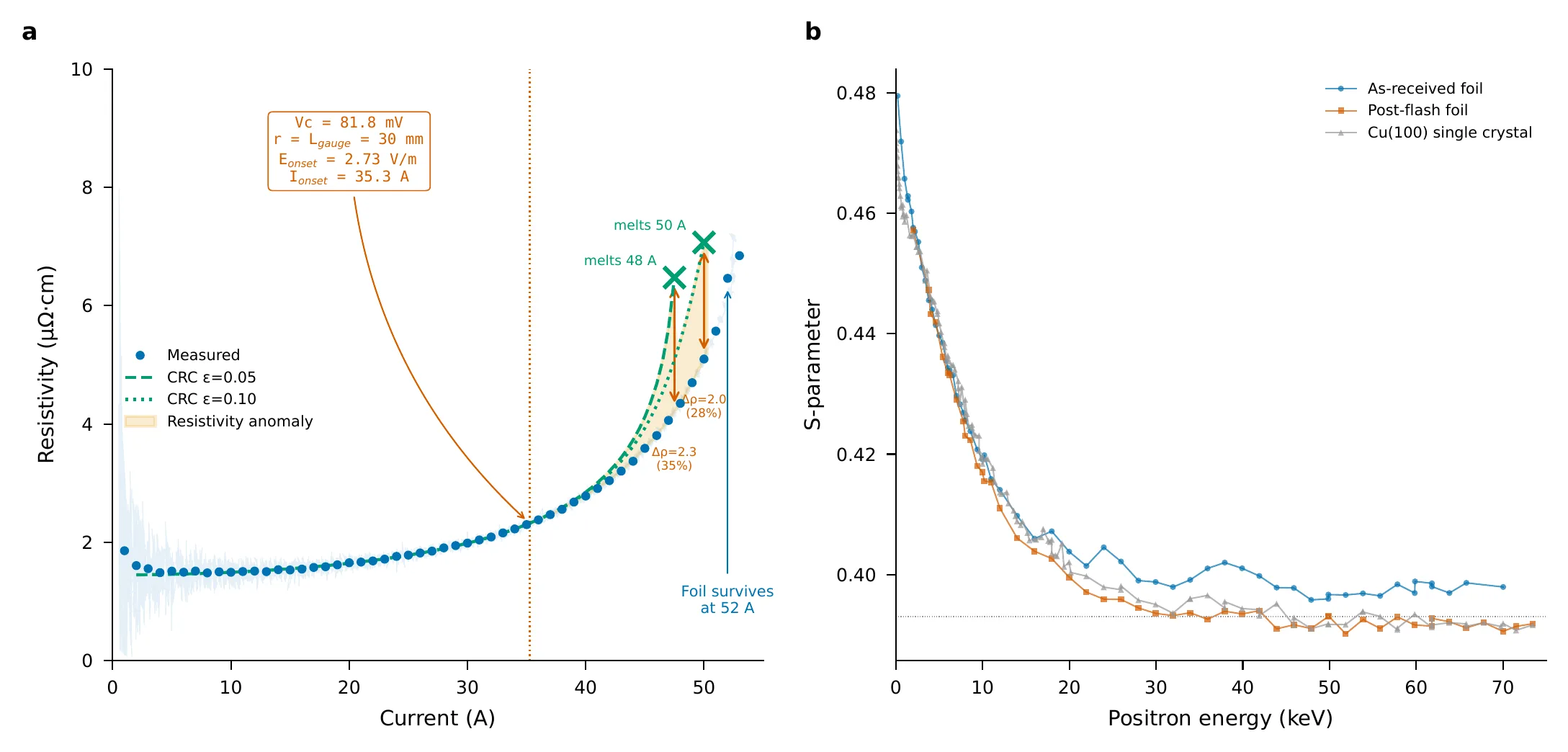
A copper wire under current is a familiar sight, but inside it something unexpected is happening. A strong electric current doesn't just heat the metal: it knocks atoms out of their rightful places, leaving behind tiny voids, as if a few balls were suddenly removed from a tightly packed arrangement. These voids exist only while the current flows, and after it's switched off, they vanish within minutes.
Scientists measured this using a beam of positrons — antiparticles of electrons that are especially sensitive to empty spots in the crystal lattice. When a positron enters such a void, it lives longer than usual, and by measuring its lifetime, one can infer the size and number of defects. It turns out that at currents above a certain threshold, a huge number of vacancies, empty lattice sites where atoms once stood, appear in copper. Their number is a million times greater than what would be expected from simple heating to 352 degrees Celsius.
This behavior explains a long-standing mystery of the so-called 'flash state' in materials: when a short, powerful current pulse is passed through ceramics or metals, the material's properties change abruptly, which cannot be explained by heating alone. Now it's clear that the current creates defects that accelerate sintering and densification processes. Understanding this mechanism opens the way to more precise control over material properties — from electronics to ceramics manufacturing.
A positron is the electron's twin with a positive charge. When it meets an electron, they annihilate, turning into two gamma-ray photons that can be detected by a detector.
In Larry Niven's novel 'Ringworld', super-strong materials are described, created by manipulating defects. Our current-controlled voids are a step toward such precise engineering.