An energystate is a specific, quantized level of energy that a physical system—such as an electron in an atom, a molecule, or a lattice—can occupy. In quantum mechanics, systems do not have continuous energy ranges; instead, they exist in discrete states, each with a well-defined energy. Transitions between these states occur when energy is absorbed or emitted, often as photons. The concept is fundamental to understanding atomic spectra, chemical bonding, and the electronic properties of materials, including semiconductors and superconductors.
History
The idea of discrete energystates was introduced by Niels Bohr in 1913 to explain the hydrogen spectrum, building on Max Planck's quantum hypothesis (1900). Erwin Schrödinger's wave mechanics (1926) provided a rigorous framework for calculating these states.
How it works
Energystates arise from the wave-like nature of particles. When a particle is confined (e.g., by an atomic nucleus or a potential well), its wavefunction must satisfy boundary conditions, leading to only certain wavelengths—and thus certain energies—being allowed. The lowest energy state is the ground state; higher ones are excited states. The spacing between states depends on the system's size and potential shape. For example, in a hydrogen atom, energy levels follow the Rydberg formula, while in a solid, many states form bands. Transitions occur when a perturbation (like a photon) matches the energy difference between two states.
In practice
Energystates underpin lasers (where electrons are excited to higher states and emit photons), quantum dots (used in displays and biological imaging), and nuclear magnetic resonance (NMR) for medical imaging.
Fun fact
In a hydrogen atom, the energy difference between the first two states corresponds to a photon with a wavelength of about 121.6 nanometers—in the ultraviolet, invisible to the human eye.
A layered cake of molybdenum disulfide MoS2 sits on the lab bench. It is prepared in the usual way: adhesive tape peels off the top layers to obtain a thin sample. But beneath the tape remains an invisible cavity where the atomic floors are no longer pressed together. It is there that electrons begin to behave differently than in the crystal bulk.
A superconductor is like an ideal highway with no traffic lights: electrons race along without hindrance. But apply a voltage, and the picture changes. In a new experiment, physicists found that an electric field penetrates the superconductor and creates a mixed regime inside.
Quantum batteries harness quantum effects to circumvent the limitations of ordinary devices imposed by entropy — a measure of disorder and energy losses. Imagine a bucket under a powerful jet: filling is lightning-fast. But the bucket has holes: the environment constantly drains the energy.
Two thin sheets with honeycomb patterns were stacked and slightly rotated, creating a new pattern — a moiré, like the shimmer of silk. The electrons in the experiment behaved similarly: they arranged themselves into two layers, with one layer rotated exactly 30 degrees relative to the other.
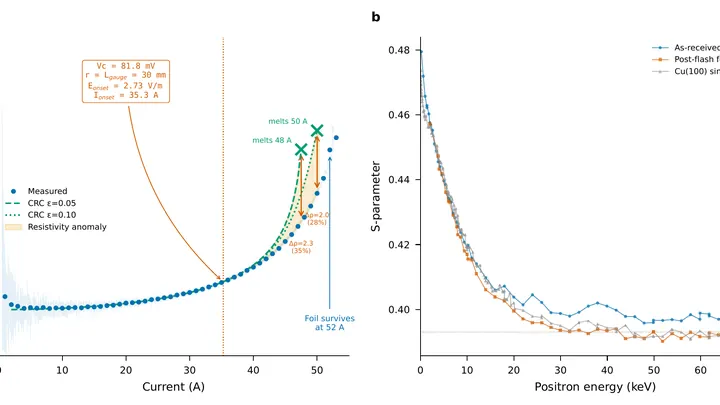
A copper wire under current is a familiar sight, but inside it something unexpected is happening. A strong electric current doesn't just heat the metal: it knocks atoms out of their rightful places, leaving behind tiny voids, as if a few balls were suddenly removed from a tightly packed arrangement.
An ultracold cloud of atoms trapped in laser light can 'breathe': it rhythmically contracts and expands, much like lungs. Physicists have long been able to observe this breathing, but only now have they realized that its amplitude is not just a pretty picture: it is a precise measure of hidden energy jitters inside the cloud.
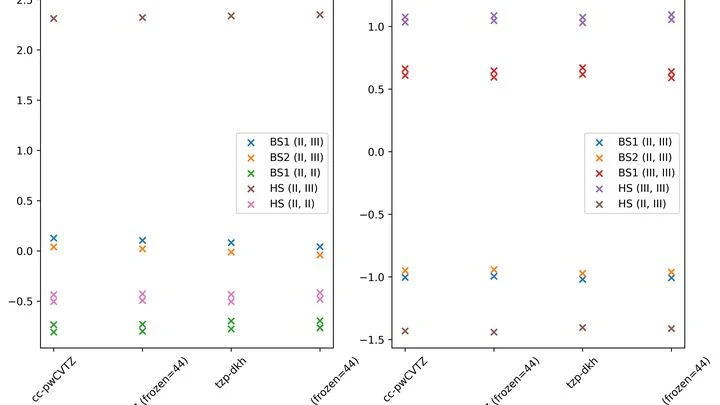
In every handful of fertile soil, there are bacteria that do something no factory can: they take nitrogen straight from the air and turn it into fertilizer. The secret lies in the enzyme nitrogenase, and its working core, a cluster of iron and molybdenum atoms, looks like a tiny factory floor.
Chemists have long tried to understand how this factory works from the inside.
An orchestra without a conductor, where each musician hears only the hall's echo, can create a powerful melody. That's how a quantum battery works: many particles, immersed in a warm environment, don't dissipate heat but exchange it synchronously. Instead of chaos, an orderly charge emerges.
In 1976, Gerard 't Hooft noticed that the vacuum of a gauge theory is not as simple as it seems: it possesses a topological structure that manifests itself in a nonzero topological susceptibility.
Quantum entanglement long remained a curiosity — 'spooky action at a distance,' as Erwin Schrödinger put it, which shatters our conventional picture of the world. But in 2008, physicists realized: entanglement can be used not only to transfer bits, but also to teleport energy.
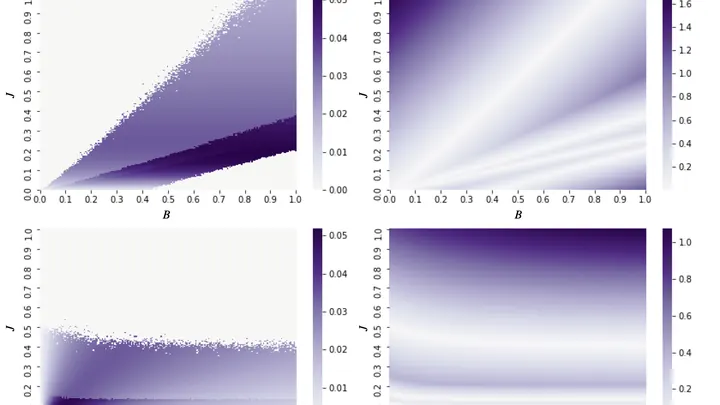
In a chain of eight spins, a defect lurks — a tiny magnetic moment. The Kondo effect, known since the 1930s, makes electrons around it align into a collective screen. The material's resistance abnormally increases. But detecting such an impurity hidden deep in the structure is like finding a stone at the bottom of a dark pond.