A vacancy is a type of point defect in a crystal lattice where an atom that should occupy a specific site is missing. This absence creates an empty space, or 'hole,' in the otherwise regular periodic arrangement of atoms. Vacancies are not static; they can move through the crystal as neighboring atoms jump into the empty site, effectively shifting the vacancy's location. They are a fundamental feature of all crystalline materials, present even in perfect crystals at any temperature above absolute zero due to thermodynamic equilibrium.
History
The concept of vacancies was first proposed in the early 20th century, notably by Yakov Frenkel in 1926, who introduced the idea of Frenkel defects (a vacancy paired with an interstitial atom). The thermodynamic justification for equilibrium vacancies was developed by Walter Schottky in the 1930s.
How it works
In a crystal, atoms vibrate around their equilibriumpositions. At any finite temperature, some atoms have enough energy to break their bonds and leave their lattice site, creating a vacancy. The energy required to form a vacancy is called the formation energy, and the number of vacancies increases exponentially with temperature. Vacancies migrate when an adjacent atom hops into the vacancy, leaving a vacancy at its original position—a process that requires a lower activation energy than forming a new vacancy. This migration is the basis for atomic diffusion in solids.
In practice
Vacancies are exploited in materials science to control diffusion, which is essential for semiconductor doping, and in solid-state batteries, where vacancy-mediated ion transport is key to performance.
Fun fact
The concentration of vacancies in a crystal near its melting point can be as high as one vacancy for every 10,000 atoms, dramatically affecting properties like electrical conductivity and mechanical strength.
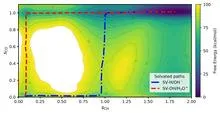
Picture a tiny hole in a sheet of graphene: a single missing carbon atom. It used to be thought that a water molecule splits apart at this defect only on its own, in dry gas. But if liquid water is sloshing all around, everything changes.
A transparent film of bismuth tungstate sits on a substrate and does not conduct electricity. Three minutes in a cloud of nitrogen plasma, and it turns black, with resistance dropping by a factor of a billion.
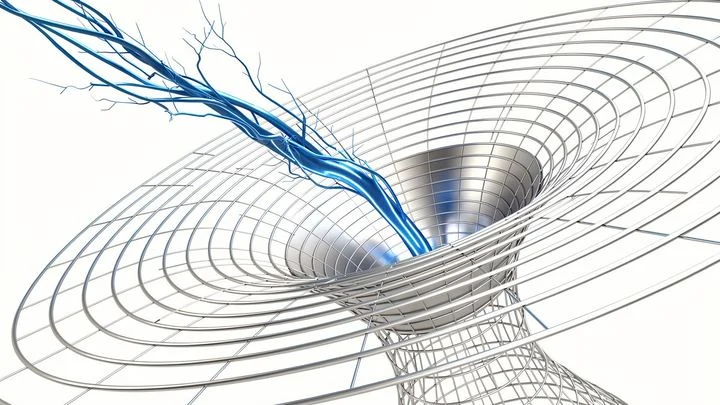
Plasma is a gas in which electrons are stripped from atoms and roam freely. Sometimes, regions where electrons are almost absent spontaneously appear in such a gas; they are called holes. It is like a whirlpool forming in a stream, pulling everything around it in. But exactly how such a whirlpool is born has long remained a mystery.
A mosaic of squares and triangles covers the floor without gaps, yet it never settles into a simple repeating pattern. Such a pattern is a quasicrystal — a solid where atoms are arranged not periodically but according to a pattern of several waves of different lengths. These waves are incommensurate with each other, and together they create long-range order.
A honeycomb made not of wax but of atoms is graphene — a flat crystal just one atom thick. Electrons in it are like runners at an intersection: they speed up here, slow down there, but never get stuck at the edge. Physicists call such a sheet "topologically trivial," meaning its edges are perfectly ordinary, with no special properties.
Now, let's knock out a single atom from the honeycomb.
Light passing near a massive body slightly changes its path — gravity pulls even on rays. In ordinary situations, a beam of light from a distant star is squeezed as if drawn together by an invisible rubber band. This property is called the null convergence condition: gravity makes light trajectories converge rather than diverge.
The black hole paradox has haunted physicists for decades. If a hole evaporates, where does its contents go? Discoveries by Stephen Hawking and Jacob Bekenstein showed that saving the laws of nature requires an unconventional move.
Imagine the universe as a woven blanket of invisible threads.
A ball on a slope with two pits usually rolls into the nearest one and comes to rest. But if the slope is slightly deformed and 'remembers' recent nudges, the ball can hang around halfway for a long time — in a narrow spot it doesn't want to leave. That's exactly the trick physicists played with light.
Since time immemorial, physicists have dreamed of tunnels piercing the cosmos — wormholes, capable of connecting far-flung corners of the Universe in an instant.
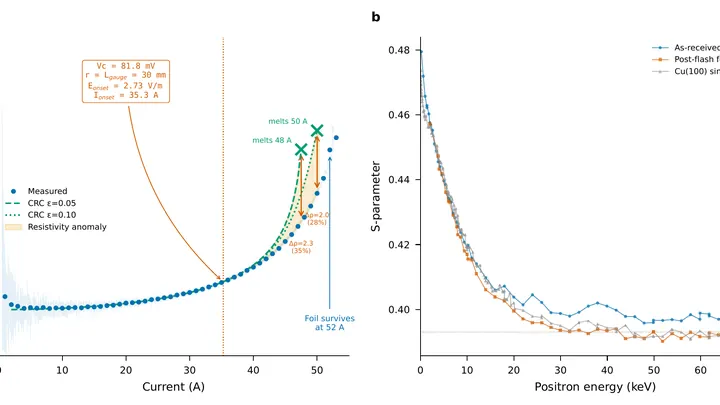
A copper wire under current is a familiar sight, but inside it something unexpected is happening. A strong electric current doesn't just heat the metal: it knocks atoms out of their rightful places, leaving behind tiny voids, as if a few balls were suddenly removed from a tightly packed arrangement.
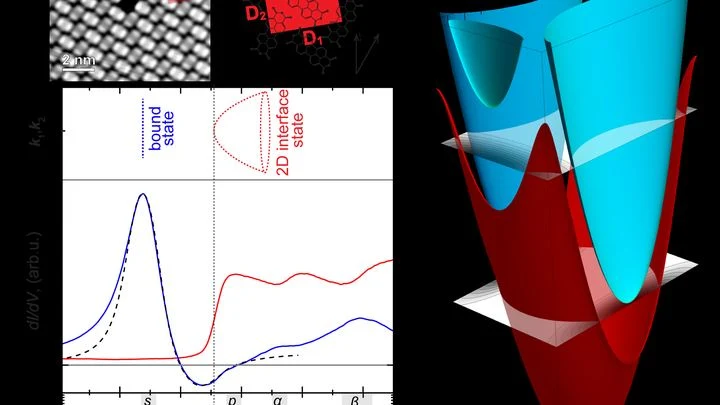
A wafer-thin film of organic molecules was grown on a silicon substrate. In this film, as if on a sheet of graph paper, tiny "pens"—artificial atoms — were laid out with the tip of a scanning tunneling microscope.
In the quantum world, there are rules that seem to be broken. One of them is the conservation law: if in classical physics symmetry guarantees the conservation of charge, then in the quantum description this guarantee can disappear. This phenomenon is called a quantum anomaly.
In a metal crystal, atoms line up in neat rows like bricks in a wall. Knock out a single brick, and you're left with a void — what scientists call a vacancy. Under irradiation, these voids multiply and start merging into large holes, sapping the metal's strength. It's like holes in a brick wall joining up into a gaping breach.
A handful of sand on a vibrating table is like a crowd on a dance floor that still holds the rhythm of the old song for a second after the DJ has switched to a new one. Scientists made a thin layer of grains bounce on a vertically shaking platform and abruptly changed the shaking intensity.
Emptiness isn't always empty: it can hide energy, like supercooled water hides ice. Physicists call this false vacuum — a state that only needs a nudge to cascade into the true one.
A waterfall doesn't ask if you're ready to jump. Its flow accelerates, and at some point even light can't escape back. A McVittie black hole is such a waterfall, but not in an ordinary river; it's in an expanding universe: the water here is space itself, which continuously stretches, carrying galaxies apart from each other.
The hall is silent, but the conductor has already raised the baton. The orchestra is quiet, yet the score is changing. So it is in an optical resonator: there is no light, but the quantum vacuum—that emptiness filled with short-lived field fluctuations—is already conducting the…