The positron is the antimatter counterpart of the electron, carrying the same mass but a positive charge. It was first predicted by Paul Dirac in 1928 from his relativistic equation for the electron, which had solutions with negative energy. Dirac interpreted these as describing a particle with the same mass as the electron but opposite charge, later identified as the positron. Its existence was confirmed experimentally by Carl Anderson in 1932, who observed its track in a cloud chamber.
History
Paul Dirac predicted the positron in 1928, and Carl Anderson discovered it in 1932 in cosmic ray tracks, for which he received the Nobel Prize in 1936.
How it works
In Dirac's theory, the positron can be viewed as a 'hole' in the sea of negative-energyelectronstates, or equivalently as an electron moving backward in time. When a positron meets an electron, they annihilate, converting their rest mass into two gamma-ray photons (or more, depending on the conditions). Positrons are produced in various processes, such as beta-plus decay, pair production from high-energy photons, and cosmic-ray interactions.
In practice
Positrons are used in Positron Emission Tomography (PET) scans in medicine, where a positron-emitting isotope is injected into the body and the annihilation gamma rays are detected to create 3D images of metabolic activity.
Fun fact
The positron is the same particle as the electron but with a positive charge, and when they meet, they annihilate completely into pure energy, following Einstein's E=mc².
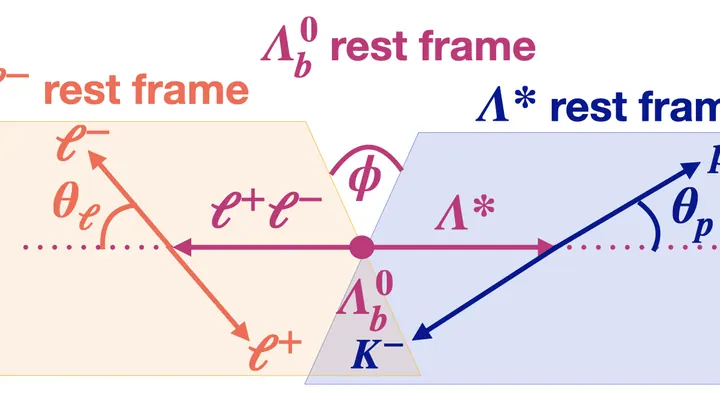
At the Large Hadron Collider, protons are smashed together, and among the debris, a heavyweight particle, the lambda baryon, sometimes appears. It lives for a tiny fraction of a second before decaying into other particles.
The helium atom is like a tightly stretched string: every note it plays is strictly predicted by theory. But in recent years, precise measurements of one such "note"—the energy needed to strip an electron from an excited helium atom — have started to sound slightly higher than they should.
The antiproton is the mirror twin of the proton: same mass, but negative charge. When it hits matter, it usually annihilates instantly — disappearing in a burst of energy upon colliding with an atomic nucleus.
The mystery of antimatter in space has long puzzled astrophysicists: where do positrons come from, settling like snowflakes into our detectors? The answer might lurk in the most ubiquitous gamma-ray background. The Universe is soaked in diffuse light — the cosmic photon background (CPB).
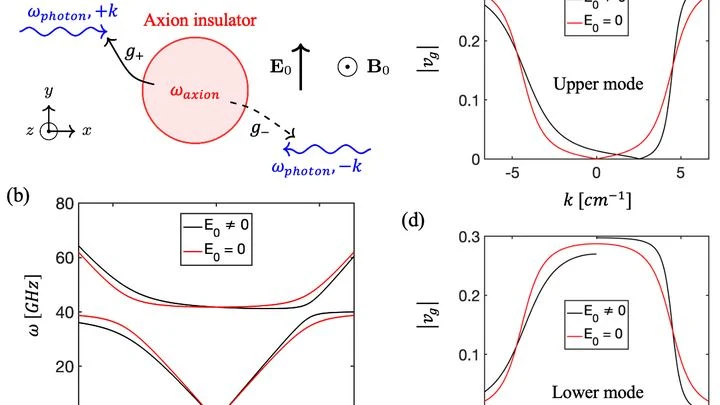
A regular flashlight shines equally forward and backward. But in magnetic crystals, a axion appears — a ghostly excitation, like a wave going around a stadium: atoms pass a magnetic impulse to each other. When light meets an axion, a hybrid forms, whose fate depends on electric and magnetic fields.
A pinch of salt falls into water, and sodium and chlorine ions scatter, surrounded by water molecules. Now, instead of an ion, a positron (an antiparticle, the electron's twin but with a plus instead of a minus) joins the molecular crowd.
To uncover the proton's true size, physicists swapped the electron in a hydrogen atom for its heavy copy — the muon. Acting like a magnifying glass with thousandfold power, the muon gets right up against the nucleus and 'probes' the proton with unprecedented precision.
When particles collide at enormous speeds, they produce a shower of new particles. Among them are antiprotons — twins of ordinary protons but with the opposite charge. Each of these particles has its own spin, like a tennis ball sent with a twist. But whether antiprotons are actually spun up at birth has never been checked.
In a giant particle accelerator, where protons traveling at nearly the speed of light smash into a neon target, charmed baryons are born — particles that live for less than a billionth of a second.
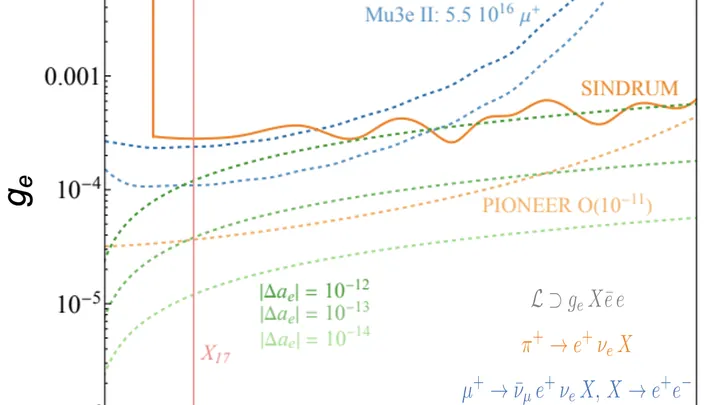
In nuclear transitions of beryllium-8, helium-4, and carbon-12, physicists from the ATOMKI collaboration have been seeing extra events since 2020—as if, when an excited nucleus decays, something else is sometimes born besides the usual photons. The energy of this "something" is always the same: about 17 million electron-volts.
In a dark room, you might notice a faint blue glow around some radiation sources. This is Cherenkov light: it appears when a charged particle travels through a medium faster than light can propagate in it. The result is a light shock wave, similar to the sonic boom from a supersonic jet, but made of photons.
In 1935, Einstein, Podolsky, and Rosen proposed a thought experiment that, in their view, exposed the incompleteness of quantum mechanics. Two particles fly apart after interacting, and measuring the momentum of one instantly gives exact knowledge of the other's momentum.
In a dark laboratory where superconducting chips are cooled to thousandths of a kelvin, a qubit spins under the influence of a magnetic field. A regular qubit rotates in one direction. An antiqubit, its mirror twin, rotates in the opposite direction. Together they form a pair that senses the field twice as sharply as any ordinary pair.
Two translators listen to the same symphony. One hears only the fundamental tone: a clean, predictable melody. The other catches the overtones that color every note.
The cosmic electron spectrum is like fingerprints at a crime scene. Particles arriving from the depths of the Galaxy carry in their energies the traces of those that produced them. For a long time, the picture was blurred: instruments with wide energy bins, like out-of-focus photographs, did not reveal details.