Graphene from the Cold: How to Make Layers Even express
A graphene sheet is a one-atom-thick grid of carbon atoms. Stacking several such sheets with a specific twist yields a material with unusual properties: it can be a magnet or a superconductor depending on how you poke it. The trouble is that in natural graphite, such 'properly twisted' layers are rare, and growing them artificially is tricky.
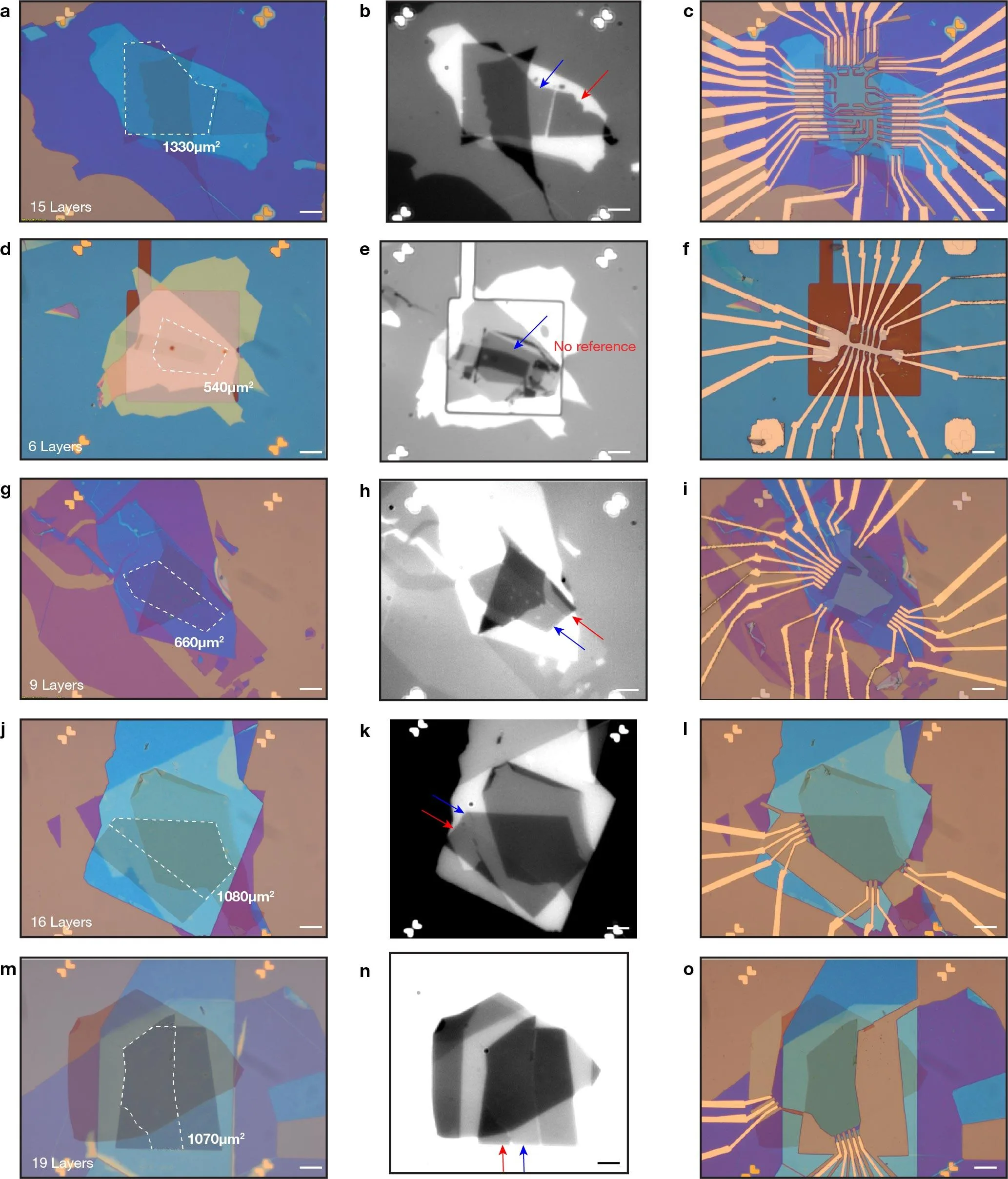
A team of researchers figured out how to extract the right pieces from graphite: they cooled it to ultra-low temperatures and split it with a sharp blow. This 'cold shock' yields large, flat pieces with the desired stacking. Then they carefully stacked these pieces under light pressure to avoid crumpling the layers. The result was flakes with an area of over 1300 square micrometers — roughly the size of several rice grains in a row. Nine out of ten attempts succeeded.
The cleanliness of the layers allowed them to see how the electron flow changes character: as temperature rises, it stops flowing in a smooth layer, like water through a pipe, and starts going around obstacles, like water through a sponge. This transition is a sign that the material is nearly perfect. Now such large, clean sheets can be used to assemble electronic circuits where layers work together, like notes in a chord.
Original abstract
as written by the authors arXiv:2604.21912
Rhombohedral multilayer graphene (RMG) offers a highly tunable platform for correlated electron physics, featuring field-effect control of magnetic, superconducting, and topological phases[1-24]. The promise of these materials has been held back by the limited abundance of rhombohedral stacking in natural graphite, which constrains both sample yield and useful area. Here we introduce 'cryogenic shock exfoliation' to produce large area rhombohedral graphene flakes which, combined with a low-pressure van der Waals assembly technique that preserves stacking order, enable highly uniform devices exceeding 1300 $$\mu m^2$$ with fabrication yields of 90%. Using scanning nanoSQUID-on-tip imaging, we demonstrate uniform spin magnetism over the full central 10 times 10 $$\mu m^2$$ area of our devices. Transverse magnetic focusing reveals a disorder mean free path exceeding 200 $$\mu m$$ at low temperatures. Within the flat surface bands of RMG[20], we observe a size-driven crossover from Poiseuille to porous electron flow in the intermediate-temperature regime of strong electron-electron hydrodynamics[16, 25], providing a further signature of ultrahigh device quality. Our approach overcomes a key materials bottleneck in the fabrication of mesoscopic rhombohedral graphene devices, paving the way for incorporating strongly correlated phases into two-dimensional nanoelectronics.
A square meter of graphene weighs less than a milligram, but it can support the weight of a cat if stretched over a cup.
In Neal Stephenson's novel 'The Diamond Age,' carbon structures become the basis for smart materials — graphene with controlled layers brings that idea closer.