Graphite is a naturally occurring crystalline form of carbon where atoms are arranged in hexagonal layers that can slide over each other easily. This layered structure gives graphite its characteristic properties: it is soft, slippery, and an excellent conductor of electricity, making it ideal for use in pencils and as a dry lubricant. In modern physics, graphite is the starting material for producing graphene, a single atomic layer of carbon with extraordinary electronic, thermal, and mechanical properties.
History
Graphite has been used for centuries, with its name derived from the Greek 'graphein' (to write). The existence of graphene as a single layer was first isolated and characterized by Andre Geim and Konstantin Novoselov in 2004, earning them the Nobel Prize in Physics in 2010.
How it works
In graphite, each carbonatom forms strong covalent bonds with three neighbors in a planar hexagonal lattice, creating sheets. The fourth electron is delocalized across the sheet, allowing electrical conductivity. The sheets are held together by weak van der Waals forces, so they can easily slide past one another, which is why graphite feels slippery and can leave marks on paper. When these layers are isolated into single sheets, the resulting graphene exhibits unique quantum behaviors, such as electrons behaving as massless relativistic particles.
In practice
Graphite is used in batteries, lubricants, and nuclear reactors as a neutron moderator, while graphene derived from it is explored for flexible electronics, high-speed transistors, and composite materials.
Fun fact
Graphite is one of the few materials that can absorb neutrons without becoming highly radioactive, which is why it was used as a moderator in early nuclear reactors, including the first one built by Enrico Fermi in 1942.
Picture a tiny hole in a sheet of graphene: a single missing carbon atom. It used to be thought that a water molecule splits apart at this defect only on its own, in dry gas. But if liquid water is sloshing all around, everything changes.
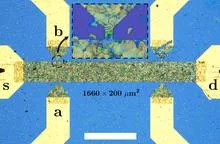
On the lab bench lies a piece of graphite grown from gas, like a deposit on the wall of a reactor. Usually, such material is not suitable for converting heat into electricity: inside it, electrons and holes run in opposite directions and cancel each other out.
The triptycene molecule resembles a three-pointed star with rigid arms. When such stars are scattered on a lead surface, they spontaneously assemble into a pattern like a woven basket: triangles and hexagons alternate, and at each node sits not one star but a pair.
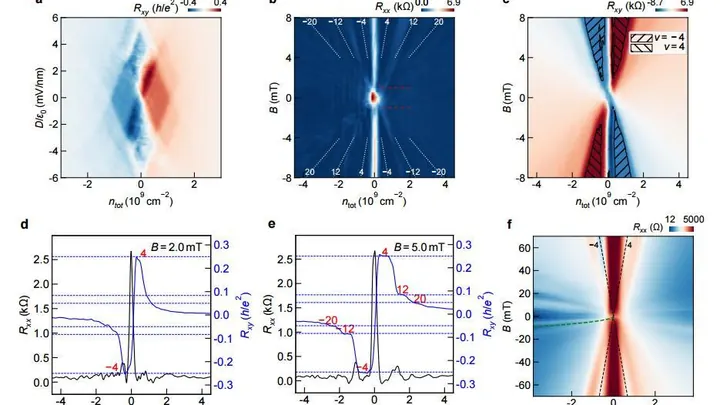
In the world of two-dimensional materials, states sometimes emerge that are as extraordinary as they are fragile. One of them — the fractional anomalous Hall crystal (FAHC)—is like a quantum centaur: half ordered lattice, half topological liquid.
Graphene, a two-dimensional carbon crystal, has long tantalized physicists with the hope of high-temperature superconductivity. Its electrons obey the relativistic equation of Paul Dirac, racing at tremendous speed, barely noticing each other.
Inside a crystal, an invisible ballet unfolds: the magnetic moments of atoms, like dancers, sometimes align in unison, sometimes scatter in antiphase. The choreography is dictated by quantum exchange — music sensitive to the geometry of bonds.
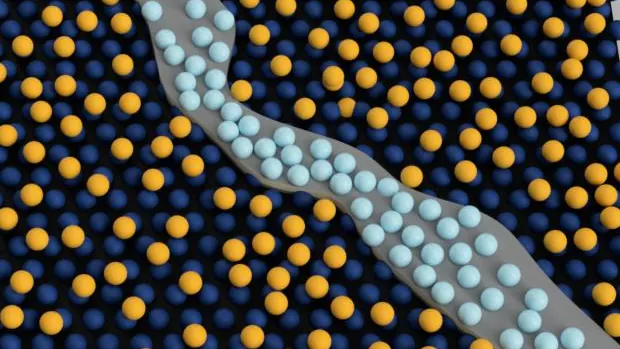
An ionic conductor resembles a crowded bus where passengers (ions) try to squeeze toward the exit. Previously, it was thought that fast exit could be achieved either by a gently swaying bus (soft lattice) or by passengers standing in chaotic order (geometric disorder). The new work shows these are not two different tricks but the same one.
A switch that knows which way to let current flow. That's how a Josephson diode works — a superconducting bridge where current goes willingly in one direction but meets resistance in the other. In the new study, such a bridge was made from graphene — a sheet of carbon just one atom thick.
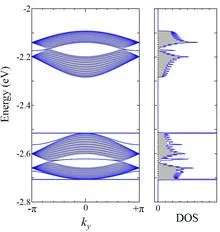
Electrons in a crystal are like cars on city streets: some race down avenues, others get stuck in traffic jams. In certain lattices, motion freezes entirely — velocity stops depending on energy, and electrons become "flat." This isn't a traffic jam but a special rhythm of the network where waves cancel each other out.
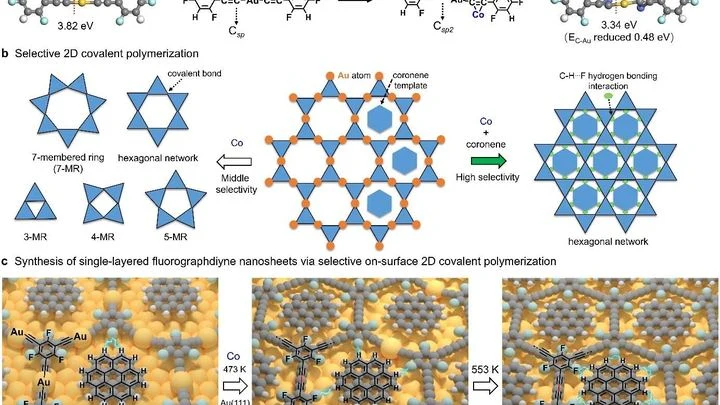
Crocheting, but instead of yarn you have individual molecules, and instead of a hook, a gold surface. Until now, attempts to knit such molecules into a smooth fabric ended in a tangle: the threads hooked where they shouldn't, and the pattern went awry.
A team of scientists has found a way to fix this.
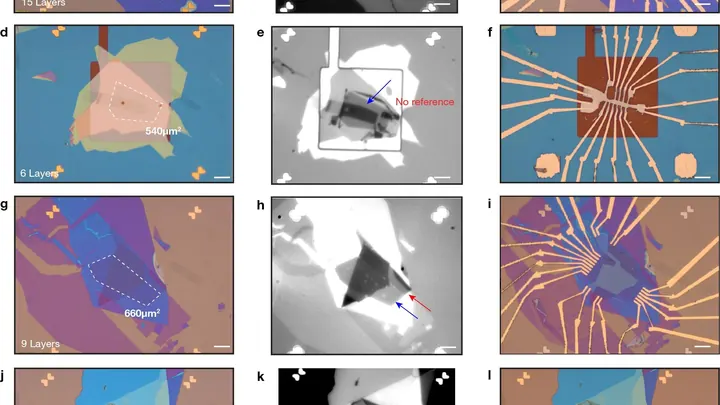
A graphene sheet is a one-atom-thick grid of carbon atoms. Stacking several such sheets with a specific twist yields a material with unusual properties: it can be a magnet or a superconductor depending on how you poke it. The trouble is that in natural graphite, such 'properly twisted' layers are rare, and growing them artificially is tricky.
Graphene is a carbon film exactly one atom thick. Two such sheets placed on top of each other with a slight twist behave very differently from a single sheet. At an angle of about 1.1 degrees, electrons slow down so much that the material can become a superconductor or an insulator — depending on the conditions.
A sheet of graphene one atom thick hangs in the air like a taut bedsheet. Heat waves, vibrations of atoms that physicists call phonons, ripple across it. Previously, it was thought that these waves quickly scatter due to strong interactions, and heat transfer is poor.
A sheet of graphene is a mesh of carbon atoms one atom thick. Even the slightest contamination shows up on it, like dust specks on eyeglass lenses. Ten years ago, researchers learned to hide graphene between layers of boron nitride, like placing a fragile sheet between two pieces of plastic wrap.
A sheet of graphene one atom thick is like a perfectly smooth tablecloth on which electron marbles roll. Place an electric barrier in their path, and usually they'll bounce back. But in graphene, it's different: under certain conditions, electrons pass through the barrier without even noticing it, as if the wall were made of mist.
A superconductor is a material where electric current flows without loss, like water through a perfectly smooth pipe. But if vortices appear, the current starts to 'stumble' over these tiny whirlpools. In graphene twisted at a special angle, such vortices can be created and studied one by one.
Graphene is a carbon sheet just one atom thick, a fantastic conductor. But its surface is crinkly, like a wrinkled tablecloth that hasn't been ironed. Scientists built a 'sandwich': two of these sheets pressed together with a non-conductive spacer in between. They iron out each other's folds, like two halves of a sandwich making the surface perfectly even.
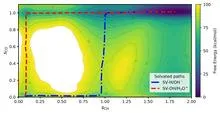
A graphene sheet is placed in a solution of sodium sulfate — an ordinary salt, similar to table salt. Near the surface, water stops being uniform: it arranges into layers, like a stack of pancakes. Between and within these layers, ions, charged particles from the dissolved salt, distribute themselves.
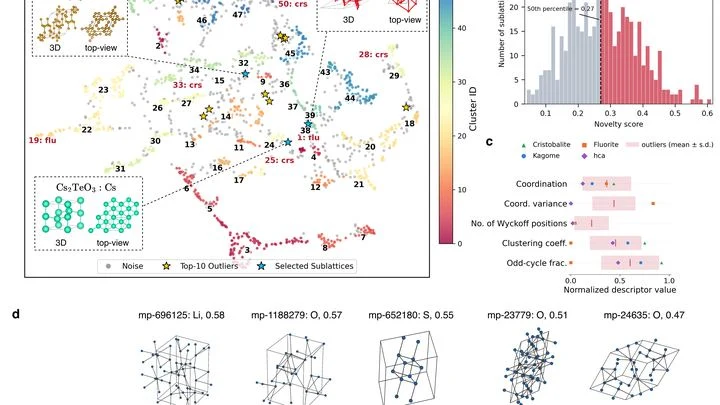
Graphs are considered identical if their 'terrain' matches. Imagine two maps with mountains and valleys: even if drawn differently, the heights and steepness of slopes can be the same.
A Swiss Army knife is simple: one handle, many blades, each for its own task. Grab what you need and get to work. In materials science, graph neural networks have long resembled a scattered set of tools: MEGNet sat in the TensorFlow drawer, M3GNet in the PyTorch drawer, and CHGNet in a separate box with its own scripts.