Entanglement in the Crosshairs express
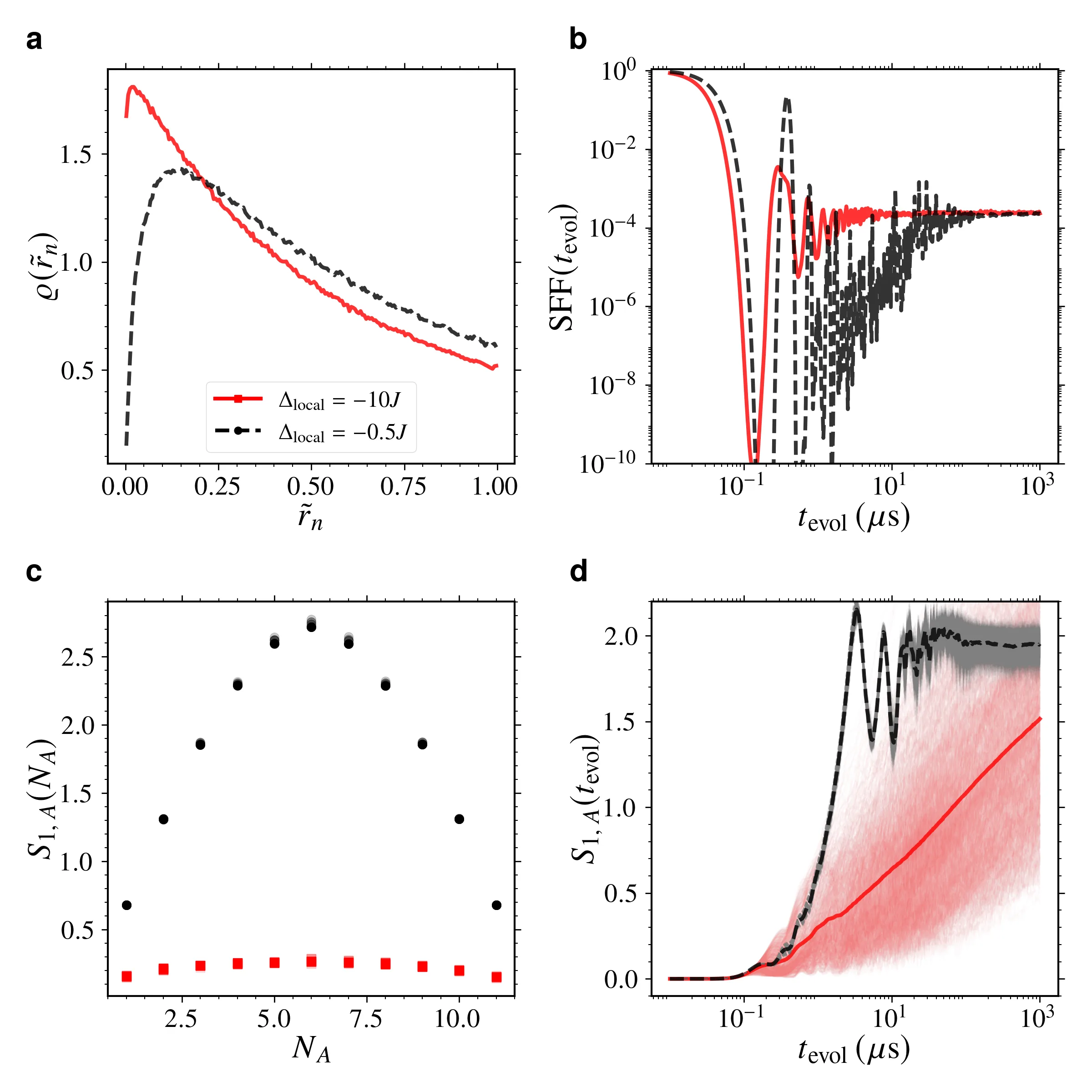
Quantum entanglement is like an invisible web that connects particles even when they are far apart. In large systems (say, a piece of material) this web can either quickly weave through all the atoms or tangle into a knot and stay put. The first case is called quantum chaos, the second localization. Understanding when and why the transition from one to the other occurs is crucial for creating new materials and quantum computers.
But measuring this web directly is no easy task. Typically, it requires complex manipulations of each atom individually, as if you had to pull every thread to understand the pattern. In the new work, physicists figured out how to do without such fine control. They took a commercial neutral-atom quantum simulator (a device where atoms float in a vacuum, held by laser tweezers) and applied a clever method: they locally changed the atoms' energy while simultaneously applying a global field to all of them. This allowed them to "shake" the system and reconstruct the entanglement pattern from its response.
The experiment on the Aquila simulator showed how adding disorder, random energy shifts for different atoms, changes the web's behavior. Without disorder, entanglement spread rapidly from atom to atom, like fire through dry grass. But when disorder became strong enough, the spread slowed and stalled: the web got tangled into local clumps, unable to encompass the whole system. This transition from chaos to localization was clearly resolved over time, despite inevitable environmental noise.
This approach opens the door to broader use of analog simulators. After all, you no longer need to control each atom individually, just coarse but smart interventions suffice. This means we can delve even deeper into the world of nonequilibrium quantum physics. And then the invisible web of entanglement, which physicists peeked at in this experiment, will become a bit clearer, and with it, the laws governing the very fabric of reality.
Neutral atoms in the simulator are held at temperatures of millionths of a degree above absolute zero — colder than outer space.