Quantum entropy, often called von Neumann entropy, is the quantum analogue of classical thermodynamic entropy. It measures the amount of uncertainty or missing information about the exact quantum state of a system. For a pure state, the entropy is zero, meaning the state is completely known; for a mixed state, it is positive, reflecting that the system is in a statistical mixture of possible pure states. In the context of entanglement, the entropy of a subsystem (like one particle of an entangled pair) quantifies how much information about that subsystem is inaccessible due to its correlations with the other subsystem.
History
The concept was introduced by John von Neumann in 1927, building on the work of Lev Landau and others, as a rigorous mathematical foundation for quantum statistical mechanics.
How it works
The von Neumann entropy is defined as S = -Tr(ρ ln ρ), where ρ is the density matrix of the system. For a bipartite system in a pure state, the entropy of one part equals the entropy of the other, and this common value is a measure of the entanglement between them. If the state is separable (not entangled), the entropy of each part is zero. The more entangled the state, the higher the entropy of each subsystem, indicating that the individual particles carry less definite information on their own.
For a maximally entangled pair of qubits, the entropy of each qubit is exactly 1 bit, meaning that each qubit individually contains no definite information, yet the pair as a whole contains 2 bits of information.
A superconductor is a material in which electricity flows without loss, like water through a perfectly smooth pipe. But if you squeeze it slightly, like a spring, its properties change. Scientists have long wanted to measure how much heat such a compressed material absorbs, but instruments couldn't fit into the cramped setup. Now they've devised a way around this obstacle.
When a heavy atomic nucleus splits into two fragments, an invisible quantum thread remains between them. This thread is entanglement: the state of one fragment is instantly linked to the state of the other, as if they were still a single whole. For the first time, physicists have precisely calculated how long and strong such a thread can be, tracing the fission process step by step.
Alice prepares a quantum particle in one of several states and sends it to Bob. The channel the particle travels through isn't perfect: it's noisy, scatters, interacts with the environment. Bob receives the signal and tries to figure out what Alice actually sent. This is the classic "prepare-send-measure" scheme, and there's always a risk of losing something along the way.
The wind carries pollen, and each grain moves as if on its own. But once the air swirls into a vortex, the pollen trajectories can no longer be separated: they are tangled. This is roughly how electrons behave in a strange metal: their motion is so strongly coupled to soft fluctuations of the medium that the usual particle carriers disappear.
The quantum vacuum is not empty: it is permeated by entanglement linking distant regions. But when physicists tried to compute this entanglement, it turned out to be infinite. The culprit: particles with very low energy that can smear out over arbitrarily large volumes. They are like waves with no shores to contain them.
A quantum chain is like a string of lights, where the bulbs are the spins of particles. Ideally, all bulbs glow in sync, following a common rhythm: that's symmetry. But if you cut off a piece of the string, the rhythm can get out of step: within that segment, symmetry is broken.
Physicists study a chain of strongly interacting particles (the XYZ model).
Empty space is not as empty as it seems. According to quantum theory, the vacuum is filled with particles that constantly pop in and out of existence. In 1976, physicist Bill Unruh showed that if an observer moves with acceleration, this 'quantum soup' turns into a genuinely warm bath for them — the Unruh effect.
The vacuum is not as empty as it seems. If an observer moves with acceleration, the vacuum around them heats up: this was predicted by William Unruh back in the 1970s. The effect is akin to black hole radiation, but in flat space.
A soap bubble hangs in the air, and its shape already contains everything needed to calculate the internal tension. A similar principle worked in a new study on quantum gravity. Physicists took a closed surface, an analog of such a bubble, and specified a few numbers on it: for example, the electric field strength and the curvature.
Two simultaneous interpreters sit in the same booth. The first translates from English into Russian but swallows half the words. The second goes from Russian into French, and also loses half. If you put them together, you'd expect a mess: the losses would add up, and only a quarter of the meaning would reach the listener. But what if they start correcting each other?
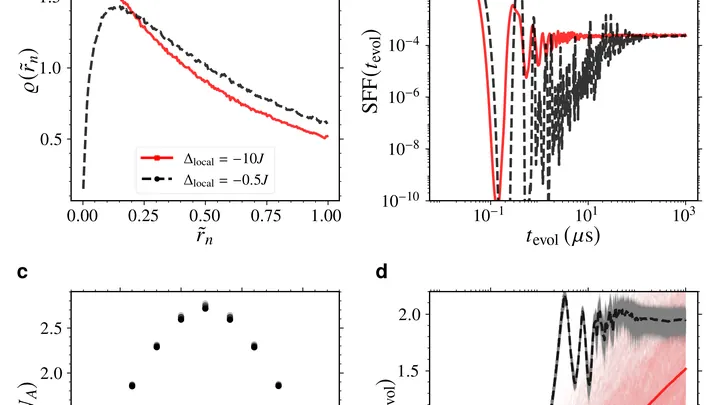
Quantum entanglement is like an invisible web that connects particles even when they are far apart. In large systems (say, a piece of material) this web can either quickly weave through all the atoms or tangle into a knot and stay put. The first case is called quantum chaos, the second localization.
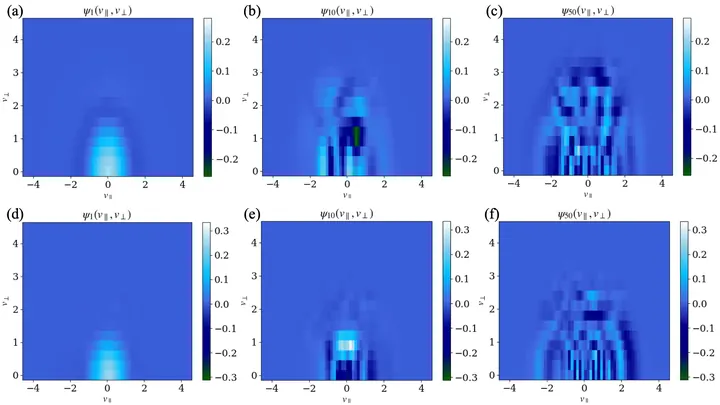
Hot plasma in a future fusion reactor is like a packed dance floor: billions of particles whirl in a complex rhythm, colliding and changing speed. Figuring out how tangled this dance is — no easy task. Scientists have found a way to measure its complexity without watching every move.
Run a current through a wire, and the wire heats up. Anyone who has ever touched a phone charger knows this. Physicists call this heating Joule heating, after James Joule, who in the mid-19th century measured how much heat electricity produces. Since then, the formula has been simple: the greater the resistance and the current, the hotter the wire.