Galaxy Clusters: Where the Signs of Collisions Hide express
Giant galaxy clusters are cities of thousands of star islands, held together by gravity. Inside them, hot gas churns and glows in X-rays. If a cluster has recently collided with another, it develops clumps of galaxies and distortions in the gas, like ripples on water after a stone is thrown.
Astronomers took a catalog of hundreds of clusters assembled from optical images and used a clever algorithm to identify distinct groups of galaxies within each cluster. They then compared these groups with X-ray images of the same clusters. It turned out that 40% of clusters show noticeable clumps, and in a quarter of cases, these clumps account for more than a third of all the cluster's galaxies.
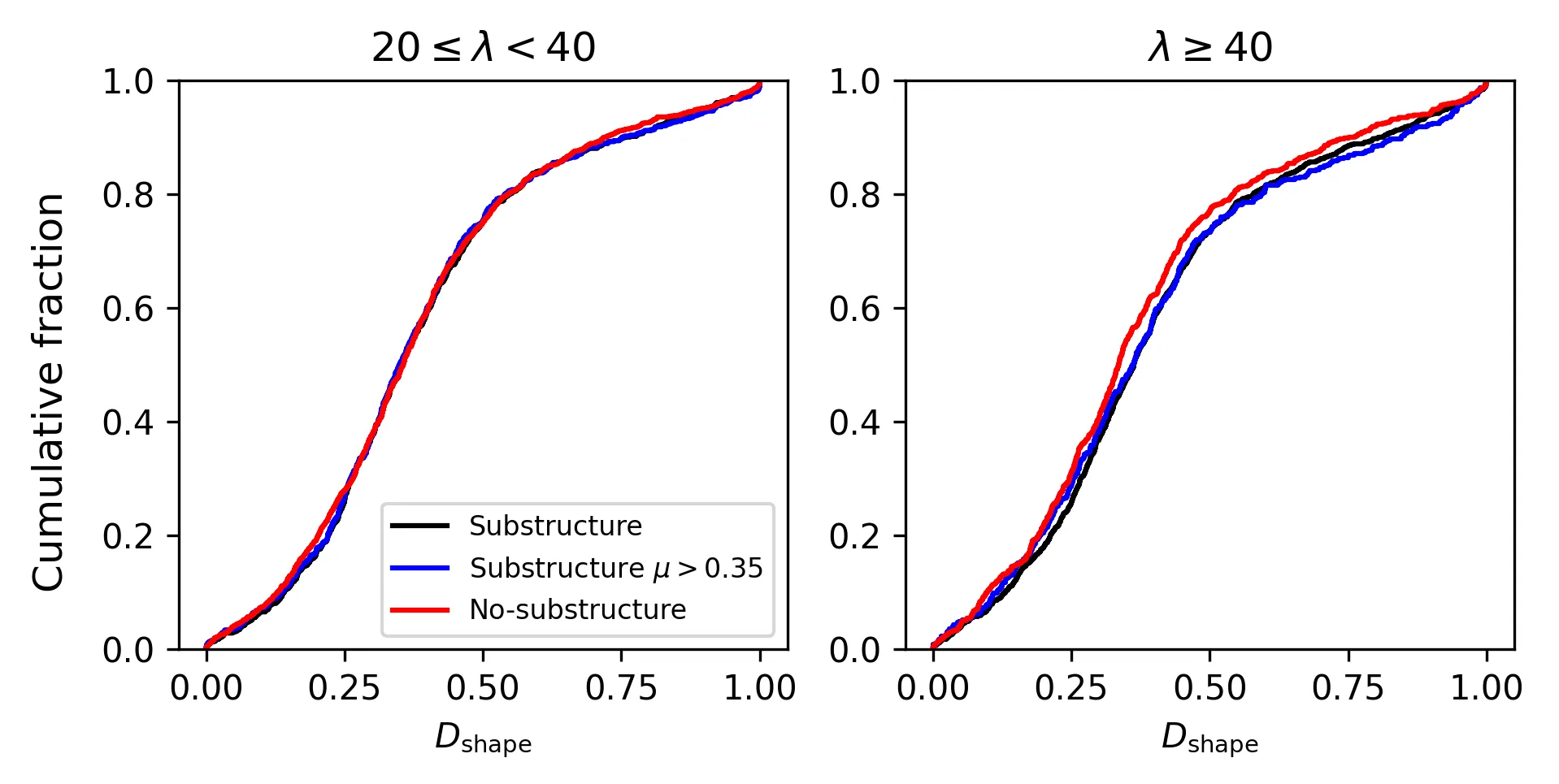
Clusters with clumps are more likely to have a disturbed, lopsided shape in X-ray light. This is especially evident in the most massive clusters. Moreover, among nearby clusters (out to a distance of about 2.5 billion light-years), those that have undergone a collision shine more brightly in X-rays than calm clusters with the same number of galaxies. For distant clusters, this difference is almost absent.
The reason, it seems, is that in nearby clusters the hot gas at the center is denser and cooler, so after an impact it stays compressed and bright for longer. In addition, in nearby clusters the clumps survive longer — magnetic fields, like an invisible film, prevent the gas from mixing and erasing the traces of the collision.
In smaller clusters, where there are fewer galaxies, the X-ray shape does not always indicate a collision. There, the central black hole takes the lead, injecting energy and reshaping the gas cloud on its own. So an X-ray image of a cluster is not just a photo; it's the story of its turbulent life.
Original abstract
as written by the authors arXiv:2604.25770
We statistically quantified the prevalence and properties of substructure in optical galaxy clusters and directly investigated its impact on X-ray morphology and scaling relations, leveraging new data from the DECaLS Legacy Survey and the SRG/eROSITA all-sky survey. We applied the hierarchical density-based clustering algorithm HDBSCAN to the redMaPPer galaxy cluster catalog to identify and characterize substructure from the probabilistic membership assignments. We then cross-matched this sample with the eROSITA X-ray morphology catalog to correlate optical substructure with a comprehensive set of X-ray morphological parameters. Finally, we analyzed the scaling relation between X-ray luminosity and optical richness for clusters with and without substructure. Substructure is a common feature, present in approximately 40% of clusters; a quarter of the full sample exhibits a fractional contribution to richness in excess of 35%. We find a highly significant correlation between optical substructure and disturbed X-ray morphologies, a trend that is strongest for high-mass clusters. The clusters with substructure also drive a stronger redshift evolution in the scatter of the Lx-lambda relation. At low redshifts (z<0.2), they display a systematically higher X-ray luminosity at fixed richness compared to relaxed systems. We attribute the enhanced effect of mergers on X-ray properties at low redshifts to the increased density contrast of low-redshift cool cores and longer substructure survival times, which are possibly due to the suppression of disruptive mixing by effects such as magnetic draping. At lower cluster richness, a discordance between X-ray morphology and the merging state indicates a growing relative importance of active galactic nucleus feedback in governing X-ray morphology.
Galaxy clusters are the largest objects in the universe held together by their own gravity. Some have masses of $10^{15}$ solar masses, and their diameters reach tens of millions of light-years.