Spin and Flavor Entangle in a Particle express
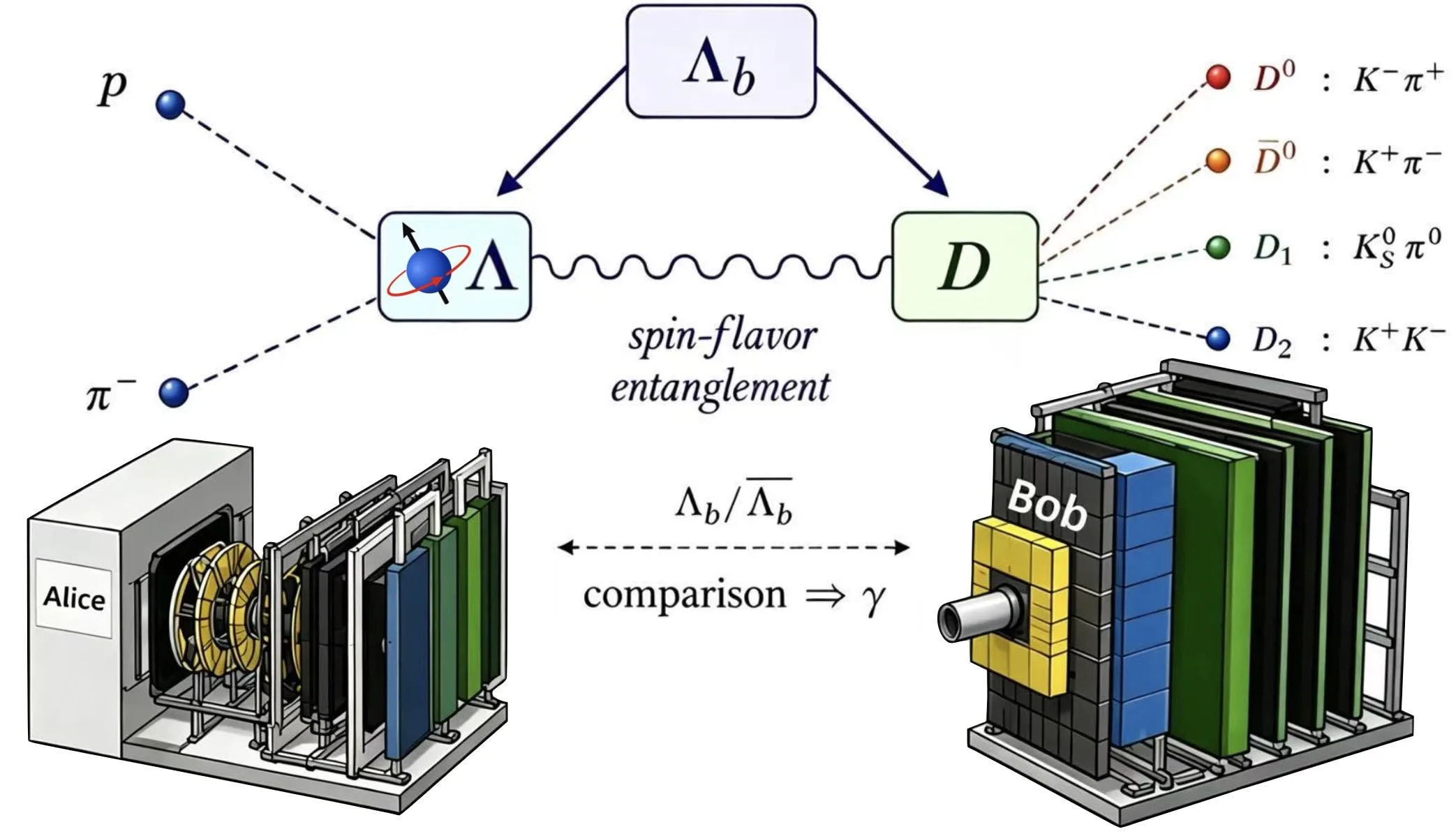
A coin tossed with the right hand always lands heads, while the left hand always lands tails. That's roughly how the lambda-b particle behaves: its intrinsic rotation (spin) is inextricably linked to which D-meson is born in its decay. This link is quantum entanglement, but not between two particles — rather between two properties of the same particle.
Physicists studied the decay of Λb into a Λ baryon and neutral D-mesons (particles containing a charm quark). The spin of the Λ and the type of D-meson (there are four varieties) form a single entangled structure. Information about it is hidden in the decay rates and in special parameters — known as Lee–Yang parameters. By observing how often heads comes up, you can infer the invisible force governing the toss.
This entanglement can be used to measure the angle γ (gamma) in the unitarity triangle. The angle γ is one of the fundamental constants of the Standard Model. It explains why the Universe contains more matter than antimatter. Usually, the angle is measured by analyzing the interference of different decay paths. The new method relies on the degree of entanglement. The authors derived a simple relation: the measurement uncertainty is inversely proportional to the measure of entanglement. The stronger the correlation between spin and flavor, the more precise the result.
This approach gives physicists a new tool. It elegantly connects quantum information with particle physics. It's as if the coin doesn't just land heads or tails, but chooses the side itself — depending on how it was spun. And from this game, you can deduce the hidden rules of the cosmos.
The Wootters concurrence, used to measure entanglement, is named after physicist William Wootters, who introduced it in 1998 for pairs of qubits, and now this measure is applied to particles in accelerators.