The lambda baryon (Λ) is a neutral, unstable particle composed of three quarks: one up, one down, and one strange. It is the lightest baryon containing a strange quark, making it a key subject in the study of quark flavor physics. Because it is neutral, it can oscillate into its own antiparticle, a phenomenon that offers a window into matter–antimatter asymmetry.
History
The lambda baryon was discovered in 1947 in cosmic ray experiments by the group led by Clifford Butler and George Rochester, who observed its characteristic 'V-shaped' decay tracks in a cloud chamber.
How it works
The lambda baryon is produced in high-energy particle collisions, often in association with other strange particles. Its decay typically proceeds via the weak force, producing a proton and a negatively charged pion. The oscillation between Λ and its antiparticle (Λ̄) occurs because the particle and antiparticle states are not exact mass eigenstates, allowing quantum mechanical mixing.
In practice
Lambda baryons are used in particle physics experiments to test the Standard Model, particularly in measurements of CP violation and in searches for new physics beyond the Standard Model.
Fun fact
The lambda baryon's lifetime is about 2.6 × 10⁻¹⁰ seconds, which is remarkably long for a particle decaying via the weak force, because the decay requires a change in strangeness.
Three voices merging into a single chord. In the physics of quantum materials, this image takes on a literal meaning: three layers of graphene, separated by thin spacers, force electrons and holes from different layers to move as a single fluid.
A handful of sand in your fist: the grains press against each other, and your hand can't squeeze any further. Ordinary matter behaves similarly. But in a neutron star, compression is billions of times stronger — atoms are crushed, electrons are squeezed into protons, and nearly all space is filled with neutrons.
Strike a tuning fork. The frequency is 440 Hz. That's the note A — the standard of sound.
In the world of numbers, there's a standard too. It's tuned not to sound, but to prime numbers. Though their distribution seems random, it obeys strict laws. All primes resonate together. There's just one value: λ∞ ≈ 0,674036.
On one side of the scale lies all the matter in the Universe; on the other, all the antimatter. According to the laws of physics, at the moment of the Universe's birth, the pans should have been balanced. But we see one pan tipping: around us are stars, planets, people, and almost no antimatter. This imbalance is one of the greatest mysteries.
At the SuperKEKB accelerator, electrons collide with positrons, and among the debris, B-mesons are found. These heavy particles live briefly and break apart into lighter ones. Recently, the Belle II detector recorded a suspiciously high number of cases where a B-meson transforms into a K-meson (kaon) and something invisible—2.7 sigma more than expected.
In the first moments after the Big Bang, matter and antimatter should have been created in equal amounts. But today we see only matter — stars, planets, ourselves. Where did the antimatter go? One clue hides in nearly elusive particles: right-handed neutrinos. The usual story is that their decays create a slight bias in favor of matter.
A handful of sand weighing as much as a small mountain: that's roughly what strangelets are like: tiny clumps of 'strange' quark matter where particles are squeezed to unimaginable densities. In a new study, astrophysicists tested whether such objects could exist in nature and what they would look like.
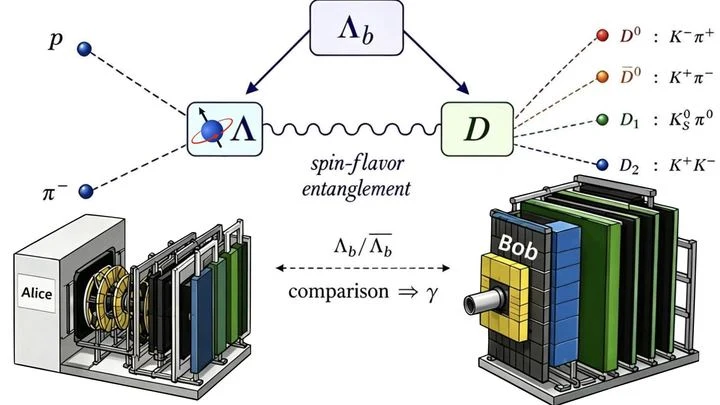
A coin tossed with the right hand always lands heads, while the left hand always lands tails. That's roughly how the lambda-b particle behaves: its intrinsic rotation (spin) is inextricably linked to which D-meson is born in its decay. This link is quantum entanglement, but not between two particles — rather between two properties of the same particle.
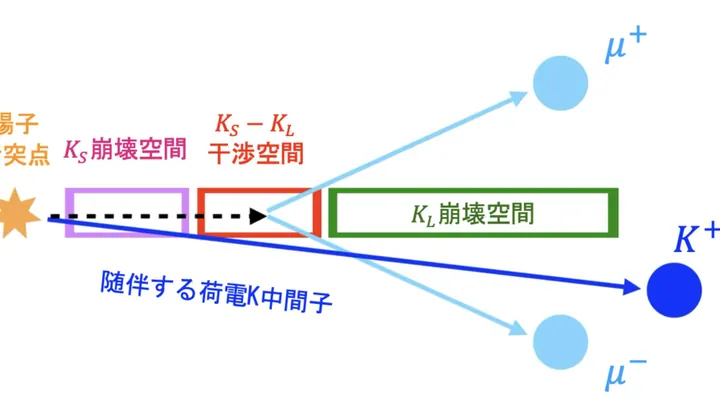
Two nearly identical pendulums are set in motion at the same time. One decays quickly, the other swings for a long time. At some point, their motions overlap, and in the combined picture, a subtle shift appears that would be invisible if you looked at each pendulum separately.
The Universe is structured like a sponge: there are dense regions packed with galaxies and gas, and giant pores — cosmic voids. These voids occupy most of space, but their contents have remained a mystery because matter there barely reveals itself.
Now astronomers have 'felt' the voids using fast radio bursts — super-powerful pulses from distant galaxies.
Heavy particles, which physicists call baryons, are like tiny families of three quarks. The common baryons are protons and neutrons, which make up everything around us. But there are also exotic relatives: instead of light quarks, they harbor charm or bottom quarks — heavy and short-lived.
In proton collisions at the Large Hadron Collider, physicists have for the first time caught a particle with two charm quarks. It is called Ξcc+ (pronounced "ksi-ksi-plus") and resembles a bead with not one but two heavy nuclei.
In a giant particle accelerator, where protons traveling at nearly the speed of light smash into a neon target, charmed baryons are born — particles that live for less than a billionth of a second.
In a particle accelerator, the anti-lambda particle is a rare guest. It is born on the fly, lives for a tiny fraction of a second, and usually decays on its own. But sometimes it manages to collide with an ordinary proton, and then a whole shower of light particles is born: kaons, pions.
In the BESIII detector, particles put on a show: they collide, are born, and decay, leaving flashes of light. But sometimes an actor can leave the stage unnoticed — through a hidden door that cameras don't see. Physicists were looking for exactly such 'quiet' decays, when a particle turns into something invisible to the instruments.