Measurement uncertainty is the quantification of the doubt about the result of a measurement. It arises from two main sources: statistical fluctuations (random errors) and systematic biases (such as instrument calibration drift or environmental influences). Unlike a simple error, which is a single deviation from the true value, uncertainty defines a range within which the true value is expected to lie, with a certain confidence level. This concept is essential in experimental physics, where no measurement is perfect, and it allows results to be compared and reproduced across different laboratories.
History
The formal treatment of measurement uncertainty was developed in the late 20th century, culminating in the 1993 publication of the 'Guide to the Expression of Uncertainty in Measurement' (GUM) by the International Organization for Standardization, which standardized how uncertainties are reported worldwide.
How it works
To estimate uncertainty, scientists repeat measurements and analyze the spread of results, often using standard deviation as a measure of random error. Systematic errors are identified by calibrating instruments against known standards or by using independent methods. The total uncertainty is then combined, typically by adding the random and systematic components in quadrature (square root of sum of squares). The final result is reported as a value plus or minus the uncertainty, such as '9.8 ± 0.1 m/s²'.
In practice
Measurement uncertainty is critical in fields like metrology (the science of measurement), quality control in manufacturing, and in scientific research where precise values—such as the speed of light or the mass of an electron—are established and verified.
Fun fact
The concept of uncertainty is so important that the International System of Units (SI) now defines all base units in terms of fundamental constants with zero uncertainty, shifting the burden of precision to the measurement process itself.
Imagine a ball in an unfamiliar hall: two guests start from opposite corners. Their movements are not a smooth waltz but chaotic improvisation in search of rare treasures. Contrary to intuition, the outcome hinges not on tempo but on the geometry of the floor.
You can zoom into a high-resolution photo for a long time — until suddenly a smooth face dissolves into individual pixels. Something similar, according to a new study, happens to spacetime itself. The authors propose that tiny intervals of length are not pre-existing 'parts' of the universe but results of measurements.
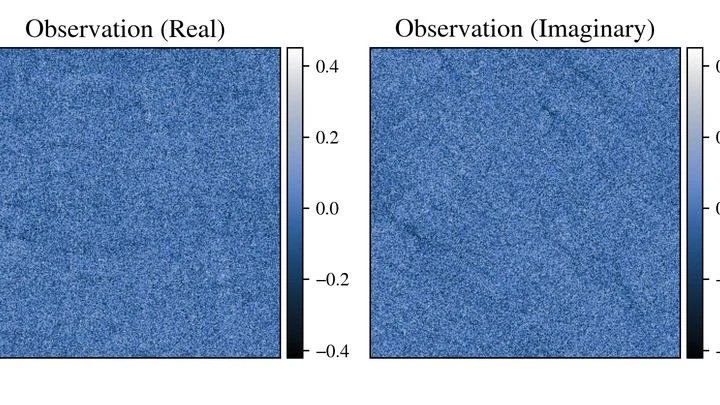
A camera takes a snapshot, but the sensor is noisy, the optics blur, and some pixels are overexposed. Reconstructing the original picture is like guessing a melody from a scratched record: there are many possibilities, and which one is true is unclear.
Quantum calculations are a recipe with perfect ingredients, but nature-the-chef cooks in her own way. Machine-learned models of atoms memorize the recipe and predict material properties in seconds instead of weeks.
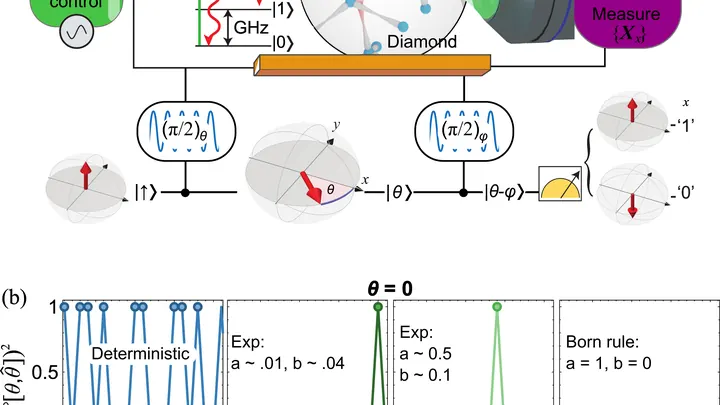
Imagine reality as an undeveloped photograph: until the moment of measurement, it exists only as a cloud of probabilities — a superposition of all possible states. Only the act of observation, like developing film, forces a particle to acquire definite properties.
A coin toss seems random, but in reality, physics decides everything: the force of the throw, air resistance, the surface's elasticity. If you knew all the details, you could predict the outcome. True randomness lives deeper — in the quantum world.
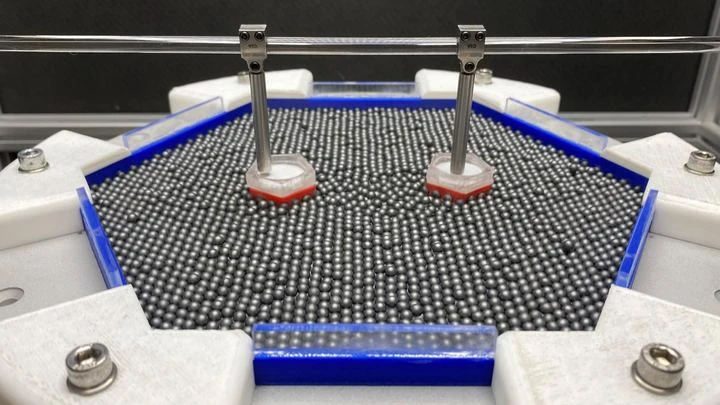
Shake a jar of sand and marbles, and you'll see large objects float or sink depending on their size. But if you shake it cleverly, you can make the marbles gather into pairs and chains, as if glued together. It's this kind of 'invisible glue' that physicists from India and Germany have now caught and measured for the first time.
An orchestra of a hundred musicians plays without a conductor. As long as the score is familiar, each player confidently follows their part, and together they sound harmonious. But when the composer changes the rhythm, discord creeps in: some instruments keep playing the old tune, others try to adapt, and a few fall silent.