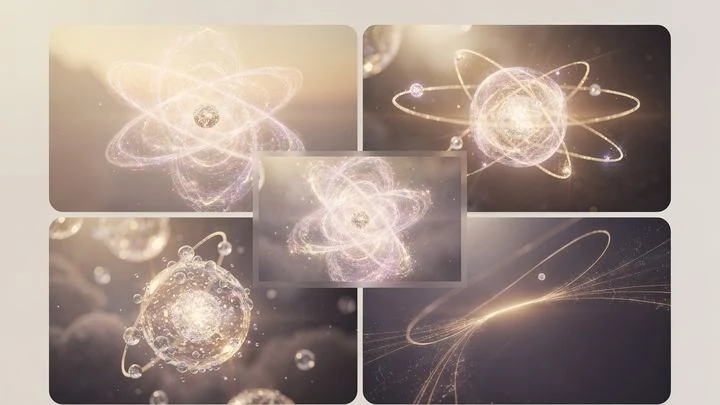
The muonneutrino is one of the three flavors of neutrinos, elementary particles that interact only via the weak nuclear force and gravity. It is produced in processes involving muons, such as the decay of pions in cosmic-ray showers, or in particle accelerators. Muon neutrinos are famously elusive: billions pass through your body every second without leaving a trace. Their study has revealed that neutrinos can oscillate — change flavor — which implies they have tiny masses, a discovery that earned the 2015 Nobel Prize in Physics.
History
The muonneutrino was first detected in 1962 by Leon Lederman, Melvin Schwartz, and Jack Steinberger at Brookhaven National Laboratory, using a beam of neutrinos produced by pion decay. They showed that these neutrinos produced muons, not electrons, confirming the existence of a distinct flavor.
How it works
Muonneutrinos are created when a muon decays or when a pion decays into a muon and a neutrino. They are detected indirectly: when a muon neutrino interacts with a nucleus, it typically produces a muon, which leaves a long, straight track in a detector like Super-Kamiokande or IceCube. By counting the number of muon neutrinos arriving from a given source (e.g., the Sun or the atmosphere) and comparing it to the expected number, physicists can measure oscillation probabilities. The flavor change occurs because the three neutrino mass states are superpositions of flavor states, and they acquire different phases as they travel.
In practice
Muonneutrinos are used in long-baseline experiments (like NOvA and T2K) to study neutrino oscillations and CP violation, which may explain the matter-antimatter asymmetry of the universe. They also serve as a probe of the Earth's interior via neutrino tomography.
Fun fact
The muonneutrino was the first particle discovered using a particle accelerator, and its discovery required a 10-ton spark chamber detector placed in a neutrino beam at Brookhaven.
A neutron star is what remains after a massive star explodes. Its matter is compressed so tightly that a teaspoonful would weigh billions of tons. Under such conditions, protons and neutrons can rearrange, and new particles (hyperons, similar to neutrons but containing a 'strange' quark) can appear.
A massive star exhausts its fuel, and its core collapses in a fraction of a second. A supernova is born, along with a brief but powerful shower of neutrinos. These particles barely interact with matter, so they fly away freely, carrying information about the catastrophe.
Neutrinos are like invisible dancers who change masks mid-flight. The three types (electron, muon, and tau neutrinos) constantly morph into each other. This dance is described by a complex mixing matrix, and physicists have long tried to break it down into simple moves.
The authors of the new work reassembled one such decomposition, TM1, using the 'flavor spin' formalism.
Electrons and muons are tiny magnets. Their magnetism is slightly more than two (in special units), and this 'excess fraction' (anomalous magnetic moment) arises from constant ripples in the vacuum: particle pairs momentarily pop into existence and vanish.
Atomic nuclei are wrapped in fluffy electron coats — in such attire, they can't get close enough to embrace. But swap the light coat for a heavy one: a muon, a particle from the standard model, shrinks the cloud by nearly 200 times.
At the SuperKEKB accelerator, electrons collide with positrons, and among the debris, B-mesons are found. These heavy particles live briefly and break apart into lighter ones. Recently, the Belle II detector recorded a suspiciously high number of cases where a B-meson transforms into a K-meson (kaon) and something invisible—2.7 sigma more than expected.
A magnet with only one pole — north, but no south. Split it in half, and instead of two ordinary magnets, you get two more one-pole magnets. In our world, no such particle has been found, although many theories predict their existence. These hypothetical objects are called magnetic monopoles.
The authors of the study noticed a curious connection.
In the very beginning, moments after the Big Bang, the universe was ridiculously symmetric: particles and antiparticles in equal measure. But a tiny imbalance occurred, like one extra grain of sugar in a kilogram, and the entire familiar world, stars, planets, people, arose from that surplus. How nature created this imbalance remains a mystery.
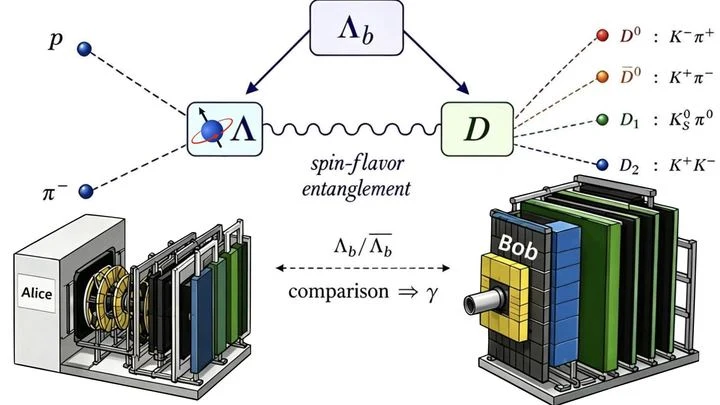
A coin tossed with the right hand always lands heads, while the left hand always lands tails. That's roughly how the lambda-b particle behaves: its intrinsic rotation (spin) is inextricably linked to which D-meson is born in its decay. This link is quantum entanglement, but not between two particles — rather between two properties of the same particle.
Fusion, the merging of a proton with a boron-11 nucleus, promises a near-perfect energy source: no dangerous neutron flux, just a stream of charged particles that can be directly converted into electric current. But there's a fundamental problem: the Coulomb barrier.
Two teams of radio telescopes pointed their antennas at two gas clouds: one at the very center of the Milky Way, the other in its quiet outskirts. Both clouds contain methanol molecules — an alcohol that acts as a tiny pendulum in space: it absorbs and emits radio waves at strictly defined frequencies.
Neutrinos are ghost particles. They pass through Earth as if it weren't there. To catch even one, physicists build enormous detectors. In the NOvA experiment, such a detector sits in Minnesota. Over years of operation, it has accumulated about a million muon antineutrino interactions.
Every time deuterium and tritium fuse in a fusion reactor, a fast neutron flies out. It can turn one substance into another — for example, create valuable isotopes for medicine.
Today such neutrons cost a fortune, because there are few experimental facilities and they rarely operate.
Drop a stone into a pond, and ripples spread across the water. Magnets have waves too — only instead of water molecules, it's the directions of atomic magnetic arrows that oscillate. These waves are called magnons, and their behavior reveals a lot about the invisible forces between atoms.
The cosmos is filled with invisible dark matter, which betrays itself only through gravity. Its existence was suspected by Fritz Zwicky and confirmed by Vera Rubin.
Our Sun emits streams of neutrinos — particles that barely interact with matter. Passing through the dense solar material, they change their type — scientists call this 'flavor.' It's like a voice that changes as it moves through a crowd: the thicker the crowd, the more it gets distorted.
In the 1930s, Fritz Zwicky, observing the Coma cluster, noticed anomalously high galaxy velocities: their motion pointed to a huge hidden mass gravitationally binding the system.
In 2016, the LHCb detector at the Large Hadron Collider recorded millions of proton-proton collisions. Among the debris of these collisions, neutral B mesons were born—particles that can spontaneously transform into their antiparticles and back.
In the boiling broth of the newborn Universe, all particles lost their distinctions, like vegetables at hellish temperatures. Recovering that simple recipe is the goal of modern physics.
The SO(10) theory — an extension of the Standard Model — offers such a recipe. It unifies all forces and links the masses of any particles with a single formula.