Neutrino flavor is a quantum property that determines the type of neutrino: electron, muon, or tau, corresponding to the three chargedleptons. Neutrinos are produced in specific flavors, but as they travel, they can oscillate between flavors, a phenomenon that reveals they have mass. This behavior is crucial for understanding particle physics, astrophysics, and cosmology, as neutrinos are produced in vast numbers in stars, supernovae, and the early universe.
History
The concept of neutrino flavor was introduced in the 1950s when the muon neutrino was discovered. The idea of neutrino oscillations was proposed by Bruno Pontecorvo in 1957, and confirmed experimentally in 1998 by the Super-Kamiokande experiment, which showed atmospheric neutrinos oscillate.
How it works
Neutrinos are created in weak interactions with a definite flavor, but the flavor states are quantum superpositions of mass states. As a neutrino travels, the mass states evolve with different phases, causing the flavor composition to change periodically. The probability of detecting a particular flavor depends on the distance traveled, the neutrino energy, and the mixing angles between mass and flavor states. This oscillation can be affected by matter, as in the MSW effect in the Sun or supernovae.
In practice
Neutrino flavor measurements are used to study the Sun's interior, supernova dynamics, and to search for CP violation in the lepton sector, which could explain the matter-antimatter asymmetry of the universe.
Fun fact
Neutrinos change flavor as they travel, and a neutrino that starts as an electron neutrino can be detected as a muon neutrino after traveling through the Earth, a phenomenon that was first observed in 1998.
A neutron star is what remains after a massive star explodes. Its matter is compressed so tightly that a teaspoonful would weigh billions of tons. Under such conditions, protons and neutrons can rearrange, and new particles (hyperons, similar to neutrons but containing a 'strange' quark) can appear.
At the heart of a dying star, as its core collapses into a neutron sphere, an invisible storm is born. Trillions of neutrinos, particles that barely interact with matter, race through the scorching plasma. There are so many of them that they begin to influence each other, changing their 'flavors' (electron, muon, tau) like chameleons.
High in the mountains, where the air is clear and still, physicists are preparing to catch elusive visitors from space — neutrinos. These particles, like ghosts, pass straight through the Earth, leaving almost no trace. But occasionally a neutrino does slam into an atom, producing a shower of particles that can be seen.
A massive star exhausts its fuel, and its core collapses in a fraction of a second. A supernova is born, along with a brief but powerful shower of neutrinos. These particles barely interact with matter, so they fly away freely, carrying information about the catastrophe.
Neutrinos are like invisible dancers who change masks mid-flight. The three types (electron, muon, and tau neutrinos) constantly morph into each other. This dance is described by a complex mixing matrix, and physicists have long tried to break it down into simple moves.
The authors of the new work reassembled one such decomposition, TM1, using the 'flavor spin' formalism.
A hot infant and a cold adult — the same neutron star looks different. Just born in a supernova explosion, it is scorching hot at tens of billions of degrees. But as time passes, it cools, contracting like cooling metal. For the star PSR J1012+5307, this transition means an almost twofold reduction in radius.
In the depths of a neutron star, the remnant of an exploded star, matter is compressed so tightly that a teaspoon would weigh billions of tons. Within this superdense material, a special kind of force might be at work, one that affects only muon and tau neutrinos.
Deep underground, in the thickness of granite, detectors catch rare visitors from space — muons. These particles are born high in the atmosphere when cosmic rays slam into air nuclei. They make it to the underground lab thanks to their enormous speed, close to the speed of light.
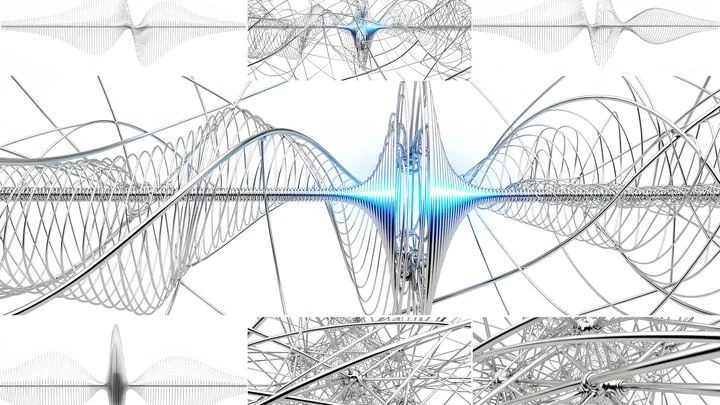
The Universe doesn't just expand — it resonates. After the Big Bang, stretched strings remained in its fabric — thin as a proton, yet heavy as a mountain range. Their oscillations give birth to gravitational waves, and in this radiation, like in a musical score, the history of fundamental symmetries is encoded.
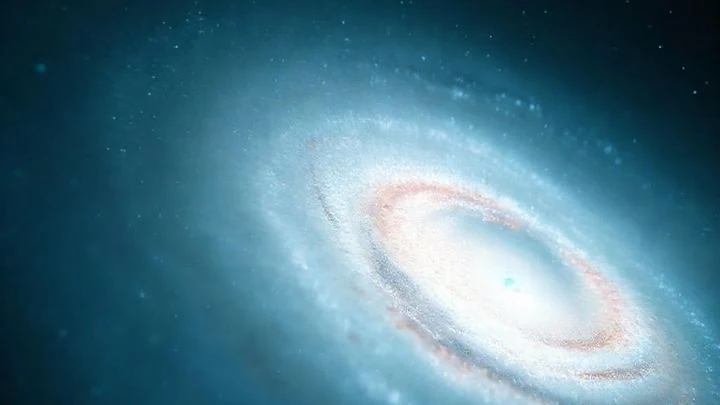
For nearly a century, astronomers have watched galaxies spin as if held together by invisible mass. Fritz Zwicky first noticed it, and Vera Rubin precisely measured the speeds of stars at the edges.
Imagine an interpreter at a crucial negotiation suddenly switching to another language, and the meaning of everything changes. That's roughly what neutrinos do in the depths of a dying star. These invisible particles are born in enormous numbers when a star's core compresses into a city-sized lump. But on their way out, neutrinos can change their type — physicists call this flavor transformation.
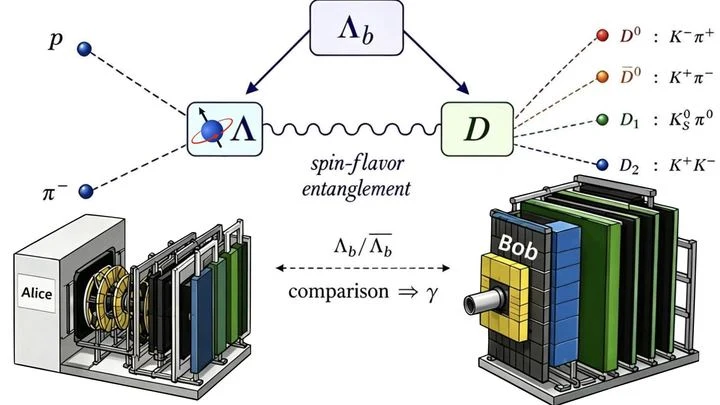
A coin tossed with the right hand always lands heads, while the left hand always lands tails. That's roughly how the lambda-b particle behaves: its intrinsic rotation (spin) is inextricably linked to which D-meson is born in its decay. This link is quantum entanglement, but not between two particles — rather between two properties of the same particle.
The speed of light in a vacuum is physics' metronome: it sets the rhythm for all processes. If it falters, the familiar harmony collapses. Neutrinos, ubiquitous but almost intangible particles from space, can check if this rhythm ever stumbles under extreme conditions.
The tau lepton is a heavy cousin of the electron, living less than a trillionth of a second. It usually decays into lighter particles, but never directly into three muons: such a transition is forbidden by known laws of particle physics. If it did happen, it would mean unknown forces are at play.
A muon is like an electron, but about 200 times heavier. When it stops in a piece of silicon, it gets pulled into the atomic nucleus like a nail to a magnet. The nucleus gains extra energy and starts to "boil": various particles fly out — protons, deuterons, tritons, and alpha particles.
Neutrinos are the most elusive of all known particles. Every second, trillions of neutrinos from the Sun fly through your body, but you never notice: they barely interact with matter. To catch even one, physicists build giant detectors — pools of water or liquid argon deep underground.
Predicted by Wolfgang Pauli and named by Enrico Fermi, neutrinos are nearly elusive particles. Inside dying supernova giants and merging neutron stars, an immense number are born. Each particle has a flavor that can change.
In 2016, the LHCb detector at the Large Hadron Collider recorded millions of proton-proton collisions. Among the debris of these collisions, neutral B mesons were born—particles that can spontaneously transform into their antiparticles and back.