Crystal Conductors for Light express
Light passing through a transparent crystal can subtly change color. That's how many lasers work: a tiny addition of a rare-earth metal makes the crystal glow. But the same metal behaves differently in different crystals, and physicists have studied this quirk using ytterbium.
They took two very similar crystals, barium fluoride and calcium fluoride, and added a minuscule amount of ytterbium to each (less than two-tenths of a percent). X-rays showed that both crystals remained perfectly smooth, without cracks or distortions. But when more sensitive instruments took over, it turned out that the ytterbium felt quite different in each. In one crystal, it prefers to give up two electrons and stay electrically calm; in the other, it gives up three and creates a slight electric tension around itself.
The difference wasn't in the overall strength of the crystal lattice, but in how barium or calcium atoms get along with ytterbium ions. Two hosts welcome one guest: in one house, the guest feels cramped and keeps bumping into furniture; in the other, there's plenty of room and the guest sits quietly. Same here: the barium ion is larger and creates more 'jiggling' around ytterbium, while the calcium ion creates less. This affects how the crystal absorbs and emits light. In the calcium crystal, light waves slightly 'split'—like a white beam passing through a prism — while in the barium crystal, this barely happens. Understanding this fine-tuning allows you to choose the right crystal for a specific task, whether it's a laser scalpel or a detector for tiny particles.
Original abstract
as written by the authors arXiv:2605.10160
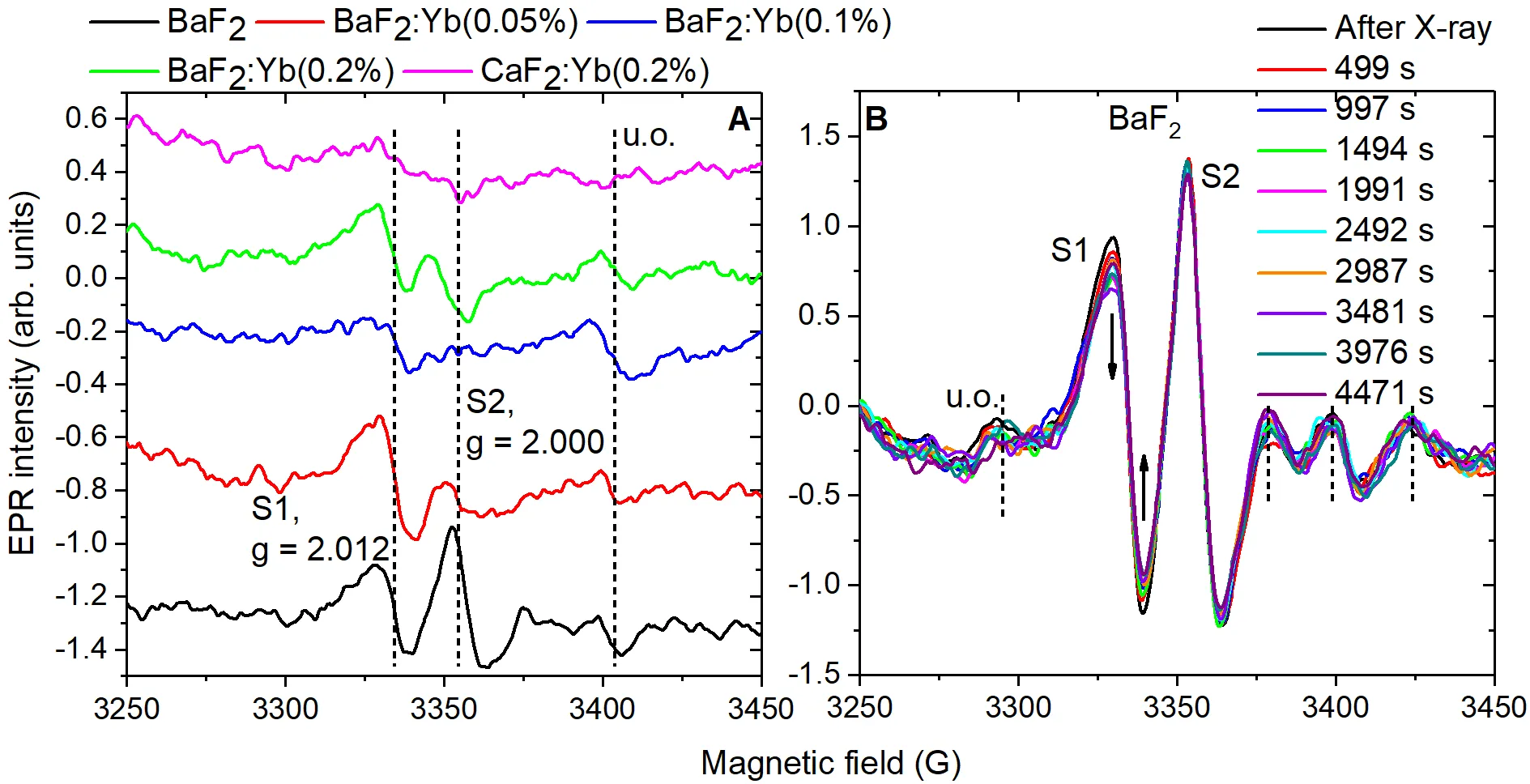
Lanthanide-doped fluorides are promising materials for advanced photonic and quantum applications due to their wide bandgap, low phonon energy, and chemical stability. In this work, we present a systematic comparative study of ytterbium incorporation at low doping levels (0.05--0.2 mol\%) in BaF$$_2$$ and CaF$$_2$$ single crystals, focusing on the interplay between host lattice properties, charge-state stabilization, and defect formation mechanisms. Using a combination of X-ray diffraction (XRD), X-ray photoelectron spectroscopy (XPS), electron paramagnetic resonance (EPR), transmittance, and infrared photoluminescence (IR PL), we explore how host lattice properties affect the stabilization of Yb$$^{3+}$$ and Yb$$^{2+}$$ ions. XRD confirmed cubic phase purity and lattice parameter stability in both hosts, while XPS revealed surface chemical composition variations associated with charge-compensating defects and trace impurities. EPR spectra indicated that BaF$$_2$$ favored perturbed Yb$$^{3+}$$ environments with increasing dopant levels, while CaF$$_2$$ maintained predominantly unperturbed sites, suggesting a more favorable ionic match for Yb$$^{2+}$$. Photothermal deflection spectroscopy (PDS) and IR PL results showed host-specific optical responses, with CaF$$_2$$ exhibiting crystal-field splitting and broader local field effects. These results reveal a clear decoupling between long-range structural stability and local lattice perturbations, and demonstrate that host cation identity governs the balance between Yb$$^{2+}$$ and Yb$$^{3+}$$ stabilization as well as defect-driven optical behavior. This offers valuable insights for optimizing rare-earth-doped fluoride crystals in laser, scintillator, and quantum device applications.
Ytterbium is named after the Swedish village of Ytterby, where a single mine yielded four rare-earth elements — yttrium, terbium, erbium, and ytterbium itself.