Crystal Conductors for Light express
Light passing through a transparent crystal can subtly change color. That's how many lasers work: a tiny addition of a rare-earth metal makes the crystal glow. But the same metal behaves differently in different crystals, and physicists have studied this quirk using ytterbium.
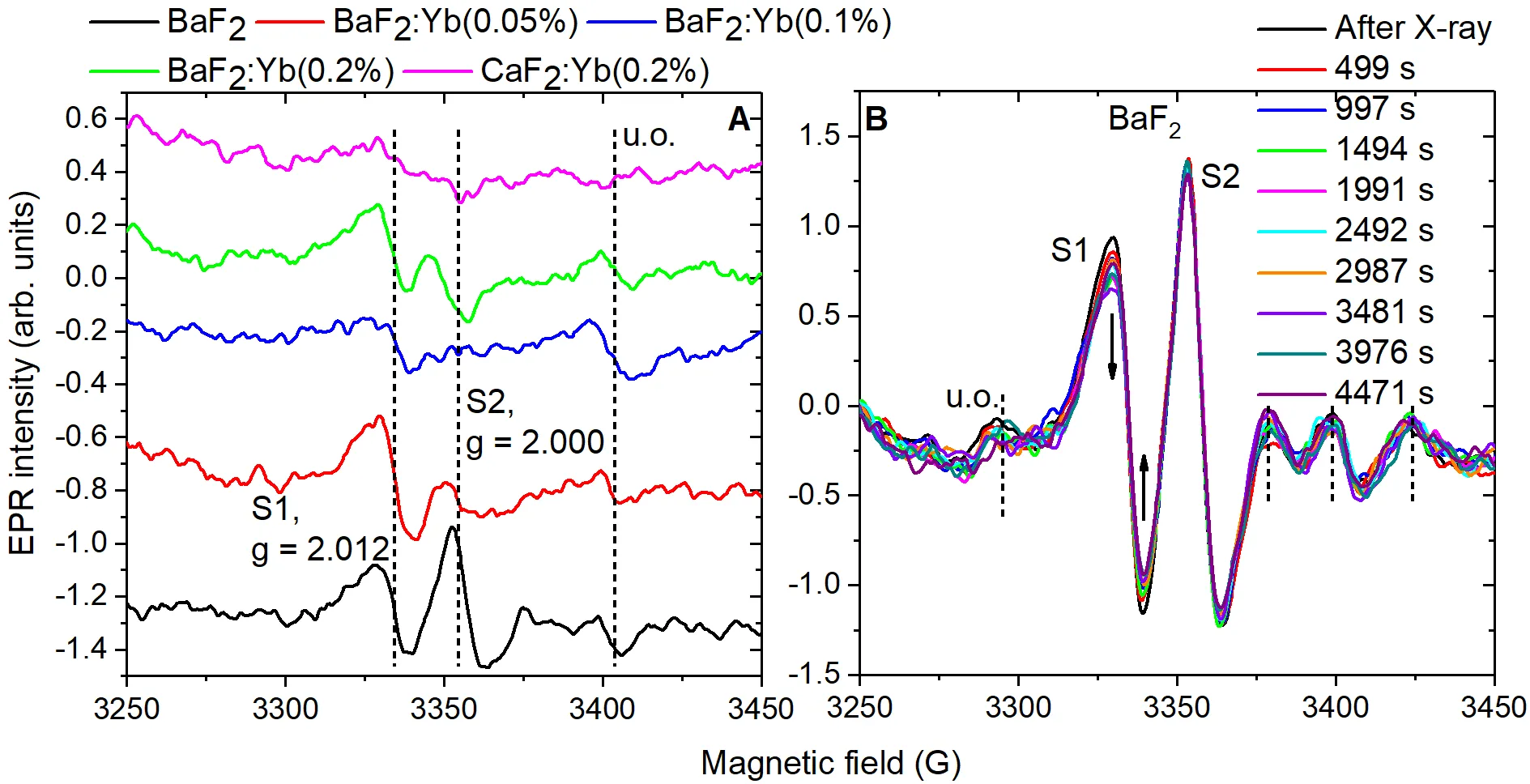
They took two very similar crystals, barium fluoride and calcium fluoride, and added a minuscule amount of ytterbium to each (less than two-tenths of a percent). X-rays showed that both crystals remained perfectly smooth, without cracks or distortions. But when more sensitive instruments took over, it turned out that the ytterbium felt quite different in each. In one crystal, it prefers to give up two electrons and stay electrically calm; in the other, it gives up three and creates a slight electric tension around itself.
The difference wasn't in the overall strength of the crystal lattice, but in how barium or calcium atoms get along with ytterbium ions. Two hosts welcome one guest: in one house, the guest feels cramped and keeps bumping into furniture; in the other, there's plenty of room and the guest sits quietly. Same here: the barium ion is larger and creates more 'jiggling' around ytterbium, while the calcium ion creates less. This affects how the crystal absorbs and emits light. In the calcium crystal, light waves slightly 'split'—like a white beam passing through a prism — while in the barium crystal, this barely happens. Understanding this fine-tuning allows you to choose the right crystal for a specific task, whether it's a laser scalpel or a detector for tiny particles.
Ytterbium is named after the Swedish village of Ytterby, where a single mine yielded four rare-earth elements — yttrium, terbium, erbium, and ytterbium itself.