Europium is a chemical element (atomic number 63) that belongs to the lanthanide series of rare-earth metals. In its pure form it is a silvery-white metal, but its fame comes from its compounds, which exhibit intense and sharp luminescence. When europium ions are embedded as dopants in a host crystal, they can absorb energy from incoming light or electrical excitation and re-emit it as visible light of a very specific color — typically red or blue, depending on the oxidation state (Eu³⁺ for red, Eu²⁺ for blue). This property makes europium a cornerstone of modern display and lighting technology.
History
Europium was discovered in 1901 by French chemist Eugène-Anatole Demarçay, who isolated it from samarium-magnesium nitrate. He named it after the continent of Europe. Its practical use in phosphors began in the mid-20th century with the development of color television.
How it works
The mechanism relies on the electronic structure of europium ions. The 4f electron shell, which is partially filled, has energy levels that are well-shielded from the surrounding crystal lattice by outer 5s and 5p electrons. When the ion absorbs energy, an electron jumps to a higher level; when it falls back, the energy is released as a photon. Because the 4f levels are so isolated, the emitted wavelength is very stable and does not shift much with temperature or host material. For Eu²⁺, the emission is a broad band in the blue region, while Eu³⁺ gives a narrow red line. The host crystal (e.g., Y₂O₃ or BaMgAl₁₀O₁₇) holds the ions apart and prevents concentration quenching, where too many dopants would absorb each other's emission.
In practice
Europium is used as a red phosphor in color TV screens, LED lamps, and fluorescent lighting; europium-doped crystals also serve in anti-counterfeiting phosphors and in medical imaging scintillators.
Fun fact
Europium is one of the most reactive rare-earth metals — it oxidizes rapidly in air and must be stored under mineral oil or in an inert atmosphere.
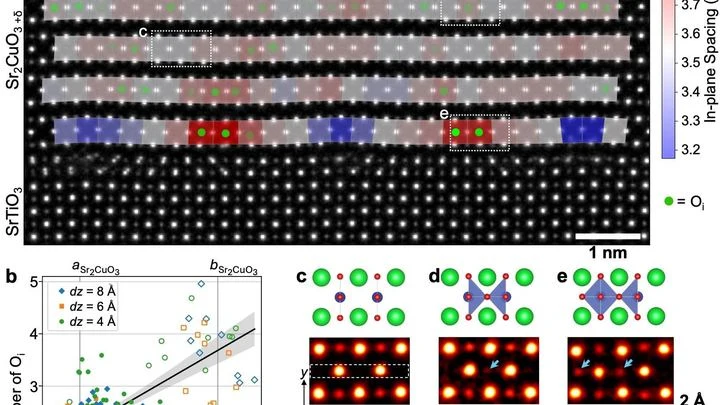
A superconductor is a material that conducts electricity without loss, like water flowing through a perfectly smooth pipe. In copper-based superconductors, tiny oxygen additions act like a volume knob: a bit more and the material starts superconducting; a bit less and it stops. But the oxygen atoms themselves are so small that seeing them directly was impossible.
Deep beneath our feet, in the scorching mantle, iron leads a double life. It can be divalent or trivalent, like a coin that lands heads or tails. Which side dominates determines how much oxygen stays in the planet's rocky shell and how much sinks into the core.
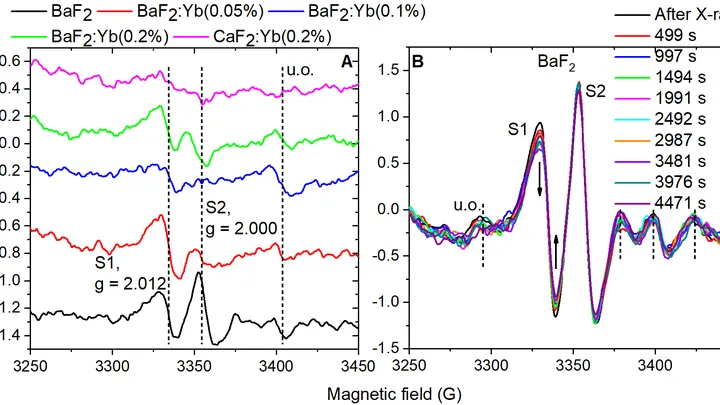
Light passing through a transparent crystal can subtly change color. That's how many lasers work: a tiny addition of a rare-earth metal makes the crystal glow. But the same metal behaves differently in different crystals, and physicists have studied this quirk using ytterbium.
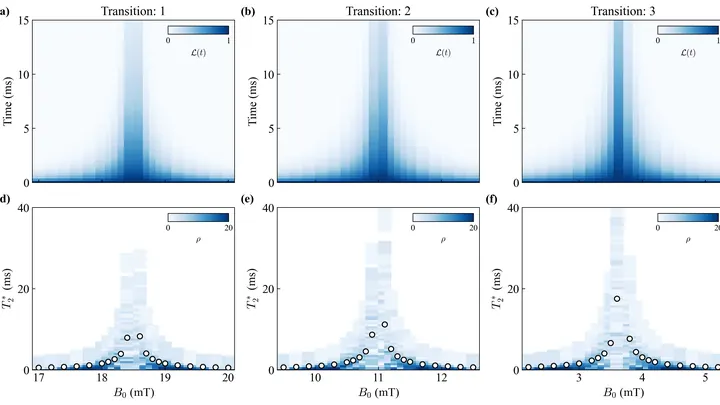
Holding a phone number in your head while people shout and slam doors around you is nearly impossible. That's roughly the life of a quantum bit, a qubit, in an ordinary material: the nuclei of neighboring atoms, like tiny magnets, constantly jostle it and erase information. To keep a qubit from forgetting, you need to find it a quiet spot.
A big sticky ball thrown onto a dusty shelf bounces off and kicks up a cloud of dust, but if you roll it slowly, it picks up every bit. Rydberg excitons behave just like that — they're giant 'atoms' inside a crystal, named after Johannes Rydberg.
Diamond is the hardest natural material and usually does not conduct electricity. But if you add a few foreign atoms to its crystal lattice, it can become a semiconductor, like silicon in computer chips.
A copper wire hit by a laser is like a kitchen where the chef turns on the stove and watches the stopwatch at the same time. Copper atoms start to dance, losing the order of the crystal lattice, while electrons, like waiters in the dining room, instantly feel the change. But how much disorder do they need to notice?
Blue is the most finicky part of any screen. Producing it takes a lot of energy, and the light often comes out dull. Chemists have long searched for molecules that glow deep blue brightly and for a long time. Now they've come up with a new design based on europium, a rare-earth metal that can deliver pure blue light.
Blue pixels in screens are like light bulbs that burn out fast. Conventional organic LEDs for blue are unstable: their light dims over time, and the color shifts. Chemists found a replacement — the rare metal europium.
In a dark room, a flashlight only illuminates what falls within its beam. That's roughly how physicists study atoms: a short flash of light knocks out electrons, and by tracking their paths, you can figure out how the atom is built. But helium has states that don't fall into the ordinary 'beam'—they hide in the shadows.
In a sealed glass bulb the size of a finger, metallic vapor boils. The main component is cesium, but one percent rubidium hides within. A laser beam at 795 nanometers finds this impurity and makes it glow.
Rubidium alone would give a weak signal: atoms quickly fly through the beam.
A typical light sensor is like a well with a windlass: to bring up the bucket, you have to turn the crank. Similarly, a photodetector needs an external voltage to pull out an electric charge. But there are materials that convert light into current by themselves — like a spring that flows without a pump.
The helium in a party balloon is the very gas that makes it float. But long before balloons, helium appeared in the first minutes after the Big Bang. Its exact abundance in the universe is like a fingerprint: it tells you how many kinds of neutrinos (ghostly particles that pass through walls) exist.
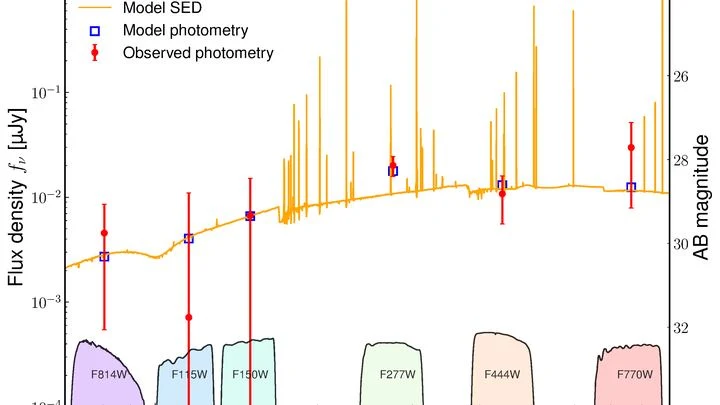
In the deep cosmos, more than 12 billion light-years away, the James Webb Space Telescope has spotted a galaxy that looks like a visitor from the dawn of creation. Its light has been traveling to us since the universe was only about two billion years old — a time when galaxies were growing especially vigorously, a period astronomers call the cosmic noon.
A tiny magnet made of layers of sulfur, chromium, and bromine sits on a microscope stage. Inside it, like unexpected guests, sit erbium atoms — a rare-earth metal. These atoms can glow when hit with a laser, and their light tells us what's happening around them.
A printer that prints not with ink but with metal and ceramic is now a reality. Scientists took an ordinary drop of water containing dissolved metal salts and made it deposit copper, zinc oxide, or nickel hydroxide onto a surface — all with precision down to millionths of a meter.
The secret lies in electricity.