Quantum Clocks with Three Ticks express
An ordinary pendulum swings at the same frequency as the push it receives. But in the quantum world, you can create a system that responds to a push two, three, or more times slower, as if it has its own rhythm. Such systems are called discrete time crystals. Until now, almost all experiments were limited to period doubling on the simplest elements — qubits (quantum analogs of bits with two states).
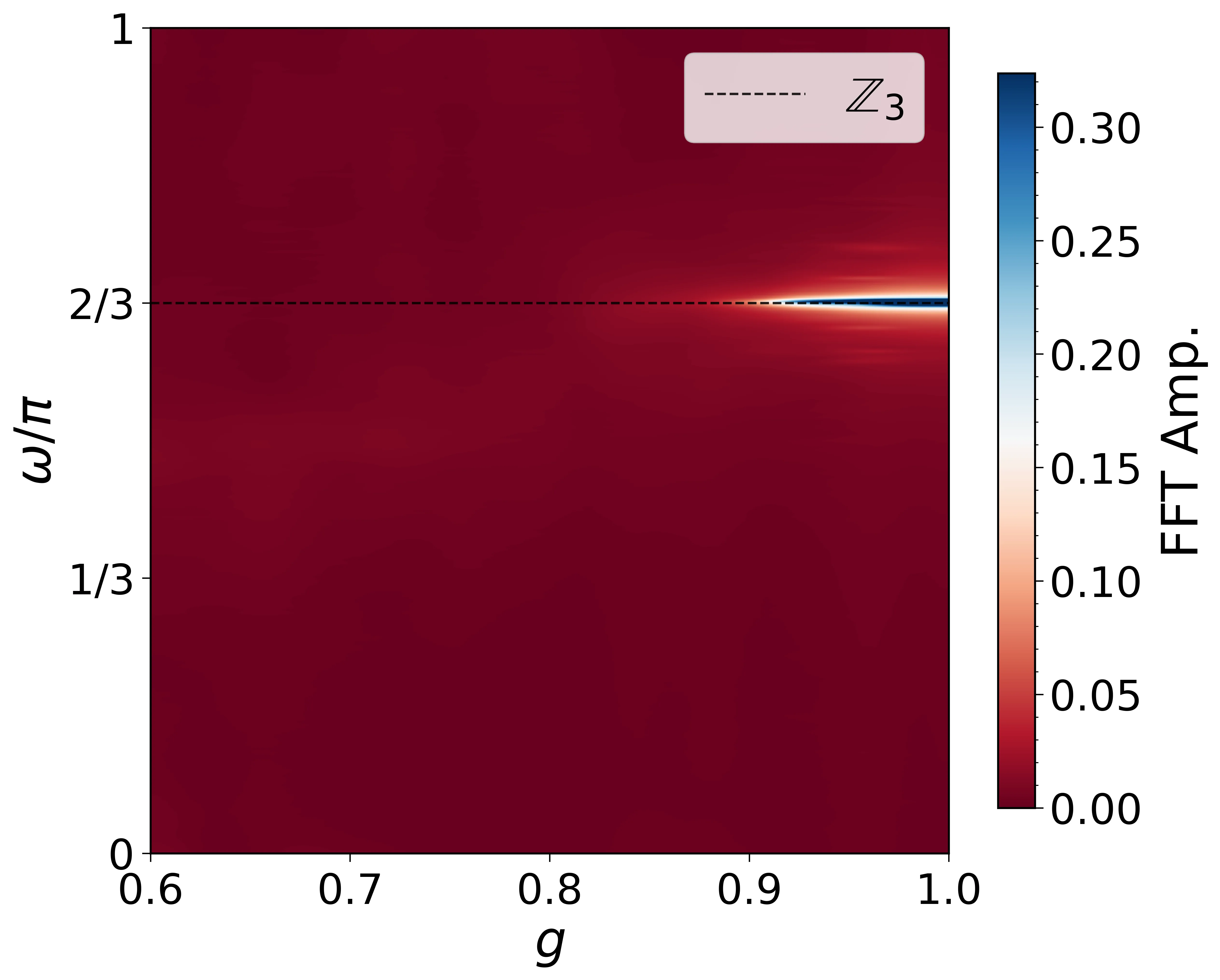
In the new work, physicists assembled a chain of 15 superconducting qudits — elements that can exist in three states, like a switch with three positions. The chain was periodically shaken with microwave pulses, and in response it began to pulse with a period three times longer than the external drive. This is a time crystal with $\mathbb{Z}_3$ symmetry.
Chirality acts as a conductor that makes all domain walls, boundaries between regions with different oscillation phases, move coherently. Thanks to this, the period tripling persists even with slight disorder in the coupling strengths and does not depend on how the system was initialized. The experiment with qudits opens the door to exploring a richer set of nonequilibrium phases of matter that were previously inaccessible with ordinary qubits.
Original abstract
as written by the authors arXiv:2605.14293
Periodically driven quantum many-body systems can spontaneously break discrete time-translation symmetry, realizing discrete time crystals. To date, both experimental and theoretical efforts have largely focused on the simplest case of spontaneous period-doubling in $$\mathbb{Z}_2$$ discrete time crystals realized with qubits. This owes, in part, to the challenge of stabilizing eigenstate order in higher discrete symmetry ($$\mathbb{Z}_n$$) time crystals, due to the presence of richer domain wall physics. Here, we demonstrate the realization of a $$\mathbb{Z}_3$$ discrete time crystal by implementing a Floquet chiral clock model in a chain of 15 superconducting qutrits. Unlike the conventional Ising setting, our system features a tunable chiral angle that governs domain-wall dynamics, spectral degeneracies, and crucially, the stability of time-crystalline order. Using disordered nearest-neighbor chiral interactions, we observe robust subharmonic period tripling that persists across a wide range of drive strengths and is independent of initial state. Finally, we highlight the special role that chirality plays in our $$\mathbb{Z}_3$$ discrete time crystal -- in its absence, the system's Floquet dynamics exhibit a marked initial state dependence governed by domain wall degeneracies. Our results establish native qudit hardware as a powerful platform to access a broader landscape of non-equilibrium phases.
Qudits with three states are called qutrits. If a qubit is a coin (heads or tails), a qutrit is a die that can show 1, 2, or 3 pips.